Shaders are GPU programs that process visual data—such as rays, pixels, geometry, and textures—to produce specific rendering effects. Shaders find necessary...
Shaders are GPU programs that process visual data—such as rays, pixels, geometry, and textures—to produce specific rendering effects. Shaders find necessary data through a process called resource binding. CPU code orchestrates the creation of GPU resources such as textures and memory buffers and then carefully arranges for shader code to access them through a binding protocol.
In February 2024, Notion bought Skiff, an encrypted email and productivity software startup. Within a year, Notion shut down Skiff’s email service (taking @skiff.com email addresses with it). And in April 2025, the San Francisco-based company released Notion Mail, a Gmail client primarily built by people who joined Notion through the Skiff acquisition. Today, Notion announced that it’s shutting down Notion Mail, effectively killing what little remained of Skiff email.
In an X post (first spotted by 9to5Mac) today, Notion said that it will shutter the Notion Mail “inbox across web, desktop, and iOS on September 22.”
The post claimed that most Notion users don’t use email clients anyway and instead rely on AI agents to handle their electronic correspondence. It reads:
Generative AI workloads are rapidly outgrowing the memory and compute budget of single GPUs. For inference developers building media generation pipelines, the...
Generative AI workloads are rapidly outgrowing the memory and compute budget of single GPUs. For inference developers building media generation pipelines, the challenge is scaling across multiple devices without sacrificing the critical optimizations—like kernel fusions, memory planning, and quantization—that NVIDIA TensorRT delivers for production deployments. Multi-device inference support…
AI companions in games have long been constrained by fixed dialogue. PUBG Ally is a different kind of system. Built by KRAFTON for PUBG: BATTLEGROUNDS, this AI...
AI companions in games have long been constrained by fixed dialogue. PUBG Ally is a different kind of system. Built by KRAFTON for PUBG: BATTLEGROUNDS, this AI teammate is powered by NVIDIA ACE and its suite of efficient models and tooling. PUBG Ally uses automatic speech recognition, a 2B-parameter small language model, and text-to-speech to understand player voice…
Companies once moved whole factories overseas to reduce labor costs. Now, workers a world away can operate local excavators, forklifts, and even humanoid robots with an internet connection.
Packaging potassium sulfate, a fertilizer vital to the planet’s food supply, is visually striking—not because of what you see, but because you don’t see much at all. In China’s Xinjiang region, home to the world’s largest deposit of the mineral, piling it up in warehouses creates dust clouds so severe that workers are forced to drive heavy machinery by feel.
Some companies are now turning to a technology that not only offers a way to see through the dust but also keeps workers from entering the warehouse at all. The system, developed by BuilderX Robotics, a Chinese tech company, uses cameras that are like night-vision for dusty areas. More significantly, operators drive excavators, loaders, and other machines from a remote office filled with rows of videogame-like stations. All they need is a 5G or satellite connection.
The ability to control physical machines from a distance is called teleoperation, and it could become a significant force of change in the global economy.
In Japan, the shelves of over 300 convenience stores are being restocked by robots monitored and sometimes controlled by workers in the Philippines. Düsseldorf airport was slated to begin testing shuttles driven by remote workers in May. A startup in Atlanta is offering robot security guards operated by remote staff, and last summer, a surgeon in France performed a teleoperated procedure on a patient in India.
While offshoring teleoperated jobs to overseas workers hasn’t yet become routine, Mark Graham, professor of internet geography at the University of Oxford, suggests the technology is worth our attention because it might enable companies to expand on their well-established habit of outsourcing jobs to places where labor is cheaper.
The use of remote labor isn’t new, Graham told SingularityHub. But teleoperation extends the logic of outsourcing to tasks that were previously thought to be “stubbornly local.”
“The novelty is less about the existence of remote labor and more about the kinds of work that can now be pulled into a planetary labor market,” he said. “Once that happens you can expect the usual pressures around labor arbitrage, control, and fragmentation to follow.”
It’s not clear we’re ready for the consequences.
BuilderX Robotics is a global leader in teleoperation for heavy machinery and a good expression of the changes ahead. Shaolong Sui, a graduate of Stanford University with a degree in mechanical engineering, founded the company in 2018 as a response to labor shortages in the construction industry in Asia.
“A shortage of trained operators isn’t a problem only in developed countries,” he told me. “Young people here in China don’t want to do this work. It’s dusty and dangerous.”
Rather than focusing on full robotic autonomy, which many construction companies have pursued over the past decade, Sui identified teleoperation as a more realistic way to move operators from harsh environments to safer conditions. Making use of the proliferation of low-cost sensors and 5G at the time, Sui completed a prototype in 2019. Today, his company offers teleoperation for 14 different industrial machines, including excavators, loaders, and bull dozers.
In our conversation, it was clear he hopes to improve working conditions for manual laborers. I lost track of the number of times he mentioned removing operators from dangerous worksites. “These workers deserve a better life,” he said.
BuilderX’s workstations do seem to have transformed some of the punishing work of an industrial site into a more white-collar experience, complete with tea and coffee break rooms and toilets down the hall. Sui said his solution allows construction firms to hire senior citizens or people with disabilities who, thanks to the videogame-like interface, can now operate heavy machinery. In another video, a Japanese woman who pilots an excavator proudly shows off her complex nail art, something she claims she couldn’t maintain when she worked in the field.
“Not only is this a much safer workplace, but the lifestyle benefits are that you can sit in an air-conditioned space, enjoy your tea, and when you go home, you’re still clean,” Sui said.
There’s no doubt the approach is safer for frontline workers like those in Xinjiang. Evidence suggests that high levels of potassium dust exposure can cause chronic bronchitis. While pulling someone from dangerous work is a good thing and that should be taken seriously, Graham told me, it doesn’t necessarily mean they’re free from exploitation.
“A worker can be removed from the physical site and still be subjected to intense surveillance, deskilling, isolation, fragmented contracts, algorithmic management, and downward pressure on wages. In other words, the risk can move rather than disappear,” he said.
Sui and Graham both agree there are plenty of forces that might slow the pace of outsourcing. Currently, none of BuilderX’s customers offshore work to overseas operators. But that doesn’t appear to be a technology constraint, as recently demonstrated by an operator in Poland controlling an excavator over 4,000 miles away in Beijing. On the technical side, latency—the delay between operator and machine—and reliability will shape the rate at which firms can choose to offshore workers. But it’s more likely to be limited by regulatory constraints in the form of licensing, insurance, and safety requirements.
That said, Graham believes the biggest force driving work overseas will be the same one that’s pushed clerical and service work offshore; the relentless pursuit to increase profit and reduce cost.
“If firms can hire people in lower-wage labor markets to operate expensive equipment thousands of miles away, many of them will try,” he said.
Most debates about AI and robotics focus on job loss due to automation. There is relatively little discussion about the risk of offshoring teleoperated work as the technology comes online. This is partly due to the hype surrounding physical AI, a Silicon Valley buzzword describing a world where fully autonomous robots cut humans out of the loop. But Graham says that when machines arrive people tend to incorrectly assume humans disappear.
“In many cases, what gets described as automation is really a reorganization of labor. Work gets broken apart, moved around, and hidden from view,” he says.
As is the case with AI, the robotics industry’s push toward full automation is still plenty reliant on a hidden system of faraway workers. Teleoperation provides training data for robots and is needed to help them deal with unexpected events. Consumer robotics startup 1X is selling a $20,000 humanoid that will sometimes need to be controlled by remote staff. It’s not clear how often future robots cleaning dishes in San Francisco kitchens will be steered by gig workers in Mumbai.
Robotaxi company Waymo already relies on human agents to assist, though not literally drive, vehicles stuck in difficult scenarios. The firm recently disclosed for the first time that some of these agents are based in the Philippines. This information, surfaced during US congressional testimony, immediately raised questions of oversight for safety-critical work: For instance, should a worker in Manila be required to get a California driver’s license?
Amid an already combustible US political environment, teleoperation could raise the heat even higher. Fueled by fears of Americans losing jobs to people overseas, Wyndham Hotels and Resorts, the parent company of La Quinta, was last year forced to respond to anger over a viral video depicting workers allegedly in India remotely handling check-in at one of their Miami hotels. As Graham points out, people tend to care more about outsourcing when it’s no longer hidden in a back office.
But outrage alone, he says, rarely defeats a business model that saves money. Due to network effects surrounding training, infrastructure, and other business process optimization, outsourced labor also tends to cluster in specific areas. This may already be happening in the case of Waymo, which could soon see the rise of something like a “driving district” in Manila. In the future, other types of teleoperated work could follow suit, giving companies a ready-made destination to shop for low-cost labor.
For Graham, it’s urgent that we begin requiring certification from independent bodies, which can better scrutinize a company’s production networks. At Oxford he directs Fairwork, a project aiming to improve labor practices in digital supply chains.
I asked Sui how he thinks his customers may reorganize their operations around this new ability to remotely control their machinery.
“We’re working with traditional industries, and so it’s not just about adopting a new technology. There are significant management changes they will have to navigate. You could call this transformation friction because they will need time to digest this new capability step by step,” Sui said.
Despite the fact they could use the technology to outsource work across national borders, none of his customers are doing so just yet. Sui used open pit mines as an example. In this case, where fully developed towns with schools and hospitals have built up over decades, his customers still cluster their workforce next to the sites where they operate. Instead of driving into the mine, operators work from an office and go home clean at the end of a shift.
BuilderX has deployed its technology at more than 100 sites in China, Japan, and parts of Europe. It’s now expanding into new markets including South America and the Middle East. When asked whether he thinks his technology will be used for transnational outsourcing, there’s no hesitation. “Oh yes, I think this is coming in the very near future.”
Modern businesses are in a constant, uphill battle against what to do with unstructured data: PDFs, contracts, scanned images, customer call recordings, meeting videos, and more. Traditional document automation workflows that rely heavily on template-based extraction or rigid rules used to make sense. But document formats have changed; they’re diverse and don’t fit standard formats, making costly, brittle, traditional systems a relic of the past.
“Modern businesses are in a constant, uphill battle against what to do with unstructured data.”
Enterprises demand faster, more accurate processing, which raises the question: How can we reliably turn messy, multimodal content into structured, actionable insights without a mountain of manual effort?
That’s where Amazon Bedrock Data Automation (BDA) comes in.
What is Amazon Bedrock Data Automation (BDA)?
Amazon Bedrock Data Automation (BDA) is a generative AI-powered, fully managed service on Amazon Web Services for end-to-end document and media automation. It enables users to automate the extraction, classification, and transformation of unstructured content across modalities such as documents, images, audio, and video.
“At its core are Foundation models which enable intelligent extraction and understanding of content.”
At its core are Foundation models (FMs) which enable intelligent extraction and understanding of content. It allows users to configure standard output for common use cases, or even define custom extraction logic using blueprints tailored to your business. BDA is designed for scalability, accuracy, and auditability, making it ideal for enterprise workflows.
Walk-through: creating a project, standard output & custom output using blueprints
1. Create a project via console
In the Amazon Bedrock Console, navigate to Data Automation → Create Project.
Enter the name of the project:
2. Standard output:
Standard output gives you the model’s default, unstructured response (text, image, audio, or video) directly from the Data Automation pipeline.
In standard output, each modality has its own options for what is needed as an output.
Document:
Image & Video:
Audio:
Now let’s test Document Modality for Standard Output:
First, click on “Test” in the upper right corner.
Next, select the document from the system, sample, or S3 and choose the modality from the dropdown menu.
Click on the “Generate results” button:
After processing, it will show the summary and content of the document:
Custom output (blueprints):
Custom output lets you define a structured, predictable format using blueprints, which ensures the output matches your exact schema, fields, and business rules.
Let’s test custom output using blueprints for the same document:
Navigate to “Custom output” and click on “Add Blueprint”:
From here, two options will appear. You can either use LLM power to generate the blueprint (where it inspects the document), or you can choose to enter field names, instructions, and other information manually.
Below is a blueprint generated by LLM which has pulled all possible fields and tables from the document:
It has extracted the information using the blueprint as demonstrated below, including the Field name, Instruction, and Results:
It also provides the Extraction type (which can be Explicit or Inferred), Confidence percentage, and other relevant information.
Additionally, it can extract information in the form of a table, such as an account summary or transaction information:
Code examples
Amazon Bedrock Data Automation (BDA) Utility Module
Description:
    Helper functions to create BDA projects, blueprints, invoke jobs,
    monitor job status, and fetch results.
import boto3
import time
import json
import botocore
Example: From a bank statement → Date, Description, Amount, Balance.
3. Transformation: Modify or restructure data.
Example: Convert Home Address into separate fields -> street, city, ZIP code, etc.
4. Normalization: Standardize data values.
Example: Convert multiple date formats (MM/DD/YYYY → YYYY-MM-DD).
5. Validation: Validate extracted fields against rules.
Example: Amount must be numeric; dates must match the format; balances must reconcile.
Use cases that illustrate business value
Real-world scenarios where BDA provides significant ROI include:
Financial Services: Automate processing of bank statements, invoices, and loan applications, reducing manual labor and speeding up reconciliation or underwriting.
Insurance: Ingest and extract data from claims forms, medical reports, and damaged-asset photos.
HR / Legal: Process resumes, contracts, and offer letters; extract structured data, including skills, clauses, salaries, and parties.
Customer Support: Transcribe and summarize calls, extract intent and sentiment, and feed those insights into CRM or case systems.
Security & Compliance: Analyze CCTV footage or meeting recordings to detect key actions, summarize context, and flag compliance issues.
BDA proves itself flexible and powerful, as it supports both standard outputs for basic workflows and fine-tuned custom schemas via blueprints. It is scalable and robust, with projects that enable batch processing and versions (development vs. live) for safe testing. It’s also audit-friendly, providing structured fields with types, normalization rules, and validation logic.
“Compared with rule-based systems, foundation models achieve better semantic extraction across the board.”
A true key benefit is that BDA is multimodal across formats. Users can use the BDA framework to process documents, images, audio, and video. And, best of all, it’s highly accurate. Compared with rule-based systems, foundation models achieve better semantic extraction across the board.
Amazon Bedrock Data Automation empowers businesses to transform unstructured, multimodal content into structured, trustworthy, and actionable data. With minimal setup, highly customizable blueprints, and a scalable project-based architecture, BDA helps organizations reduce manual workload and unlock insights faster.
Artificial intelligence is rapidly reshaping retail, but not in the ways consumers might immediately notice. The biggest transformation may not be flashy virtual try-ons or chatbot shopping assistants, but in how decisions are made behind the scenes: how products surface in search results, how inventory moves through supply chains, how engineers ship code faster, and how retailers respond to customer behavior in real time. As legacy retailers navigate a fragmented and hyper-competitive landscape, AI is becoming an operating philosophy.
At Macy’s, that philosophy is more often defined by what senior director of engineering Murali Murugan describes as an “AI-first” approach. “AI first isn’t about adding intelligence on top,” Murugan says. “It’s about redesigning how decisions happen so the business moves faster and every experience feels more relevant by default.” Rather than layering AI onto existing workflows, Macy’s is embedding intelligence directly into systems that include personalization, search, operational planning, and software development itself.
The company’s strategy is reflective of a larger shift taking place across retail: moving from isolated AI pilots toward integrated systems designed to compress, as Murugan puts it, “the gap between the signal and the action.” Early efforts focused on narrow, high-impact use cases like search recommendations and customer engagement, where measurable gains in conversion and reduced friction quickly built internal momentum. “Once we established the quick wins, scaling was a business decision, not a technology debate anymore,” he says.
That momentum is now extending into conversational commerce through tools like Ask Macy’s, an AI-powered shopping assistant designed to act more like a personal stylist than a traditional search bar. Whether for a prom, a vacation, or a last-minute event, customers can describe what they need conversationally and receive curated recommendations informed by past purchases, preferences, and context.
Still, the company sees AI as more of an invisible layer augmenting human judgment than a replacement for it. The long-term vision is retail that feels increasingly seamless, adaptive, and personalized, powered by systems customers may never even notice are there.
“The real transformation in this all comes from continuous improvement,” Murugan says. “It’s about learning from the mistakes, quickly adapting to the newer technology standards that are coming into play, timing, and execution which compound into a meaningfully better customer experience.”
This webcast is produced in partnership with Infosys.
This content was produced by Insights, the custom content arm of MIT Technology Review. It was not written by MIT Technology Review’s editorial staff. It was researched, designed, and written by human writers, editors, analysts, and illustrators. This includes the writing of surveys and collection of data for surveys. AI tools that may have been used were limited to secondary production processes that passed thorough human review.
Semantic layers are an increasingly pivotal architecture for enterprise AI, enabling AI systems to more accurately identify relationships between conflicting data points.
The United States Department of Agriculture (USDA) is proposing to update its regulations regarding the Agricultural Foreign Investment Disclosure Act of 1978 (the AFIDA). The revisions would reflect Congressional directives to establish a streamlined process for electronic submission and retention of disclosures made under AFIDA, including the deployment of an internet database. It would also revise reporting requirements and strengthen enforcement measures. Through the implementation of modernization measures and expanded scope and depth of reporting, this proposed rule will help ensure the AFIDA regulations address foreign investment and ownership of American agricultural land, particularly as it might present a national security risk.
The Office of Personnel Management (OPM) is issuing a final rule to amend its Senior Executive Service (SES) Candidate Development Program (SESCDP) regulations to implement certain SES training and development requirements. The SES represents the Federal Government's leadership, composed of executive positions above the GS-15 level. SESCDPs serve as a crucial succession management tool for Federal agencies, designed to identify and prepare high-potential employees for future roles within the SES. These programs aim to cultivate leaders equipped with a governmentwide perspective and the competencies necessary to tackle complex challenges.
Rising pathogen drug resistance makes next-generation antimicrobial peptides a global priority. Generative AI accelerates discovery by rapidly proposing new peptides with high therapeutic potential. The key question is no longer whether broad data-driven exploration is possible, but whether it can refine biologically complex activity scaffolds.
In 2025, if you weren’t building with MCP, you weren’t serious about agents. The Model Context Protocol dominated the agent conversation for the better part of the year. Conference talks, roadmaps, hiring plans, all of it revolved around MCP.
Then late 2025 into 2026, AI Skills arrived and the backlash was immediate. Engineers declared MCP dead in favor of Skills, then dead in favor of CLI. Perplexity’s CTO said publicly that the company was deprioritizing it. The cycle was fast, loud, and predictable. New tool, new hype, new rewrite.
I started pushing Agent Experience early in 2025, while MCP was still the center of gravity. The response was mostly skepticism. AX was overthinking it. MCP was the only layer that mattered. That perspective aged poorly. The people who dismissed AX weren’t wrong about MCP being useful. They were wrong about a protocol being a strategy.
The thing they missed, and what I think most of the industry is still missing, is that the protocol is not the thing to get good at. The discipline is.
We keep falling into the tool trap
Our industry has a well-documented habit of confusing tools with strategy. We did it with microservices, Kubernetes, and GraphQL. Now we’re doing it with agent protocols.
MCP, AI Skills, A2A, and ACP are all implementations. They matter and they solve real problems. But none of them are the right thing to build your strategy on top of. They are, by nature, the thing that changes.
When you organize your agent strategy around a specific protocol, you’re building on a foundation someone else controls and the market can shift away from at any moment. Worse, you’re skipping the step that would tell you whether that protocol is even the right fit for your use case.
This is the tool trap. You optimize your usage of a specific integration mechanism without first understanding what you’re actually optimizing for.
So what is Agent Experience?
Agent Experience (AX) is the discipline of studying how AI agents discover, understand, and interact with your systems, and then systematically improving those interactions.
Think of it as the agent-facing counterpart to User Experience. UX didn’t emerge because one UI framework won. It emerged because teams realized that the quality of human interaction with software was a design problem that transcended any particular technology. You could build a terrible experience in React just as easily as in vanilla JavaScript. The framework was not the variable. The design thinking was.
AX works the same way. How does an agent discover what your service can do? How does it understand the boundaries of your API? When it fails, does it get enough context to recover? Is the interaction efficient, or is the agent burning tokens on unnecessary round trips?
These questions are protocol-agnostic. They apply whether you expose capabilities through MCP, Skills, A2A, or something that hasn’t been invented yet. The teams that can answer them will adapt to whatever comes next because they understand the problem space, not just the current toolchain.
AX is an extension of what you already care about
AX is not competing with User Experience, Developer Experience, or Customer Experience. It’s an extension of all three.
Your primary focus is still providing a great experience to your customers. What has changed is how those customers interact with you. More and more, they delegate tasks to agents. When a customer asks an agent to integrate with your API, deploy to your platform, or pull data from your service, that agent is acting on their behalf. The agent’s experience determines how likely it is to achieve your customer’s goal.
If a customer’s agent struggles to authenticate, burns through tokens parsing your error messages, or fails silently because your API lacks context, something worse than a complaint happens. The agent will quietly start using an alternative service that provides a better experience. Your customer might not even notice the switch. You just lost them without a single support ticket.
UX optimized for humans clicking through interfaces. DX optimized for developers building on your platform. CX looked at the entire customer journey. AX extends that thinking to the agents those customers now send on their behalf.
The protocol treadmill doesn’t work
Think about what actually happened with MCP. Teams invested heavily in writing MCP server implementations. A lot of those implementations were mediocre. Not because MCP was flawed but because the teams hadn’t thought carefully about what an agent actually needed from their system. A 2026 study out of Queen’s University examined 856 tools across 103 MCP servers and found that 97.1% of tool descriptions contained at least one quality issue, with 56% failing to state their purpose clearly. The protocol worked fine. The experience design was the problem.
When Skills emerged, those same teams faced a familiar problem wearing new clothes. They still hadn’t answered the foundational questions: What does an agent need to accomplish with our service? What is the minimum viable interaction surface? What context does an agent need to make good decisions?
The teams that had worked through those questions adapted fast. Migrating from one protocol to another is mechanical when you already know what your agent-facing interface should look like. The protocol is the serialization format. The experience design is the hard part.
This pattern will keep repeating. Whether it is the Universal Commerce Protocol, A2A, or whatever lands next, something new will always be gaining traction. If your strategy is to become an expert in each successive protocol, you’re signing up for a treadmill that only speeds up.
What an AX practice looks like
So what does it actually look like to take Agent Experience seriously? If you have ever built a UX research practice or a DX program, this will feel familiar. The steps aren’t new. The persona is.
In talks, I break it down to five steps.
Audit the agents your customers use. Know what’s walking through your front door. Look at your traffic data and logs and figure out what portion of your footprint is agents versus humans, and which agents specifically. Are your customers sending Claude Code? Cursor? Custom agents built on your API? You can’t design for something you haven’t observed. Same reason UX teams run user research. Different method, same motivation.
Identify the use cases customers want to delegate. Not every interaction needs to be agent-optimized. Take that same log data, look at the requests agents are making to your platform, and extrapolate what they were trying to achieve. You can also use AEO data to understand what areas your customers are asking about in agent-facing search. Focus on the highest-value surfaces first. If you have ever prioritized a DX roadmap by looking at what developers actually do with your API, you already know this muscle.
Verify and audit the experience of those interactions. Watch what happens when an agent tries to complete those tasks on your system. Where does it get stuck? Where does it misunderstand what your service offers? This is usability testing. The user is an LLM; the struggle is about context not button placement, but you’re answering the same question: Can they get the job done?
Improve and repeat. Agent capabilities evolve. Models get smarter. New interaction patterns emerge. At Netlify, we’ve found cases where our product works one way but agents universally assume it works another way and never ask. Instead of fighting that assumption, we improved the product to work the way agents expect. The result was more adoption of those agent flows and fewer errors. The teams that treat this as a living practice will outperform those running from one protocol migration to the next.
Automate validation and prevent regressions. Once you have a baseline for what “good” looks like, lock it in. Tools like AXIS, an open source scoring framework, let you run real agents against real scenarios and get a comparable score back. Wire it into CI and catch AX regressions the same way you catch broken tests. This is how you go from anecdotal improvement to measurable, repeatable AX quality.
When you have this practice in place, protocol choices become obvious. You can evaluate new tools on their merits. Does it solve a real friction point you have observed? Does it unlock capabilities you couldn’t achieve before? Or is it just different packaging for something you’re already doing well?
The hard part is familiar
AX is harder to pick up than a new protocol. That is just the reality. Learning MCP or Skills is a bounded technical problem. Read the docs, write some code, and ship an integration. Clear finish line, easy to show progress. That’s genuinely appealing, especially when you or your teams are moving fast.
Building an AX discipline means sitting with ambiguity for a while. Studying agent behavior before you have clean answers. Accepting that the right integration strategy depends on context you have to discover, not a tutorial you can follow. But if you’ve ever built a UX or DX practice from scratch, you’ve been here before. The why is the same: understand your users, reduce friction, and make it easy for them to succeed. How you do it is different because the user is different. The discipline isn’t new. It’s an extension of work our industry has been doing for decades.
The good news is that this thinking is gaining momentum. John Maeda’s 2026 Design in Tech Report is explicitly about the shift from UX to AX. Researchers are studying agent interaction quality as a first-class engineering concern. BCG and MIT Sloan found that 35% of organizations are already using agentic AI, with another 44% planning to. The question is no longer whether AX matters. It’s whether your team is building the practice before your competitors do.
The agents of 2028 won’t interact with your systems the way the agents of 2025 did. The protocols will be different. The capabilities will be different. The expectations will be different. What won’t change is the fundamental need for your systems to provide a great experience to the people who use them, and now, the agents those people send on their behalf.
Get good at that. The rest is implementation detail.
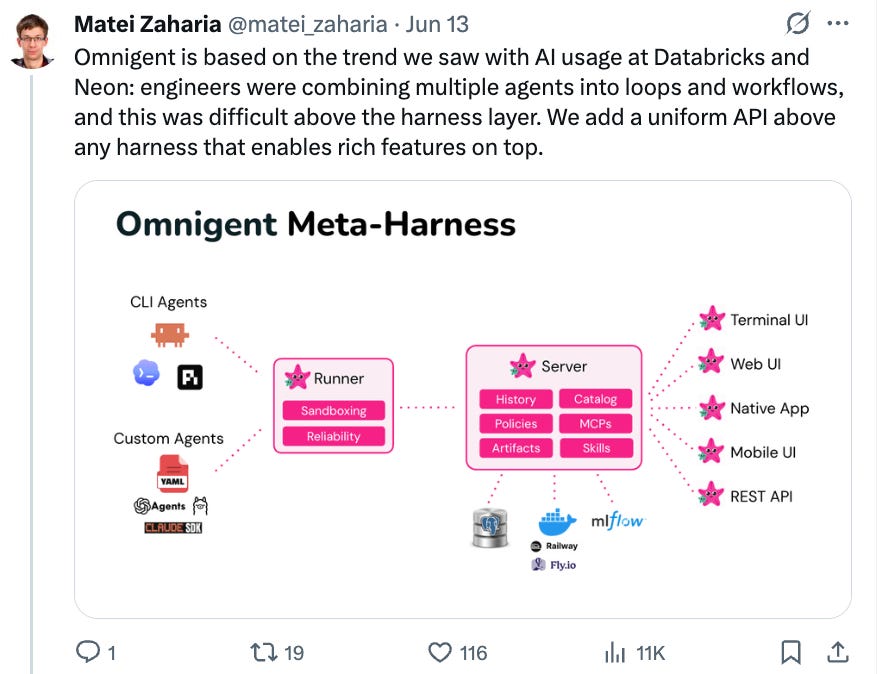
The brief history of Meta-Harnesses is a little undocumented, but it roughly goes: at first there was Conductor and Zed’s ACP, then there came OpenInspect, Cloudflare’s Flue, and then Vercel’s Eve and HarnessAgent, and Heypi.
It should not go unnoticed that today’s podcast guest Matei Zaharia, CTO of the enormously successful (for a pre LLM era company) Databricks, has a big bet now on meta-harnesses - Omnigent, an open source, pluggable architecture for pulling in any coding or knowledge work agent into a standardized, secure, reliable, scalable system:
It’s unclear whether or not Omnigent has the same kind of ingredients that made MCP’s success inevitable, but it is clear on an architectural level that some open source architecture that looks like this will probably win, if only because it is currently being independently rediscvoered at 1000 AI native shops.
OpenAI’s Jalapeño Chip and the Race Toward Full-Stack AI Infrastructure
OpenAI goes deeper into hardware: OpenAI announced Jalapeño, its first custom AI chip for LLM inference, built with Broadcom and intended for ChatGPT, Codex, API traffic, and future agent products. The strategic message is straightforward: own more of the stack—chips, kernels, memory, networking, scheduling, deployment—so compute economics and product behavior become less dependent on merchant GPU supply. @gdb emphasized strong performance-per-watt, while @kimmonismus highlighted the reported 9-month design-to-tapeout cycle, unusually fast for a high-performance ASIC and reportedly accelerated by OpenAI’s own models.
Technical read-through and ecosystem implications: Community reverse-engineering suggests Jalapeño looks TPU-like: @scaling01 estimated a near-reticle die, roughly 216GB HBM3E, ~7.1–7.4 TB/s bandwidth, and ~10 PFLOPS FP4. Even if those numbers remain unofficial, the signal is that hyperscaler-style inference silicon is now table stakes for frontier labs. The same day also reshaped the compiler/runtime landscape: Chris Lattner announcedQualcomm is acquiring Modular, while Modular saidMojo open-sourcing remains on track. That combination points to more serious competition around vertically integrated inference stacks beyond NVIDIA/CUDA.
Serving and throughput remain active fronts: On the infra side, NVIDIA said NeMo AutoModel delivers 3.4–3.7x higher training throughput for MoE models via Expert Parallelism, DeepEP, and TransformerEngine kernels. SkyPilot launched Endpoints for unified inference across owned clusters, and Modal claimed open-source inference setups outperforming proprietary providers on latency. For local optimization, @jon_durbin reported 30–50% real-world decode gains from training custom DFLASH draft/speculator models.
Agent UX Shifts From “Tool” to “Coworker,” Raising New Security and Cost Questions
Anthropic’s Slack-native agent model is the big UI story: Several tweets converged on the significance of Claude embedded into Slack/team workflows. @karpathy argued people are underrating it because it is not “just a feature” or Slack bot, but an org-level harness. @gallabytes described the experiential jump from Claude Code as a “pairing partner” to Tags as “managing a team.” @dabit3 pushed the idea further: eventually, you may not even need to explicitly tag agents.
The hard part is identity, permissions, and lock-in: Anthropic detailed its agent identity model in this thread: Claude gets its own credentials, actions are auditable under that identity, and access can be revoked centrally. That design drew both praise and concern. @KentonVarda argued explicit per-agent permissioning does not scale and advocated capability-based security with fine-grained, task-scoped access. @random_walker framed Claude Tag as “a coworker that remembers everything and bills by the thought,” warning of tacit-knowledge lock-in, prompt-injection risk, and budget opacity once one shared agent becomes deeply embedded in org workflows. @JubbaOnJeans similarly flagged attribution ambiguity for write actions and future access-control complexity outside clean Slack-like boundaries.
The open/DIY response is immediate: Hugging Face described its internal Slack-based coding agent Moon Bot in a blog tweet, emphasizing self-hosting, custom tools, auditable sessions, and zero lock-in. A follow-up from @calebfahlgren listed production integrations spanning GitHub, Athena, analytics, MongoDB, Elasticsearch, and HF Buckets. The larger pattern: teams increasingly want agent-native UX, but many would rather own the harness and memory layer than outsource organizational intelligence to a vendor.
Qwen-AgentWorld, OpenThoughts-Agent, and Memory as the Next Agent Scaling Axis
Qwen-AgentWorld pushes “language world models” for agents: Alibaba Qwen introduced Qwen-AgentWorld, positioning it as a native language world model that simulates 7 environments—MCP, Search, Terminal, SWE, Web, OS, Android—inside a single model. Qwen claims two paths: build the simulator itself, and use world modeling as agent pretraining. They open-sourced Qwen-AgentWorld-35B-A3B and AgentWorldBench, with a 35B MoE / 3B active, 256K context model. One notable result: single-turn environment prediction transfers to multi-turn agent tasks with gains across both in-domain and out-of-domain benchmarks, as summarized in this follow-up.
OpenThoughts-Agent contributes a serious open data recipe: @iScienceLuvr and @RichardZ412 highlighted OpenThoughts-Agent, an open curation/training pipeline for agentic models with 100+ controlled ablations. The team builds a 100K-example training set and fine-tunes Qwen3-32B, reaching 44.8% average accuracy across seven agentic benchmarks. The key findings are useful for practitioners: instruction choice matters disproportionately, strongest benchmark teacher ≠ best teacher, longer execution traces help, and source diversity beats over-repetition at scale.
Memory is turning into a first-class systems layer: A lot of high-signal discussion centered on memory as the unresolved problem in agents. Weaviate’s Engram GA frames memory as asynchronous infrastructure that extracts, deduplicates, reconciles, and scopes memories rather than dumping everything into context. @hwchase17 showed a LangSmith/Context Hub workflow for “sleep-time compute,” where traces are analyzed offline and written back as memory. @dair_ai pointed to a paper arguing agent memory should be evaluated as a full data-management layer—storage, retrieval, update, consolidation, lifecycle—not a black box judged only by end-task success. This is increasingly where agent differentiation appears to be moving.
Chinese Open Models Keep Closing the Gap: GLM-5.2, Kimi Distribution, and Compute Scale
GLM-5.2 continues to dominate the open-model conversation: Multiple tweets positioned GLM-5.2 as the strongest open-weight contender right now. CoreWeave said it tops open-model rankings on Artificial Analysis and Agent Arena, while Baseten and Cursor availability showed rapid serving/distribution uptake. @nutlope compared GLM 5.2 against Opus 4.8 on web tasks, reporting similar quality, ~2x token output, but still faster and roughly 3x cheaper. Arena also said GLM-5.2 Max leads Code Arena: Frontend against a strong field.
Benchmark nuance matters: GLM-5.2 also showed up on ARC-AGI-2. @fchollet called it the strongest ARC-AGI-2 result to date by an open-source model, while others debated what its 22.8% really implies relative to frontier Western models. The broader takeaway is less about any single benchmark and more about open Chinese models being consistently “in the room” across coding, agents, and knowledge work.
Commercialization and infrastructure acceleration: Moonshot’s Kimi API is now on AWS Marketplace, easing enterprise procurement via consolidated billing and EDP drawdown. Meanwhile, Chinese domestic compute remains a major theme: @teortaxesTex flagged reports that Huawei may demo a 950 SuperPOD scale system, implying production of large domestic NPU clusters at meaningful scale. If true, that would materially improve the economics and resilience of China’s model-serving ecosystem.
Policy, Talent, and Frontier-Lab Strategy Are Reshaping the Competitive Landscape
Anthropic remains at the center of policy disputes: @kimmonismus reported the first major legal challenge to Trump-era AI export controls, with Legion arguing hosted model access is not equivalent to exporting weights or technical data. In parallel, the much-discussed Mythos story gained context: Reuters/AP details summarized here suggest Anthropic’s model found vulnerabilities in sensitive U.S. systems during a restricted testing exercise, though some commenters warned earlier coverage had been overstated.
Distillation and access control are becoming geopolitical issues: @kimmonismus also reported Anthropic’s accusation that Alibaba-linked operators used ~25,000 fraudulent accounts and 28.8 million Claude exchanges to distill frontier capabilities into Qwen-class systems. If accurate, that escalates the “adversarial distillation” debate from rumor to something closer to enforcement and statecraft.
International authorities and a raft of private technology companies say they have disrupted a cybercrime “assembly line” that allowed crooks to collect millions of login credentials and steal more than $47 million in ransom payments and by other fraudulent means.
The crux of the operation was the simultaneous targeting of two unrelated tools that are widely used in various online scams. The first is Amadey, a malware-as-a-service platform for compromising devices and delivering malicious payloads for ransomware and other scams. Amadey has been observed in the wild since at least 2018 and was seen last year abusing GitHub as it collected system information from infected devices and installed customized payloads. The second tool was StealC, an infostealer-as-a-service platform that collects credentials, authentication cookies, cryptocurrency wallets, browser extensions, and files whose names match customer-defined patterns.
Severing a critical link in the cybercrime chain
Amadey and StealC are separate tools that are run independently of each other. Given their widespread use, however, many customers use both in their individual cybercrime activities. The tools also, it turns out, relied on some of the same underlying infrastructure to run. Microsoft said it made this determination after analyzing the tools using AI. This insight allowed Microsoft attorneys to seek an order disrupting both at the same time.
OpenAI on Wednesday announced Jalapeño, its first custom inference accelerator, co-developed with Broadcom and supported by Canadian electronics manufacturer Celestica, and the first step in its multi-generation compute platform.
The AI company says Jalapeño was designed to work with all large language models (LLMs) and will help make AI faster, better, and cheaper. Behind that rosy mission, OpenAI isn’t shy about its desire to own the full AI stack, something more AI giants are already leaning into.
“Those serious about platforms should be serious about silicon.”
As Ben Bajarin, CEO and principal analyst at consumer technology research firm Creative Strategies, posted on X: “Those serious about platforms should be serious about silicon.”
Remember my mantra, yes this is an intentional play on Alan Kay's quote.
But with few technical details released, developers are left wondering if OpenAI’s widening footprint will be empowering or restrictive.
Get in, Big Tech. We’re all building in-house chips now.
OpenAI isn’t the only Big Tech name to mint its own AI chips.
Way back in 2016, Google designed and built its own custom hardware for TensorFlow, its machine learning software, the Tensor Processing Unit (TPU). A couple of years later, Amazon debuted AWS Inferentia, its first purpose-built chip for AI and ML. Trainium then hit the scene in 2022, shortly followed by Microsoft’s Azure Maia AI Accelerator in 2023. And nothing is certain yet, but in April, Reuters reported Anthropic is contemplating designing its own chips, though the AI company remains noncommittal for now, at least publicly.
Why is everyone jumping on the custom-chip bandwagon?
Blame the compute gold rush, as AI companies increasingly clamor for compute power — ”a compute-powered economy,” as Greg Brockman, president, chairman, and co-founder, OpenAI, puts it. And the numbers surely back it; Stanford’s 2025 AI Index Report says, “training compute doubles every five months.”
While building custom AI chips in-house doesn’t completely alleviate compute pressures, it is one way for OpenAI and its Big Tech brethren to expand compute capacity while potentially lowering costs and reducing reliance on third-party suppliers.
Exciting claims, no proof
In its announcement blog post, OpenAI describes its new chip as “designed to be the best inference platform for LLMs.”
Specifically, Richard Ho, head of hardware at OpenAI, states:
“We optimized the architecture around the kernels, memory movement, networking, and serving patterns that matter most for frontier AI models. Based on early testing, Jalapeño will efficiently execute our most important workloads close to the hardware’s theoretical limits.”
But the AI company remains tight-lipped on any real technical details.
While it claims current tests put Jalapeño’s performance “substantially better than current state-of-the-art,” it doesn’t provide benchmarks to back that up. Instead, it tells developers to expect a detailed technical report “in the coming months.”
What OpenAI does divulge is that engineering samples of the chip are currently running on ML workloads in its lab, including GPT-5.3-Codex-Spark.
Will Jalapeño serve developers, or is OpenAI’s desire to own the AI stack?
OpenAI makes no qualms about its quest for full-stack control. In doing so, the AI company claims it will make its models “faster, more reliable, and more affordable for users.”
Its logic goes a little something like this: Better infrastructure means more efficient compute, which means better training, which means better models, which means better products, which means more revenue. Then, it explains, it can reinvest that revenue in its infrastructure to make intelligence better for everyone.
But given how little the AI company has revealed about the chip’s specs, it seems developers will have to sit back and watch where the chips fall.
Jalapeño, then, is simply the next move in OpenAI’s quest to control the whole AI chessboard, moving beyond models and products to the underlying infrastructure itself.
For developers, OpenAI seems adamant on insisting its full-stack strategy will lead to better performance and pricing for everyone and ultimately empower “anyone trying to learn, create, or solve hard problems.” Still, it’s worth considering: As OpenAI’s grip tightens, will developers become beholden to its ecosystem?
Several times in its announcement, OpenAI reiterates that it designed Jalapeño for current and future LLMs — all of them. But given how little the AI company has revealed about the chip’s specs, it seems developers will have to sit back and watch where the chips fall.
Built fast with a long roadmap ahead
The few behind-the-scenes details OpenAI does choose to share boast about its development speed, stating it brought Jalapeño from design to manufacturing tape-out in nine months — “what we believe to be the fastest ASIC development cycle ever achieved in high-performance advanced semiconductors.”
The AI company chalks up that fast timeline, in part, to its own models accelerating parts of the design and optimization processes.
Looking ahead, Jalapeño is slated for deployment at a gigawatt scale in Microsoft’s and other partners’ data centers by the end of the year.
That’s just the beginning. OpenAI hints at an upcoming multi-generation roadmap, posing the question: What will it seek to control next?

 Login
Login
 Shaders are GPU programs that process visual data—such as rays, pixels, geometry, and textures—to produce specific rendering effects. Shaders find necessary...