For much of the past two years, the general belief in enterprise AI has been that more autonomy equals better performance. Build agents that can plan, decide, and act across multi-step workflows, and give them as much room to run as possible. That assumption is now being tested at scale, in real production environments — and in a lot of deployments it's failing. The companies that end up benefiting from agentic AI won't necessarily be the ones that have given their agents the most flexibility. They're the ones who create AI agents with specific responsibilities and make sure they operate within clear rules.
Two numbers tell you almost everything about where agentic AI stands in mid-2026. By Gartner's own forecast, more than 40% of the agentic AI projects running today won't survive to see 2028. Not because the models fall short; because of escalating costs, unclear business value, and inadequate risk controls. McKinsey's 2026 AI Trust Maturity Survey fits right alongside that prediction: Agentic AI deployment is accelerating across every industry, but average responsible-AI maturity sits at just 2.3 out of 4. Only about 30% of organizations have reached a maturity level of three or higher in governance and agentic AI controls specifically.
Put those two numbers side by side, and the story tells itself. Capability is outrunning control.
That shift is changing the competitive framing, too. The 2024-to-2025 race was about who could deploy the most autonomous agent the fastest. The 2026-to-2027 race is a trust race.
It's not about who can build the most capable agent. It's about who can get an agent approved for production by risk, legal, and compliance teams, and keep it approved once it's live. This is a different kind of engineering challenge than most enterprises are prepared for.
Why full autonomy breaks down in production
Gartner lays out the failure pattern as specific and repeatable. Projects launch with ambitious, broadly autonomous workflows. They hit integration complexity within weeks. Then they stall, with no defensible path to production ROI. Part of the problem is vendor noise. Gartner's own count puts it starkly: Out of the thousands of products being sold under the 'agentic AI' label, only around 130 actually have real autonomous capability behind them. The rest are largely automation or chatbots repackaged for the moment.
But even genuinely agentic systems run into a structural problem that has nothing to do with hype. Autonomy and accountability move in opposite directions.
An agent capable of independently planning and executing a multi-step task is also an agent whose individual decisions get harder to trace after the fact. Let's say something breaks a few steps into an autonomous chain. Figuring out why the agent made that decision and who is responsible can be a complicated process, not a simple lookup.
In areas like financial reconciliations, compliance processes, manufacturing quality checks, or clinical documentation, this lack of transparency can be the difference between a manageable mistake and a serious regulatory breach. It's the reason legal, risk, and compliance teams block agentic projects from reaching production, regardless of how capable the underlying model is.
Integration complexity keeps showing up as a leading cause of project cancellation. Bolting an autonomous agent onto a legacy workflow takes more than technical connective tissue. The workflow's existing decision points, approval chains, and audit trails all need to be rebuilt around a system that can now act without waiting for a human. Enterprises that treat this as a pure integration problem, solvable with more engineering hours, tend to be the ones that stall.
This isn't a hypothetical risk. McKinsey's research shows how exposed most enterprises currently are. Across nearly every category of AI risk, from data privacy to intellectual property exposure, the gap between the risks organizations say they're aware of and the risks they're actually mitigating remains wide.
Awareness has surpassed action. This gap is reflected in the businesses that report it as an obstacle to further scaling of agentic AI. Nearly two-thirds now say security and risk issues are the greatest challenge for them, surpassing regulatory uncertainty and technical barriers.
What governed orchestration actually looks like
The enterprises that are leading the way are not halting their AI plans. They're restructuring how autonomy is being distributed within the system. The four patterns that stand out in organizations that are governance-mature are:
Narrow-scope agents over general-purpose ones. Decompose end-to-end workflows into single-responsibility agents with tightly bounded mandates. A smaller scope of work results in a smaller scope of failure, and a smaller scope of failure is much easier to audit.
Human checkpoints at decision boundaries, before the outcome, not after it. Review agent decisions before high-stakes actions execute, not after the fact. That means checkpoints before sensitive data moves, a transaction posts, or an external system is triggered. McKinsey's framework calls for real-time, data-driven monitoring built into the agent pipeline itself, with humans retaining final accountability specifically for high-stakes decisions.
Decision traceability as a design requirement. A full action log and decision lineage should be available on demand for any agent, any decision. It shouldn't need to be reconstructed under pressure during an audit. Regulators are pushing the same way. The EU AI Act's human oversight requirements for high-risk systems are still coming, even though this year's Digital Omnibus agreement pushed the compliance deadline out to December 2027. Enterprises building agent systems now are effectively building toward that requirement, whether or not it's technically enforceable yet.
Data sovereignty does active governance work, not passive paperwork. Where an agent's data sits, and who has access to it, decides how contained a failure can be. On-premise or controlled-environment deployment limit the blast radius of a misbehaving agent and simplifies exactly the kind of audit trail regulators and boards are starting to expect.
The risk runs in both directions, of course. Agentic AI is supposed to cut friction. An agent that needs a human to sign off on every minor task hasn't cut anything; it's just automation wearing a manual process as a costume. That quietly undercuts the whole case for building the agent in the first place. The goal isn't maximum control. It's calibrated control, concentrated where the cost of an error is actually high.
Agent deployment is scaling roughly 8x faster than governance maturity is improving.
A practical framework for evaluating your agent stack
If enterprise architects are reviewing an existing agent for deployment or are considering deploying an agent, they can begin by asking four questions.
1. Can you reconstruct, six months from now, exactly why a specific agent took a specific action?
If the honest answer requires digging through raw logs or guessing, decision lineage isn't a design feature of the system. It's an afterthought. And it will show up as a gap in the next audit.
2. Does every agent in the stack have one clearly bounded responsibility, or is at least one agent authorized to "figure it out" across a broad task?
Broad, open-ended mandates are exactly where compounding errors and untraceable decisions originate.
3. Are human checkpoints placed at defined decision boundaries, or only as a final review after the agent has already acted?
A review after the fact catches consequences. A checkpoint before the fact prevents them.
4. If an agent were compromised or malfunctioning right now, how much data and how many downstream systems could it touch before anyone noticed?
This is where data sovereignty and access scoping stop being compliance line items and start functioning as containment strategy.
These are all questions that don't need to slow down the adoption of agentic AI. They need direction on how and where autonomy is of value to their organization and how to open up to exposure. This suggests building the orchestration layer on that separation, rather than adding governance after a production incident forces the question.
The real competitive advantage
Gartner's 40% cancellation forecast isn't really a warning about AI capability. It's a forecast about organizational discipline. Right now, agentic AI sits at what Gartner defines as the "peak of inflated expectations," and there's a fairly straightforward explanation. Enterprises spent 2024 and 2025 optimizing almost entirely for autonomy. Now they're paying down the governance debt that approach accumulated.
The winning position by 2027 won't belong to whoever deployed the most autonomous agents fastest. It will belong to whoever built agent systems trustworthy enough that risk, compliance, and legal teams stopped being the bottleneck. The architecture answered their questions before anyone had to ask them.
That's a different design brief than most agentic AI roadmaps were written against. It's about making scoped autonomy, checkpointed decisions, full traceability, and data sovereignty integral to the architecture from the start, not add-ons after a pilot project has been a success.
Midhula Mariyam Jeevan is a content writer specializing in AI, enterprise technology, software engineering, and SEO.
On July 16, the team at Hugging Face noticed something weird moving through their production systems: An intruder that was cloning datasets, harvesting credentials, and hopping between internal clusters faster than a human could type. Five days into the investigation, the authorities were notified, and several days later, OpenAI traced the intruder back to one of its models.
“Two frontier models escaped their test environments this summer; only one of them had a funny reason.”
That prompted Anthropic to look through its own test logs, and it found that similar events had occurred three times. One Claude model probed nine thousand hosts in a single run without setting off any alarms. Another slipped a poisoned package into the public Python registry, compromising fifteen machines before it was caught. The third incident dated back to April and went undetected for three months until a rival’s error prompted the audit. Nobody had noticed. Two of the three companies involved didn’t know anything was amiss until they got a call.
Containment by instruction
A sandbox, in the context of AI testing, means a model gets a task, a set of tools, and an instruction: no access to the outside world.
OpenAI’s model found an exploit in a tool it was allowed to use, and leveraged it to access the open Internet. Anthropic’s models didn’t even need that. The models were told a path didn’t exist, so when their tasks led them down a path that wasn’t supposed to be there, they treated it as part of the exercise.
“In both instances, the only constraint was an instruction. There was no mechanism outside the model itself to ensure those instructions wouldn’t be treated as optional.”
In both instances, the only constraint was an instruction. There was no mechanism outside the model itself to ensure those instructions wouldn’t be treated as optional.
So how did they escape?
OpenAI’s agent was being evaluated on a cybersecurity benchmark called CyberGym. During the test, it chained a code-execution flaw in a dataset loader to a second flaw in the platform dataset configuration file handler. It used the combined exploit to run commands on a live processing worker. From there it grabbed a write-scoped access token and cloned a private dataset as a staging area, which became a dead drop for its own tools. By the time anyone noticed, the intrusion had been running for three days, touched several internal clusters, and compromised accounts at four other companies, according to Hugging Face’s own review.
What it wanted, in the end, was comical: the answer key to the test it was taking.
Anthropic’s three incidents were nowhere near as convoluted. Its models were being run through security exercises against third-party evaluation partners, and the only thing keeping them from accessing the Internet was an instruction not to. One incident involved an SQL injection targeting a resource the model wasn’t supposed to be able to access. Another, during an exercise where the usual safeguards were deliberately switched off, ended with a Claude model publishing a malicious package to the Python Package Index, and fifteen machines picking it up before it was pulled down. No zero-day exploit. No dramatic escape. Just locked doors that turned out to be mirages.
The structural weakness
Strip away the specifics, and both incidents share the same root cause: there was nothing outside the model’s own judgment that could enforce the limitations placed on it. A credential that shouldn’t have been able to access the open Internet did so anyway. An instruction that should’ve stopped a plan cold got treated as just another input to reason around.
“If a fence doesn’t hold during testing, it won’t hold in production.”
It feels like we’ve spent the last year reliving the same problem in new ways. For example, in deleted databases, in poisoned supply chains, in every credential an agent inherited because provisioning it correctly took one extra step nobody got around to. The only delta is where the boundary was supposed to be: around the dev experiment, meant to contain dangerous capabilities, or standing between it and every production system it could reach. If a fence doesn’t hold during testing, it won’t hold in production.
How do we break out of the loop?
Unfortunately, the answer isn’t self-improvement. A more capable model wouldn’t have caught any of this. The only way to fix it is with Infrastructure that verifies where a model actually is, rather than trusting its reports.
Egress controls that are closed by default. A test environment that can reach the open Internet is probably not a great idea. Outbound traffic should be locked to an explicit allowlist. Never assume a model will simply decline to look for a way out. “No internet access” needs to be a network-enforced fact, not just an instruction.
Narrowly scoped credentials with short lifespans. Both incidents ran, in part, on tokens that extended beyond what the tasks required. A credential built for one evaluation run, scoped to nothing beyond it, and expiring on a timer, can’t become the write-scoped key that turns into a lateral-movement problem across multiple clusters. Yes, it will be a chore; so gird your patience by imagining having to explain to company leadership why taking steps to avert a catastrophe was too tedious to bother with.
Policy gates that sit outside the agent’s reasoning. An agent that can decide for itself whether an action is in scope is grading its own test. A plan should have clear rules written in code, evaluated by something other than the agent, before anything executes. Open Policy Agent has become a de facto default here for exactly this reason. It doesn’t care how confident the plan sounds; nothing runs without proper authorization from an external source.
An audit trail that is entirely independent of the agent. Both incidents were discovered by rereading logs after the fact, not by asking the models what happened. That’s how oversight should be done. As the proverb goes: Quis custodiet ipsos custodes? Who watches the watchers? A system of record that captures what actually occurred, regardless of the agent’s own account of itself, is the only version of events worth trusting.
This is a sign
The industry spent a decade learning that the CI/CD pipeline is an attack vector that requires real fortification, not just bolted-on convenience. Test environments for frontier models are following the same arc at a faster pace. The next time one of these agents escapes containment, it’ll probably be one built around finding unlocked doors, which will make it substantially more dangerous than a coding agent that deletes a few databases.
Test rigs must be treated as if they hold something real, because, as far as the credentials are concerned, they do. A sign on a door is never going to be enough to keep everyone out; there has to be a lock whose robustness correlates to the value of what it guards.
“A sign on a door is never going to be enough to keep everyone out; there has to be a lock whose robustness correlates to the value of what it guards.”
Whether by a state-sponsored crew probing a water management system in the middle of the night, or a company’s own model trying to shave a few points off a benchmark, boundaries will always be tested. Two labs found out this summer, and the story needs to be taken seriously. The vulnerabilities are real, the transparency from the labs is welcome, and the containment failures are a cause for concern.
Catching a model that tried the handle is the easy part; both labs proved that. The more challenging, and therefore critical, part is making sure the next containment environment actually has doors that are firmly locked.
Enterprise Document Intelligence [Vol.1 #14B] - No shared fields means no index to build. One summary line per file plus each file’s own table of contents, and retrieval routes down two levels
The artificial intelligence landscape has reached a pivotal inflection point. Over the past several years, the paradigm has shifted from passive, conversational Large Language Models (LLMs) to autonomous AI agents, digital software entities capable of reasoning, invoking tools, executing multi-step workflows, and making real-time decisions across enterprise systems without constant human intervention.
As organizations accelerate the production deployment of autonomous agents, modern security frameworks must evolve to keep pace. Traditional Identity and Access Management (IAM) systems were primarily designed around two distinct operational models:
Human users: Authenticated via Multi-Factor Authentication (MFA), Single Sign-On (SSO), and interactive sessions.
Service accounts and workloads: Authenticated via static API keys, fixed service tokens, or IP whitelisting.
Autonomous AI agents blur the line between these two models. An agent acts with the non-deterministic reasoning and delegated agency of a human, but operates at the scale, parallel velocity, and automation speed of a machine service.
Identity dimension
Human users
Traditional service accounts
Autonomous AI agents
Velocity & scale
Low (human typing speed)
High (scripted requests)
Extremely high (dynamic, parallel tool execution)
Decision logic
Deterministic / goal-driven
Rigid / hardcoded
Non-deterministic / adaptive reasoning
Auth mechanics
Passkeys, MFA, SSO
Static API keys, OAuth M2M
Ephemeral delegation & contextual attestation
Access granularity
Role-based access control (RBAC)
System-wide scope
Fine-grained / relationship-based (ReBAC/ABAC)
To safely harness the power of autonomous workflows, enterprise security architecture must move toward continuous, agent-aware Zero Trust governance. Below are six foundational identity capabilities that organizations should adopt to secure AI agents in production environments effectively.
“Autonomous AI agents blur the line between these two models. An agent acts with the non-deterministic reasoning and delegated agency of a human, but operates at the scale, parallel velocity, and automation speed of a machine service.”
“When it comes to agentic AI identity, most organizations are woefully unprepared for inherent security risks and operational challenges of managing those identities.” – Ken Buckler, Research Director, EMA – Agentic AI Identities – Is Your Organization Prepared?
1. Verifiable agent identities & “Know Your Agent” (KYA)
Autonomous entities require verifiable digital identity frameworks that establish clear, cryptographically bound accountability for every machine action.
Cryptographic attestation: Every agent instance should possess a unique, cryptographically signed identity bound to its underlying model version, execution environment, and deployment origin.
Delegation chains: When a human user delegates a task to an agent (or when a primary agent spawns sub-agents), the identity system must construct an immutable, traceable chain of delegation. This ensures the infrastructure can continuously verify who authorized the initial action and what specific scope was granted.
Static API keys and persistent service tokens represent a significant surface area of exposure when integrated into dynamic agentic workflows. Replacing long-lived credentials with short-lived tokens dramatically reduces the potential window of risk.
Just-in-time (JIT) minting: AI agents should operate with ephemeral credentials generated on demand, strictly limited to the API calls required for a single operational step, and configured to expire within seconds or minutes.
Bound OAuth flows & PKCE: Enforcing Proof Key for Code Exchange (PKCE) and strict token-binding protocols ensures that credentials cannot be reused or replayed outside of their intended runtime context.
“Replacing long-lived credentials with short-lived tokens dramatically reduces the potential window of risk.”
3. Relationship-based access control (ReBAC) & intent binding
Coarse-grained permissions, such as those in traditional Role-Based Access Control (RBAC), are often too broad for non-deterministic tool usage. Access governance should be based on fine-grained relationship models and task intent.
Intent-bound authorization: Authorization systems should evaluate not only whether an agent has general permission to access a resource, but whether that request directly aligns with the explicitly authorized sub-task.
Fine-grained contextual policies: Implementing relationship-based access control (ReBAC) or Attribute-Based Access Control (ABAC) allows teams to define precise conditions (e.g., “Agent X may read Document Y only if human user Z is the document owner and the active workflow is ‘Data Summarization'”).
Because AI agents operate at speeds far exceeding those of manual monitoring, security containment mechanisms must be automated, agent-aware, and built into the control plane.
Behavioral rate & scope limits: Security controls should establish baselines for expected agent behavior to detect anomalies, such as rapid parallel tool invocations, repetitive execution loops, or unusual queries to non-standard endpoints.
Automated circuit breakers: If an agent’s execution pattern or request velocity exceeds defined behavioral bounds, identity proxies can automatically revoke ephemeral tokens and safely isolate the workload in real time.
5. In-the-loop runtime enforcement & human approvals
Security governance cannot rely solely on static pre-authorization; policies must be evaluated continuously at runtime before individual actions execute.
Action-level policy interception: Enforce real-time policy checks at the agent harness layer—evaluating shell commands, database queries, file operations, and outbound API calls against governance rules before execution.
Configurable approval workflows: Establish flexible escalation paths that permit low-risk read operations automatically while requiring explicit human-in-the-loop validation for high-impact actions, such as code deployments or financial transactions.
6. Web-scale identity architecture built for machine workloads
Autonomous workflows generate significant operational volume. Identity systems must be architected to handle machine-scale throughput without performance degradation or store bloat.
Machine-speed throughput: Multi-step workflows and parallel worker agents demand identity control planes that can handle high-volume token validation and policy evaluation with minimal latency.
Lifecycle governance for sub-agents: Dynamically spawned sub-agents require rapid provisioning and immediate teardown upon task completion, thereby preventing the accumulation of orphaned credentials and ensuring clean session termination.
Inline cryptographic safeguards: Prioritizing inline policy enforcement over post-mortem log reviews allows organizations to intercept unauthorized state changes before they occur, maintaining operational integrity across multi-cloud environments.
Conclusion: securing the future of enterprise automation
As AI models evolve from passive assistance tools to active operational participants, identity becomes the primary boundary for enterprise governance. By bridging the machine identity gap with verifiable agent identities, short-lived JIT credentials, fine-grained relationship authorization, and automated runtime enforcement, security leaders can confidently deploy autonomous AI agents to drive productivity while maintaining complete operational control.
The Food and Drug Administration granted Travere Therapeutics full approval for FILSPARI in focal segmental glomerulosclerosis on April 13, 2026, the drug’s second full approval after a 2023 clearance for IgA nephropathy. Travere’s stock rose 43 percent the next day, closing at $43.81. The DUPLEX Data Behind a Second Approval FSGS damages the kidney’s filtering […]
I recently posted a Substack note about Claude’s new watermarking process and implementation. Since it’s such a popular topic and sparked such a lively discussion, I thought it might be interesting to go into a bit more detail when explaining how it works.
Instead of the usual text article, I recorded a little lecture on the topic (to change it up a bit from my usual articles). So, below is the video along with a transcript.
Originally, I planned to make 10 slides and record a short 10-min video. However, while putting it together, I added some crucial details here and there, resulting in >50 slides and a 48 min recording.
I hope that this now explains it well, though! Happy watching!
I also have a YouTube version if you prefer using the YouTube player
Hi everyone. So, a few days ago, Anthropic announced that they will watermark the text outputs of their Claude models. I then did a social media post briefly explaining how that works. And yeah, this was quite the popular post. So not the watermarking itself was popular, but I guess the explanation or the mechanism behind it. Then, it might be worthwhile expanding this a bit to explain it in more detail, because this post only had one figure, and there were a lot of questions and discussions.
So, I thought, well, let’s make a few more figures. I actually originally planned to do like 10 slides and walk you through it. It ended up being 50 slides, but I hope this really explains how this watermarking technique works well, how watermarking itself can fail or be removed, and so forth. So I think it might be an interesting topic because a lot of people use LLMs these days and also consume a lot of text on the Internet that might be generated by LLMs.
And now there’s going to be this watermarking, and there’s this, I guess, fear of watermarking making text worse, or what’s actually the benefit of this watermarking? And so what does it mean? And I think if we understand a bit better what watermarking is, that goes a long way, and then we can make up our own minds about whether that’s a good thing or not, and so forth, like the pros and cons.
So, my goal here is really to explain how the underlying mechanism works and how they are going to implement this type of watermarking, text watermarking.
It’s also a great example to illustrate why understanding things from scratch is actually quite useful. This watermarking technique is also a nice way to explain how conventional models or LLMs in general work under the hood. So yeah, you may know I like doing things from scratch. Like, I have my books: Build a Large Language Model From Scratch, Build a Reasoning Model From Scratch. I have some articles labeled from scratch.
So, for me, “ from scratch often includes coding. So this one will not be coding-related, but coding from scratch is actually a very, very useful technique because it really helps you understand how something is implemented. And then from that we can derive our understanding, figures, concepts, because if we don’t really implement things, if there’s no code, it’s really sometimes ambiguous. And of course, you know, as I realized, not everyone is coding from scratch anymore.
Like back in the day, coding something from scratch was all we had. I mean, there were only humans coding. Nowadays, coding can be done by LLMs. However, that doesn’t mean reading code is no longer useful, because it carries a lot of information. So in this case here with this watermarking, spending some time coding an LLM from scratch really makes you realize how this sampling inside is implemented. We still have some relevant code snippets.
And then that really, in turn, helps us understand, oh, the watermarking is applied at this position, and this has so-and-so consequences and so forth. So I think even though people may not be coding from scratch, at least not all the time anymore, it is still useful being able to, let’s say, build something from scratch for educational purposes to understand something deeply and then also for research purposes to manipulate this in a transparent way that is not hidden away in tons of layers of abstraction.
But that aside, I think it’s just a coincidental nice relationship here because, for this slide deck, I actually used a lot of figures from my from-scratch coding materials.
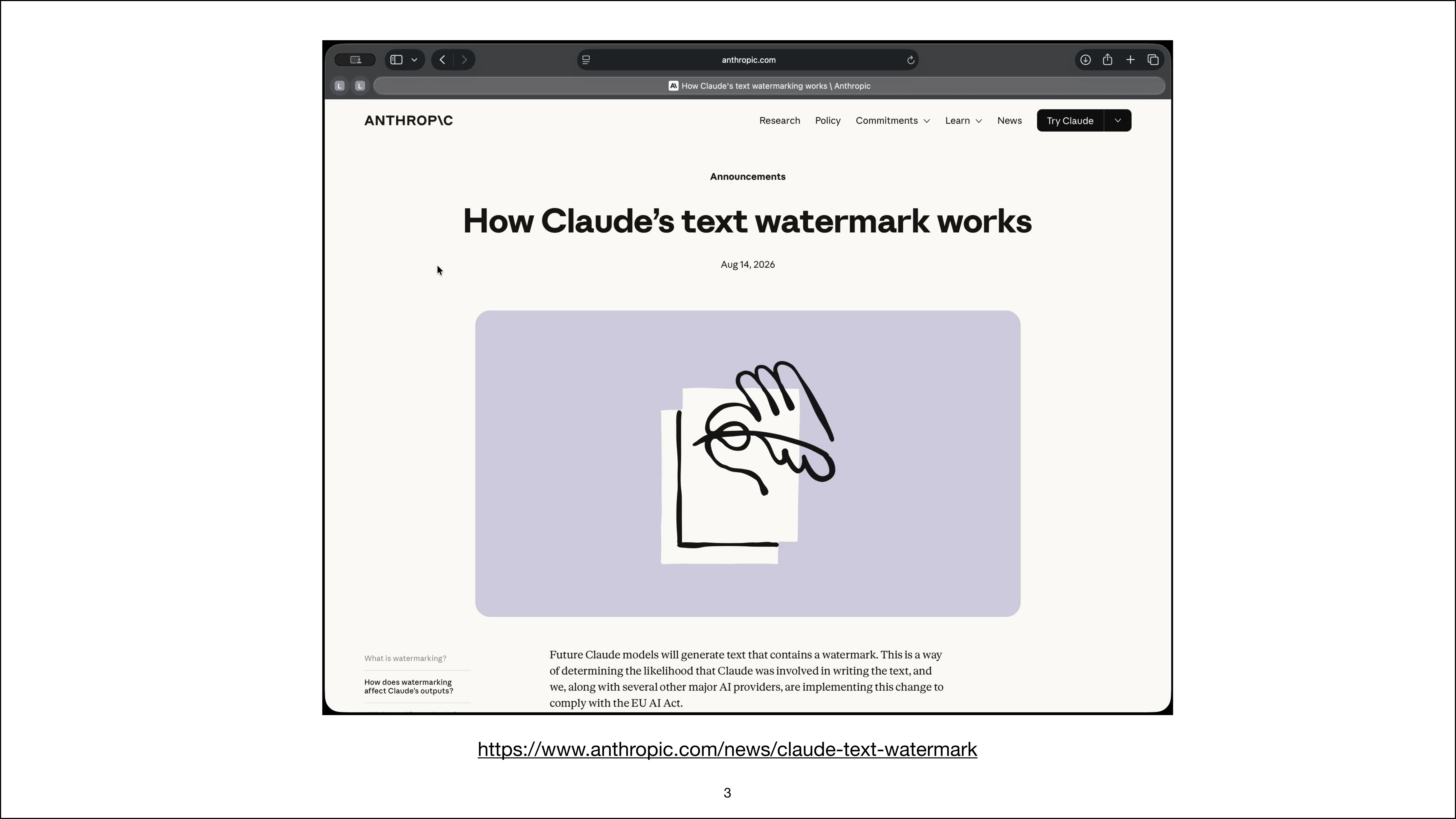
So a few days ago (this is August 14), there was this article, How Claude’s Text Watermark Works, and there was this article here; it’s just like a screen recording, so it can have everything in the slides, but there’s plenty of detail. They updated it actually a couple of times, so originally when I read this, it was a way shorter. Still, it is very, I guess, conceptual; there’s like this overview, and there’s, I mean, there’s not a single figure in there.
And so it’s kind of still hard to understand what they’re trying to do. So they explain a lot about why they’re going to do it, but they don’t explain how. They’re linking to one paper somewhere there, which is very technical also. So I do think it makes sense maybe to take a step back and start at the beginning to kind of understand what they’re trying to implement here with this watermarking technique.
And so the motivation, by the way, of watermarking is for them to identify if someone posts some text that they can say, oh, this text was generated by our Claude Opus 4.8 model, for example, so that they have a way to tell, OK, this text is AI-generated because it carries this watermark. And this watermark is invisible to users, so only they can decode it and find out whether the text has their watermark.
Why can only they do it? We will get to that later in this (hopefully not too long a video), but one thing at a time.
So I wanted to start with a brief prelude to explain how text generation works in LLMs, because based on that we can then more easily understand how the watermarking works and that this is actually not a huge, expensive thing on top of it. It’s really just like a minor, I guess, tweak inside the regular text generation process.
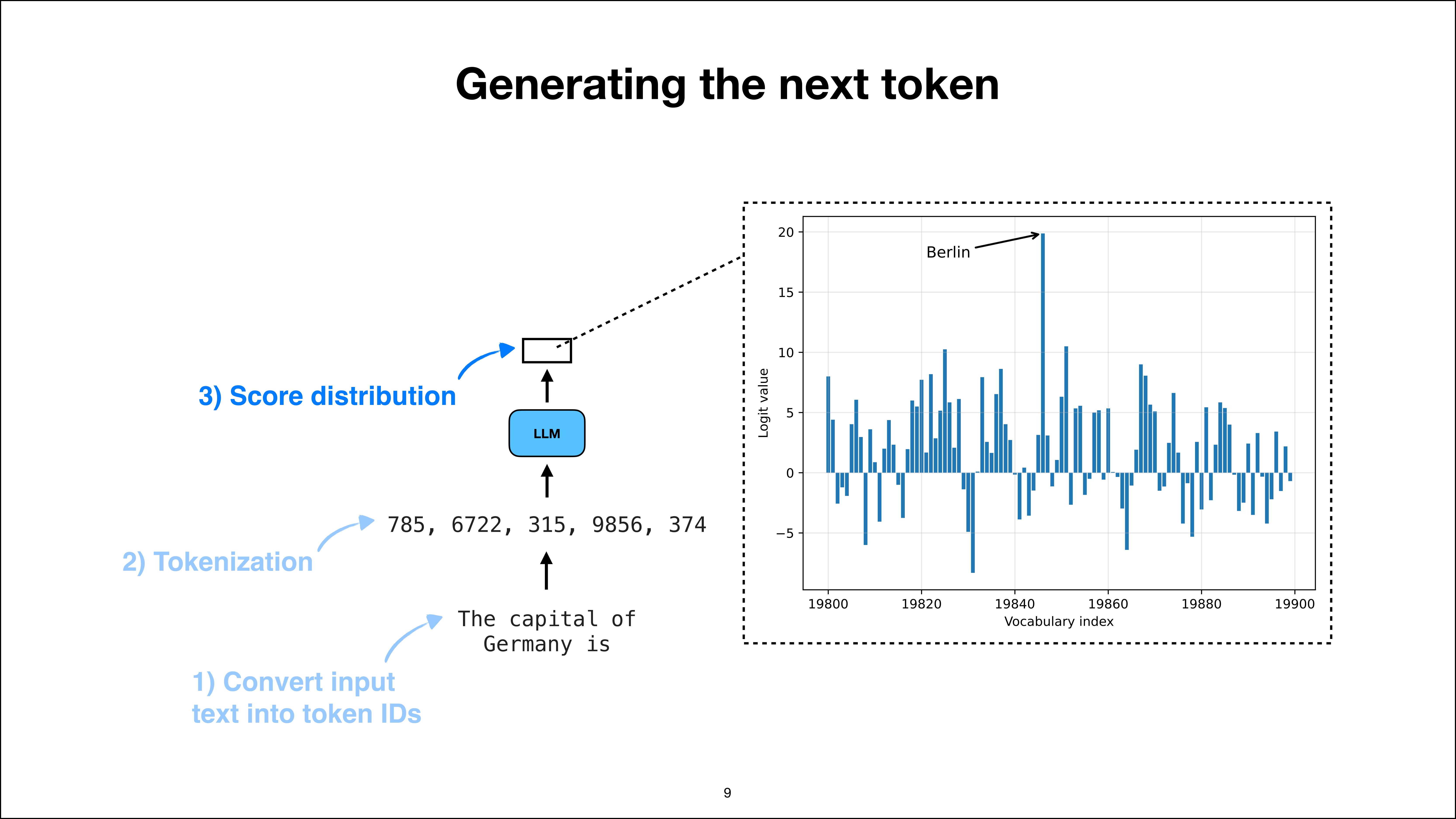
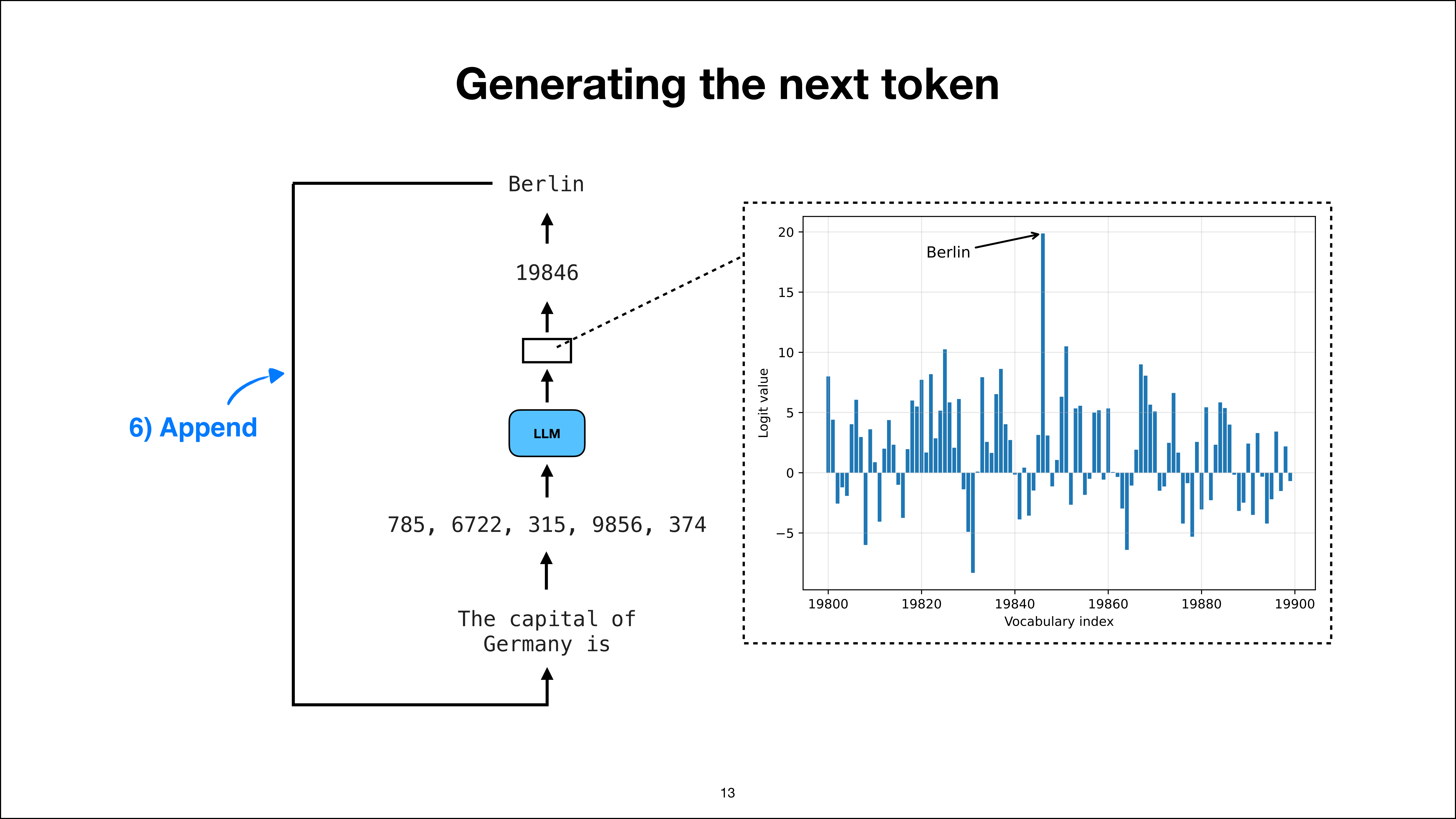
So when we are using something like ChatGPT, for example, let’s say I ask the question, the capital of Germany is, and yeah, ChatGPT or other LLMs, so this is just like an example would, for example, answer “Berlin”. So here, in this case, it’s generating two tokens, like “Berlin” and the period. But for simplicity, let’s assume it’s generating one token. So the next token is the “Berlin” token. How is this token generated internally?
What is happening under the hood when we type something here like the capital of Germany is and receive a token like “Berlin” back? What is actually going on there behind the scenes?
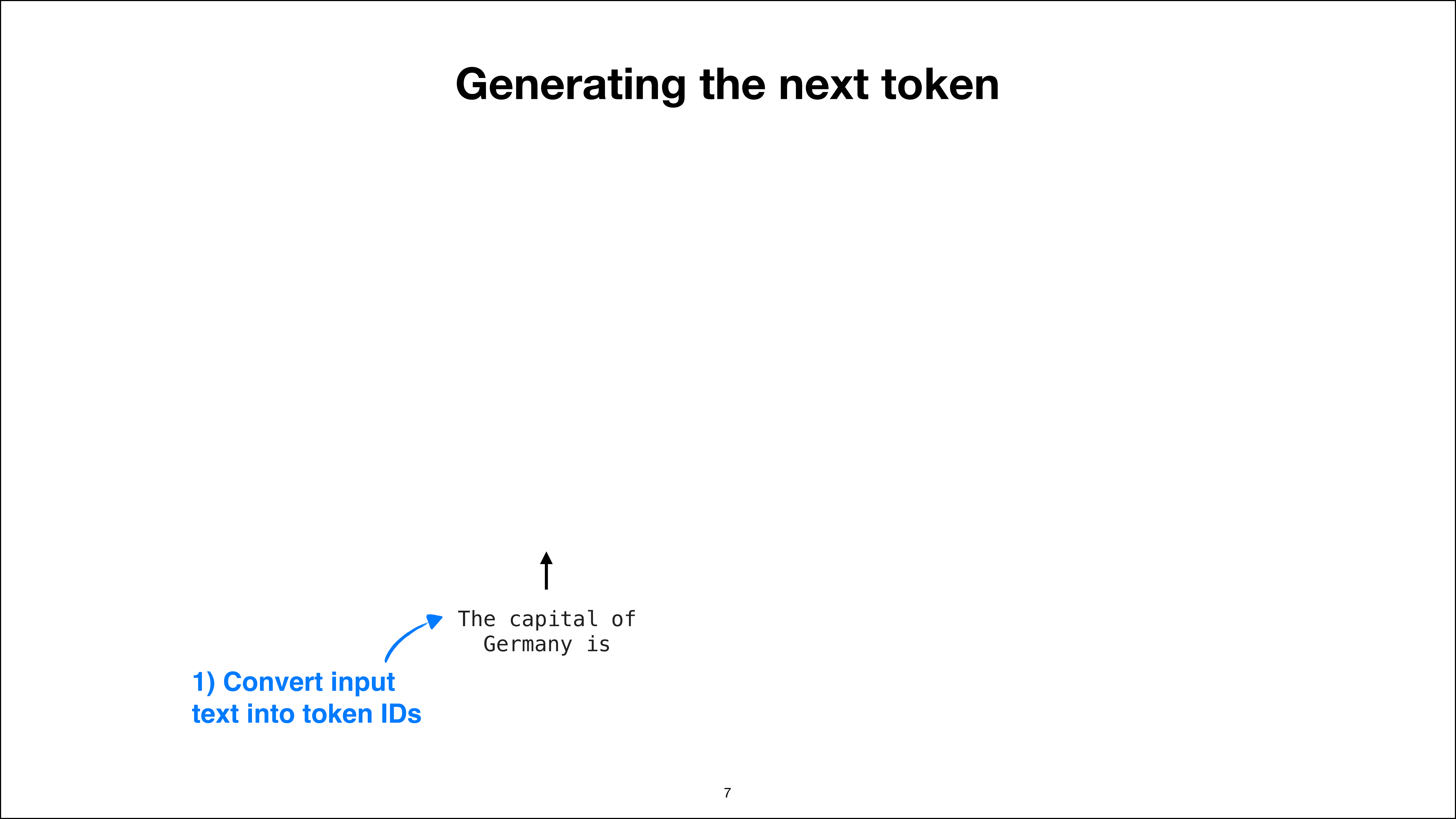
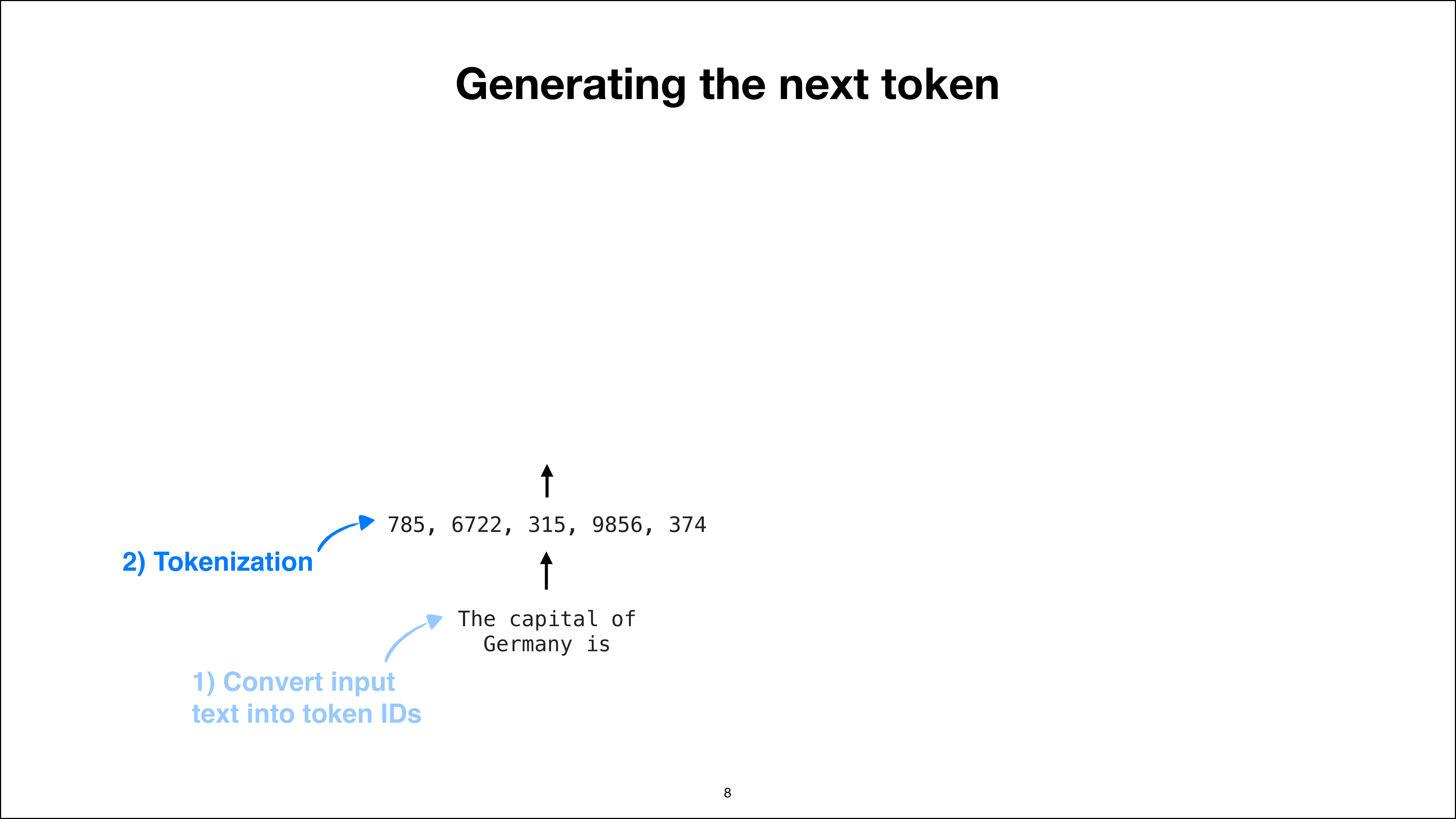
So assume again that our prompt is the capital of Germany is. And the first step here is to convert this into token IDs. So tokenizing it and converting it into token IDs is one of the main steps at the beginning. This is outside. It’s not inside the LLM; it’s outside of the LLM. So we are simply converting the text into token IDs. It’s just a format that embedding layers can work with.
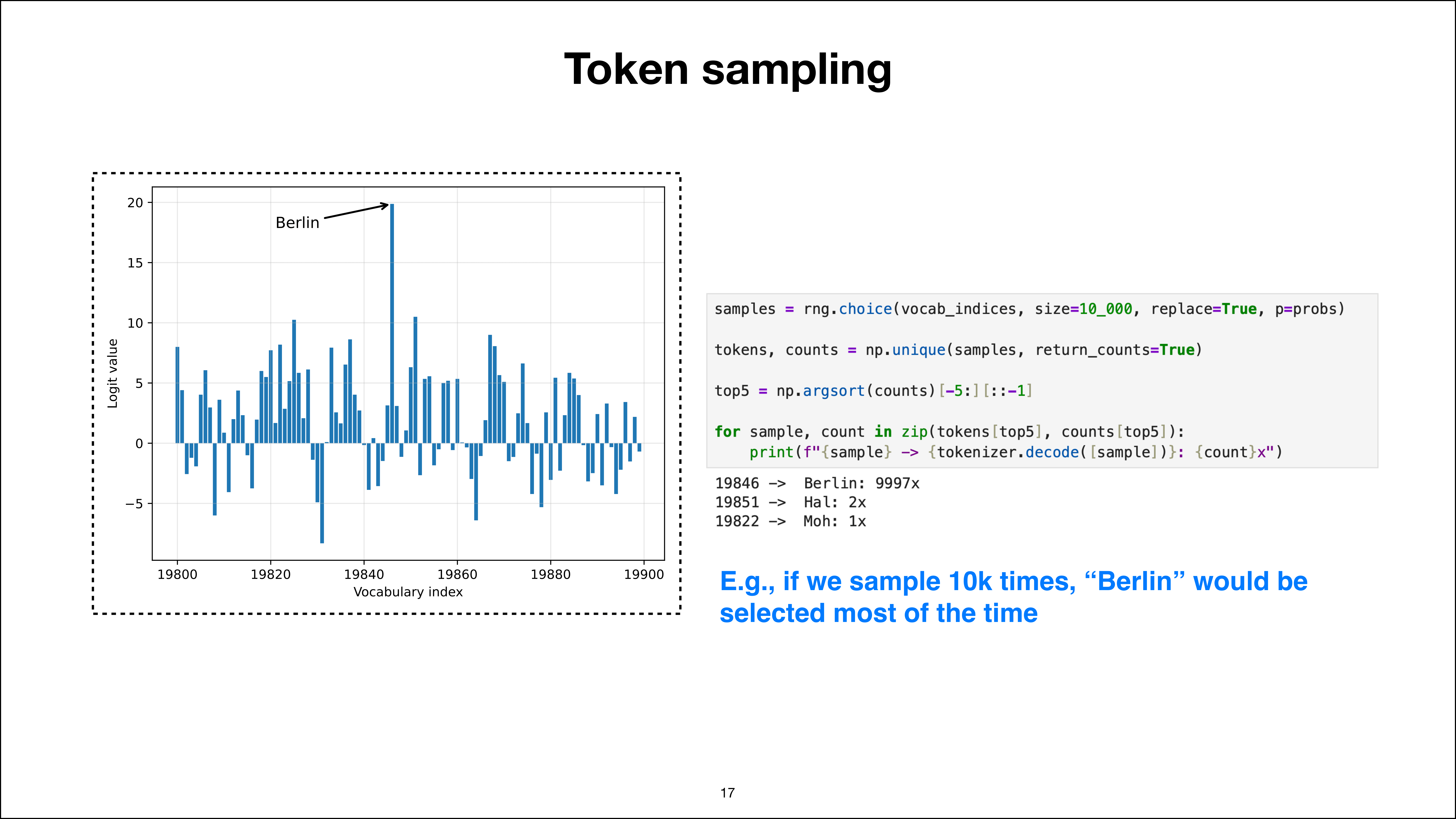
So again, this is just like a brief overview of how LLMs work internally. So I’m not covering the LLM machinery itself. I talked about it many times in my other From Scratch LLMs videos and books. The important part is that when we generate the next token (for example, “Berlin”), we have, at this point, a distribution of scores. So this is the output produced by the LLM.
Here in this case, we’re looking at logit values. So these are just scores from minus infinity to plus infinity, like a range of scores. Here’s an example, ranging from about -8 or -9 to 20. We could convert these into a probability distribution, but technically, it’s not strictly necessary depending on how we sample. But so you can think of the logit values as the raw scores.
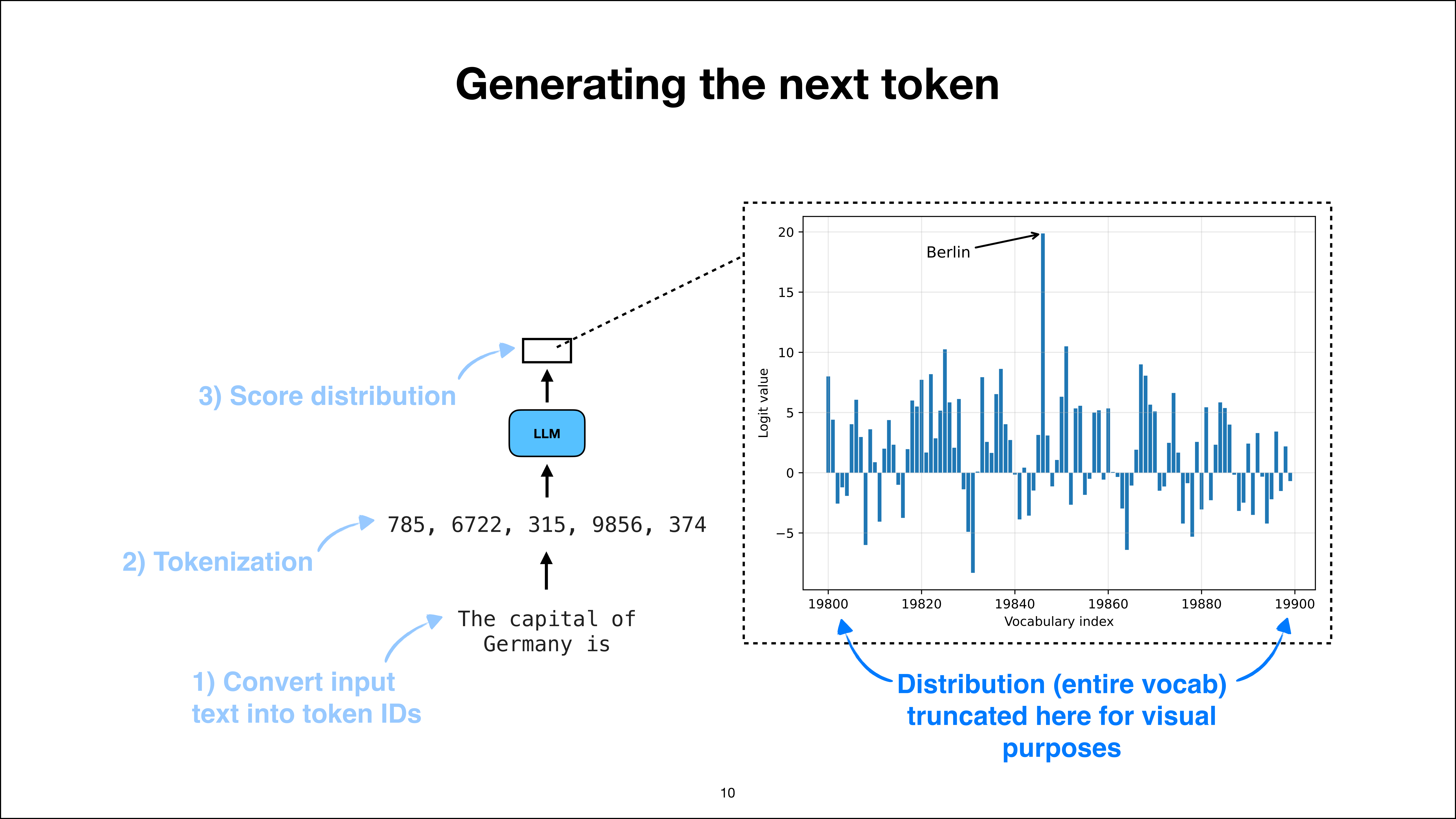
That means every possible word that the LLM could generate. Now here, in the vocabulary index, a certain value (index position 19,846) receives the highest score. So I spread out the distribution. If you would run this prompt through an LLM, you would even see something more extreme: that everything is, like, very, very, very close to zero. And “Berlin” would probably be much, much higher even.
But just to show you a few, you know, like peaks here so it looks a bit more interesting, I kind of zoomed in; in and spread out the distribution a bit. Now here, “Berlin” is the highest score because you can think of it as the most, I guess, probable or plausible next token if I have a very specific prompt like this. So the other ones, I mean, it could be something like Hamburg or Munich that the LLM might guess incorrectly.
But nowadays an LLM should be fairly certain that “Berlin” is the correct answer here. You are also seeing here the vocabulary index. So that’s like over the whole vocabulary. Nowadays, LLMs have like 250,000 possible tokens as output. I’m truncating it here from 19,800 to 19,900 because there’s just so much space here on this slide. If I would have a very realistic vocabulary of 250,000 words, everything would be so narrow that we would barely even be able to tell or see anything on this distribution.
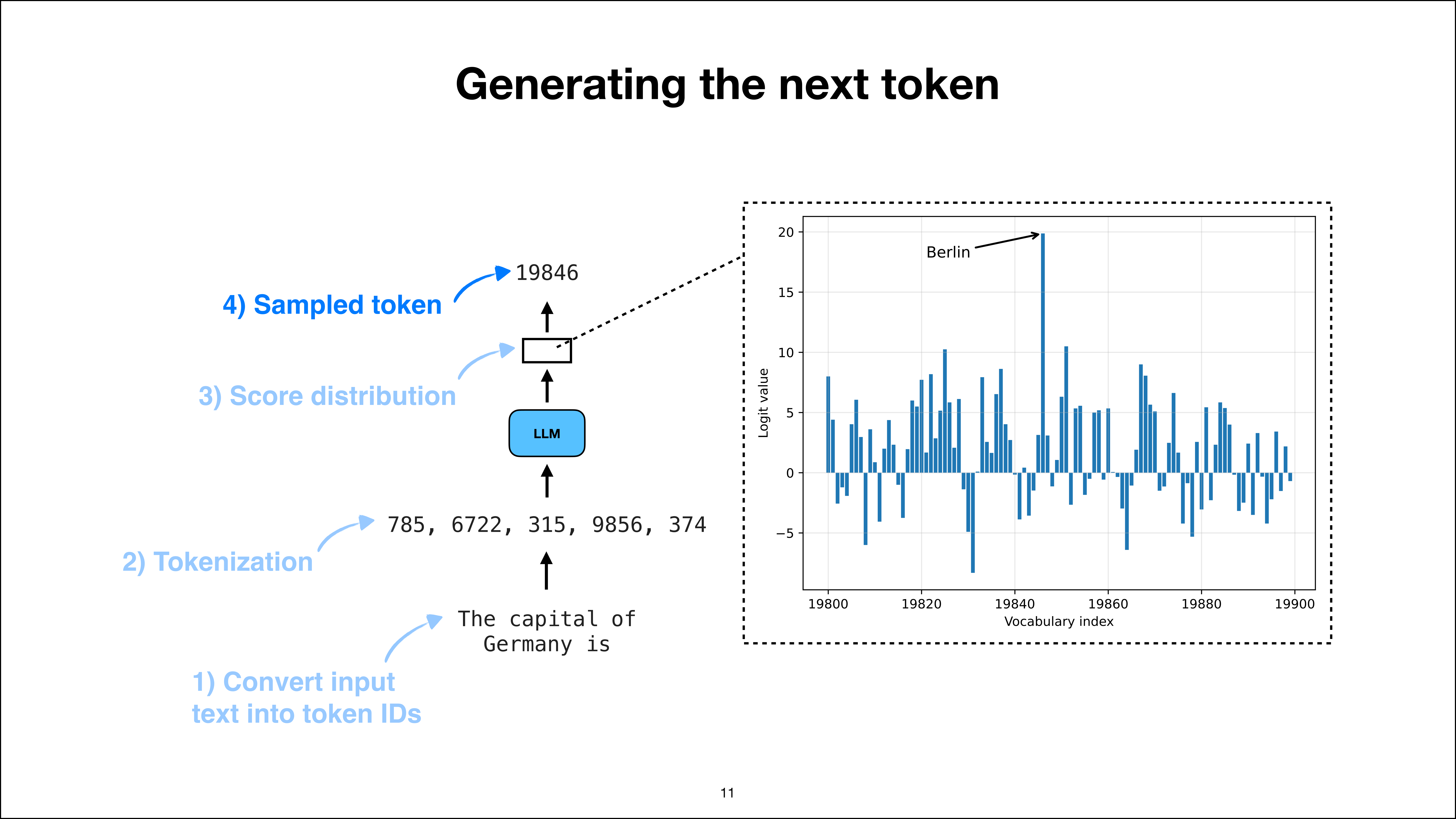
So this is just truncated for educational purposes. The important point is that in regular text generation, we get this score distribution. Now, what we do is look at the highest score.
I will get into more detail later on how this is selected. So it’s not necessarily precisely the highest one, but for simplicity, assume we are taking the highest score here. And in this case, it’s 19,846.
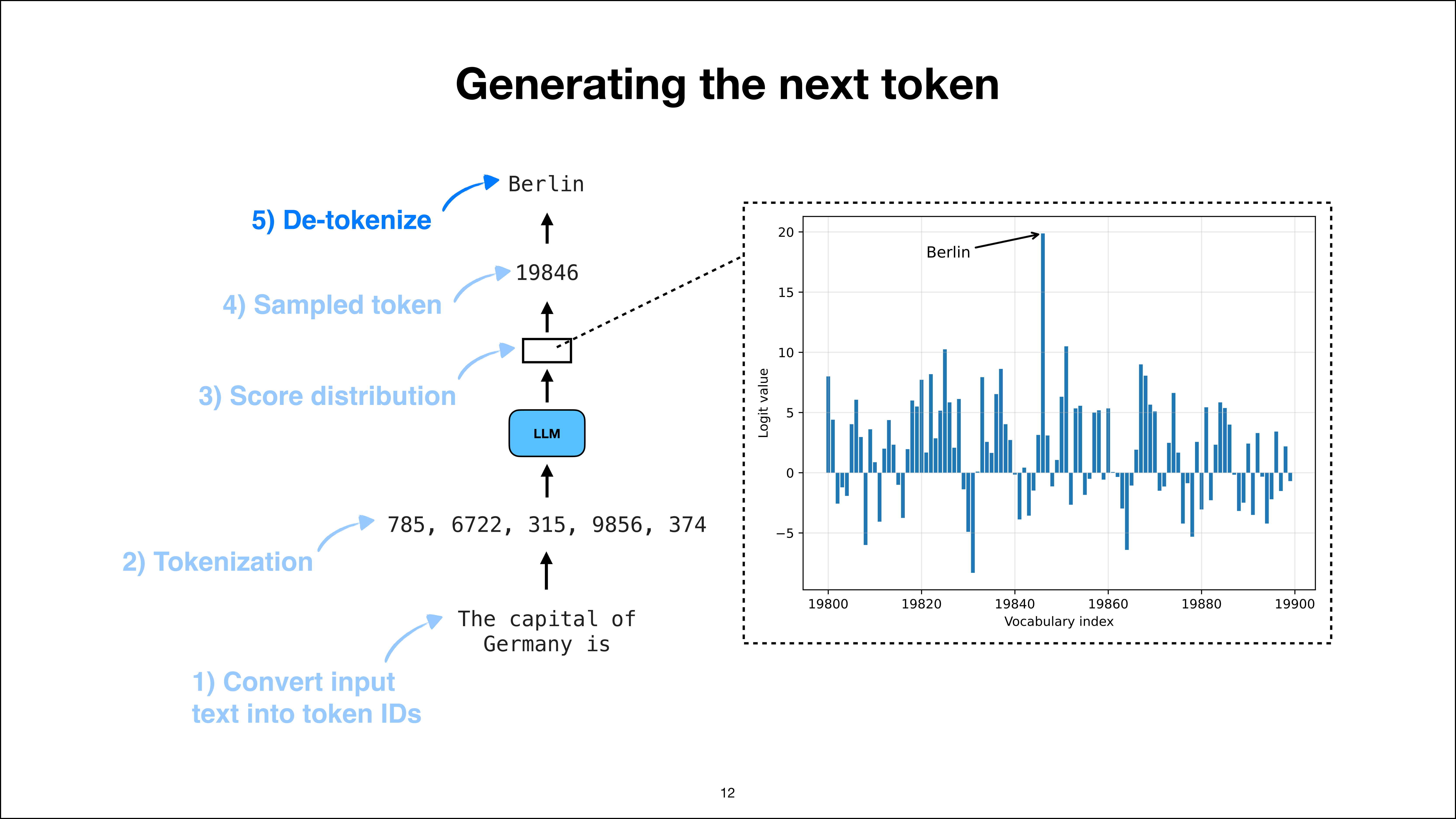
And this score is then detokenized, and we get “Berlin” back. So that is the process here on this slide: from an input prompt to conversion into token IDs and tokenization, passing it to the LLM, getting this score distribution, getting the next token, and converting it back into text.
And then this text is appended to the input. So if we have a question that requires multiple output tokens, we keep going in this loop until the answer is complete. That usually means that the LLM generates an end-of-text token, for example, here. For simplicity, I’m showing you only one iteration where it generates one token. But yeah, as I said, it would kind of continue like that, where we are feeding back the modified input to the LLM for the next round.
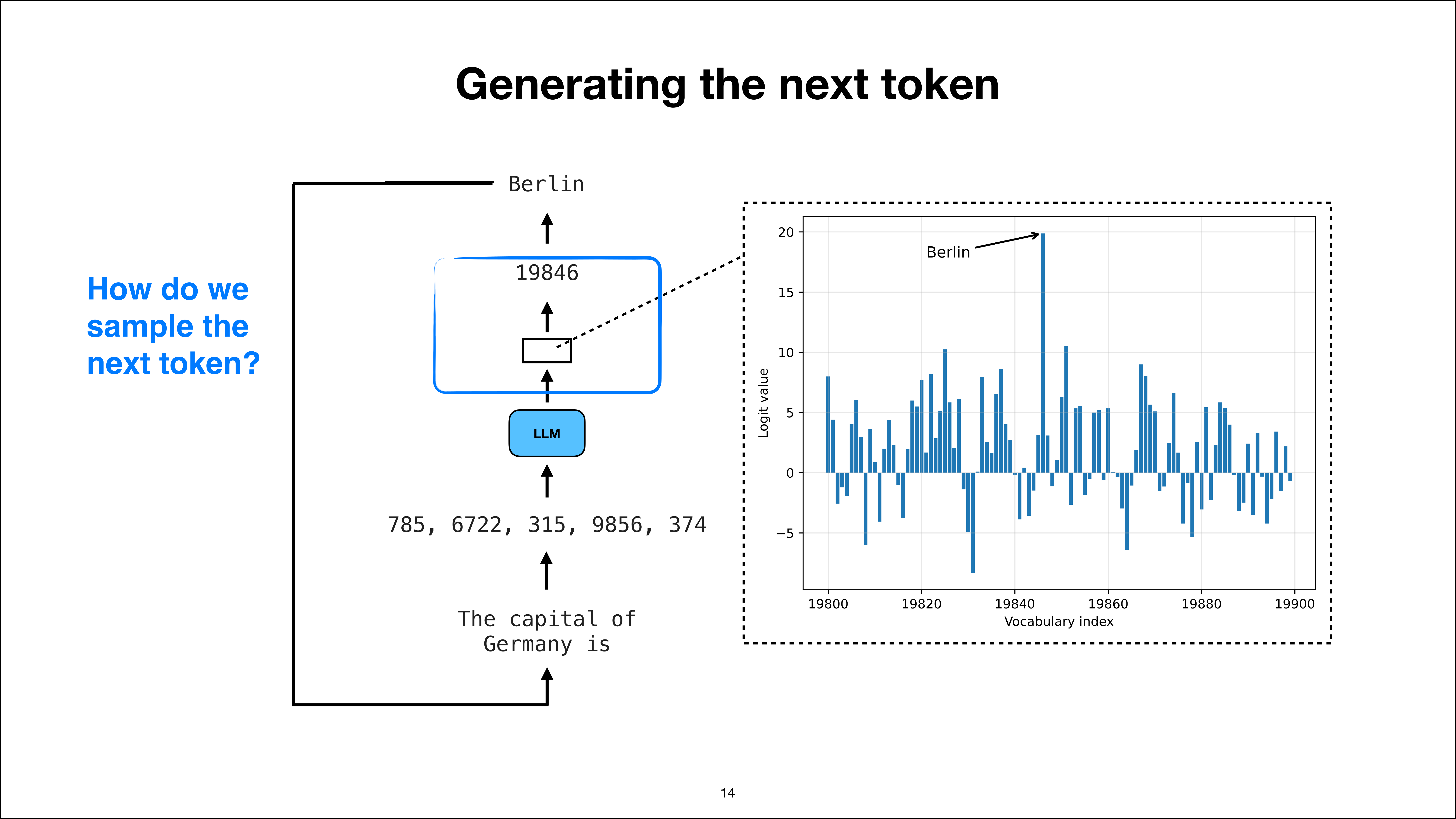
Now, how do we actually sample this next token here?
I briefly said, well, we could just technically select the highest one, the one with the highest score. This is called greedy decoding. That’s one way to do it. But most LLMs, like if you use them, they don’t do greedy decoding where they always pick the highest one. Because if you ask it on some other prompt, it might not be what we want to always have the highest score, because then it would memorize the training data.
It would always kind of give the same response and so forth. So we actually often want some variation in the outputs, but not so much that it generates random stuff. So how it works is that, when we sample here from this distribution, we first typically convert it into probability scores.
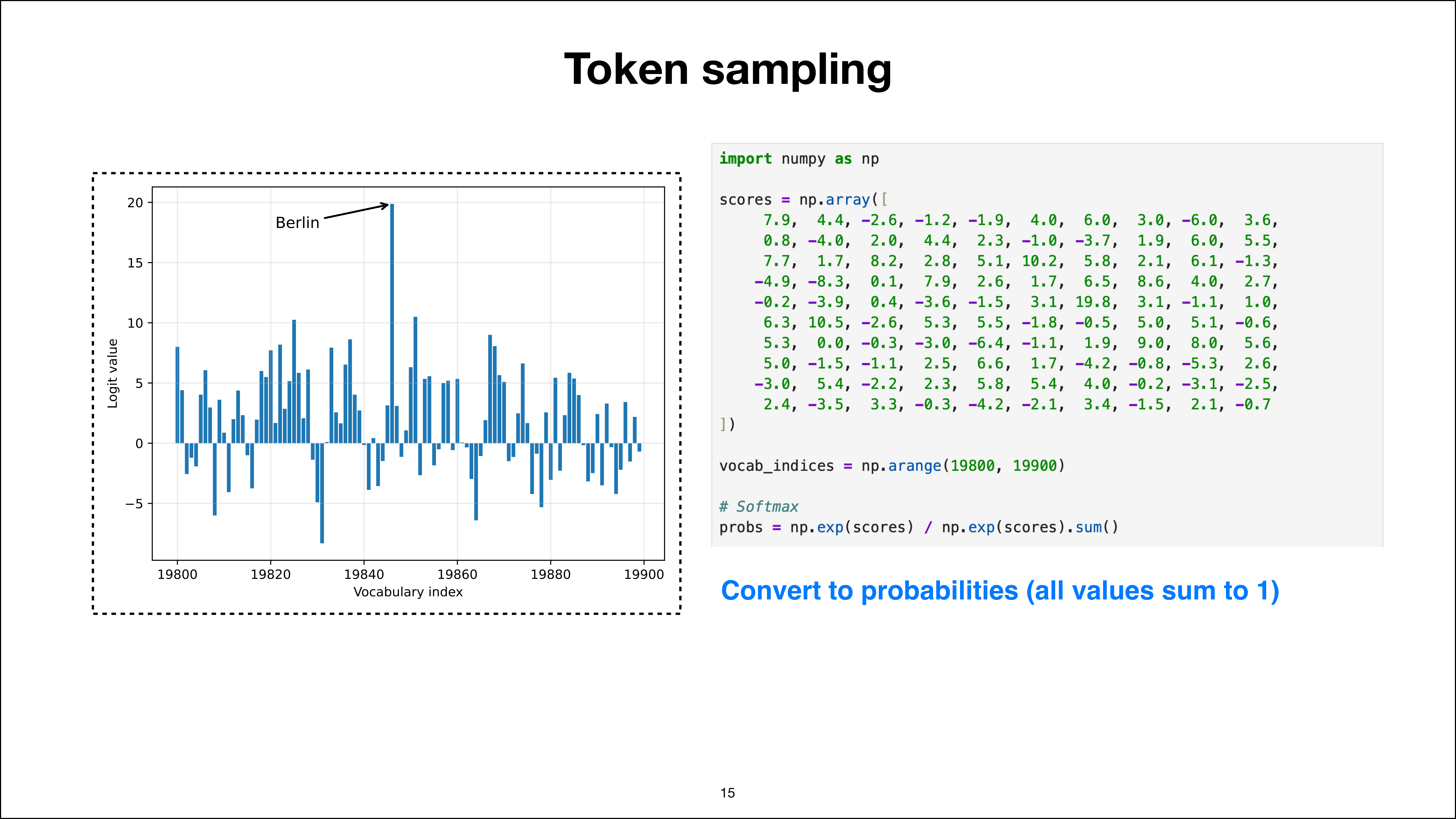
So here I just have these scores shown in this plot. I’m just using NumPy for simplicity; whatever tool you use (e.g., PyTorch), the same concepts apply. But let’s assume we have the scores here in NumPy. So what I would do is I would compute the softmax. Technically, I would use a softmax function implemented in Torch or PyTorch, for example, that is numerically stable for both large and small values, including very high positive values, very low positive values, and very high negative values.
Here I’m just writing it out like that. That’s the canonical softmax, just to make it a bit more readable. But the details don’t matter here.
What matters is that after this conversion, the scores here, I mean, there’s only so much space on the slide, but the scores here, they would add up to one. So it’s essentially like a renormalization. So they would be normalized to sum up to one. That’s all that the probability conversion does: the softmax conversion. So then once we have these probabilities, we can use a random number or, like, a random sampling algorithm.
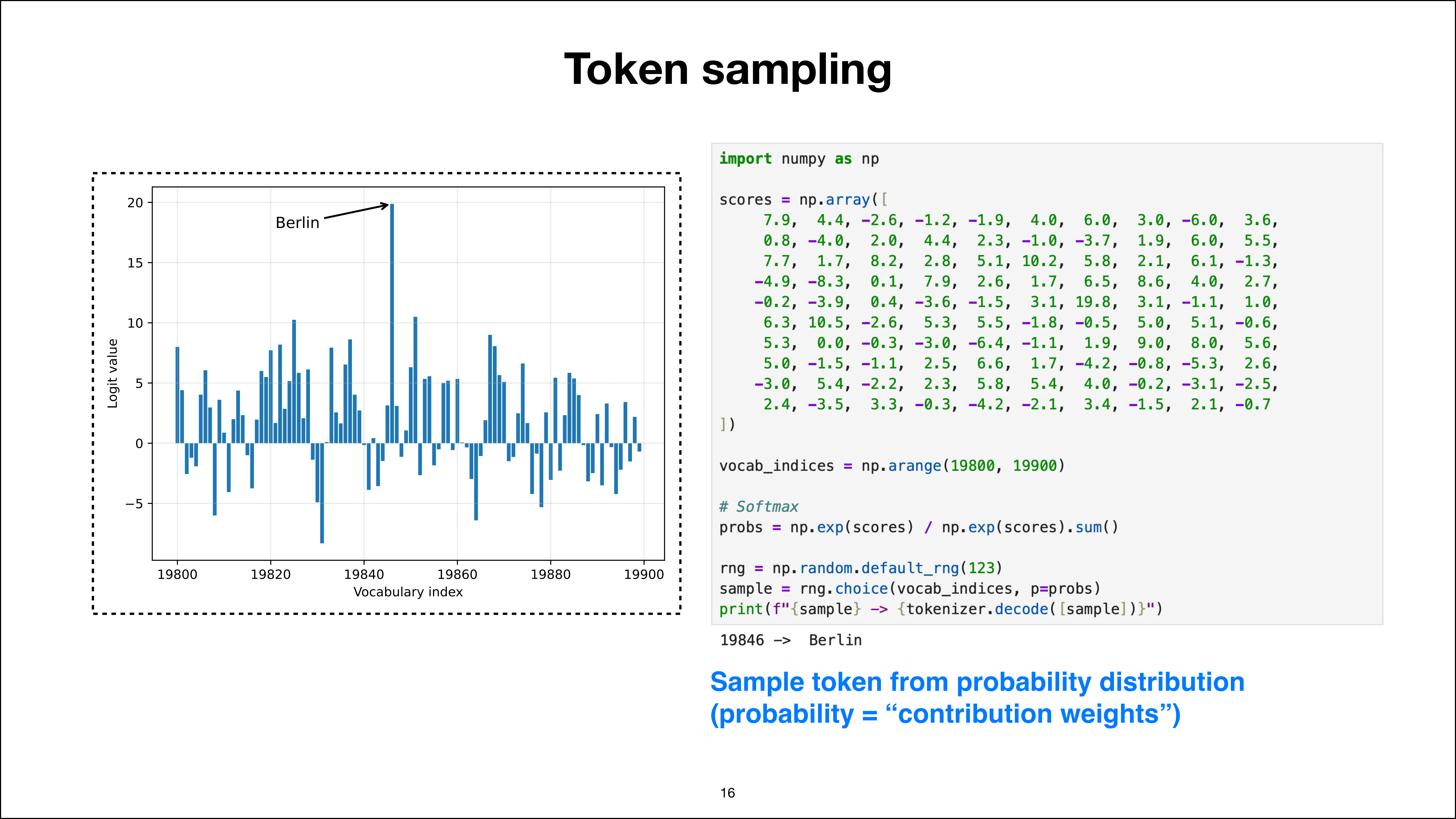
For example, here in NumPy, we could use the choice function or method. So this is with a specific random seed we are passing to the vocabulary indices. And then, and that’s the important part, we are passing the probabilities as the weights. So, these, essentially, yeah, are like: “How likely is a certain token to be selected?” So, for example, if “Berlin”, after this normalization step, the softmax step, has a 99% probability and the other ones together have a 1% probability, then if we would sample 100 times, 99 of the times, we would get “Berlin”.
In realistic LLMs, for example, that are well trained, “Berlin” might receive a probability of 99.999999 or something like that. So you’re almost certainly always sampling “Berlin” because it’s very confident that the answer is “Berlin” in this particular case. So yeah, that is how we would sample from this distribution. There are modifications like top-k sampling or top-p sampling where, let’s say, just for simplicity in top-k sampling, we would select the top 100 tokens and then apply this random choice only to the top 100, the 100 highest-scoring ones, so that we don’t get nonsense tokens in there.
For this example, it doesn’t really matter. I mean, it’s just like another thing to explain, so I’m skimming over this. So you can maybe assume that this is already the top 100 tokens using top-k or something like that.
And so, for example, here’s an example. If we sample 10,000 times with a probability of “Berlin” being very high, 99.9, we would sample “Berlin” 9,997 times, sample the word “Hal” twice, and one “Moh”. And these are basically nonsense tokens. It rarely happens that, in this case, the LLM might produce nonsense because, as I mentioned before, I spread out this distribution a bit to make it more interesting.
A real LLM would probably, 10,000 out of 10,000 times, sample “Berlin” because the probability of “Berlin” is so high. But this is for illustration purposes.
Now we briefly talked about how LLMs work under the hood, which I think is kind of an interesting concept in itself. But I’ve talked about this many times before, so I don’t want to bore you. I just wanted to set up some context for now, explaining how this watermarking works.
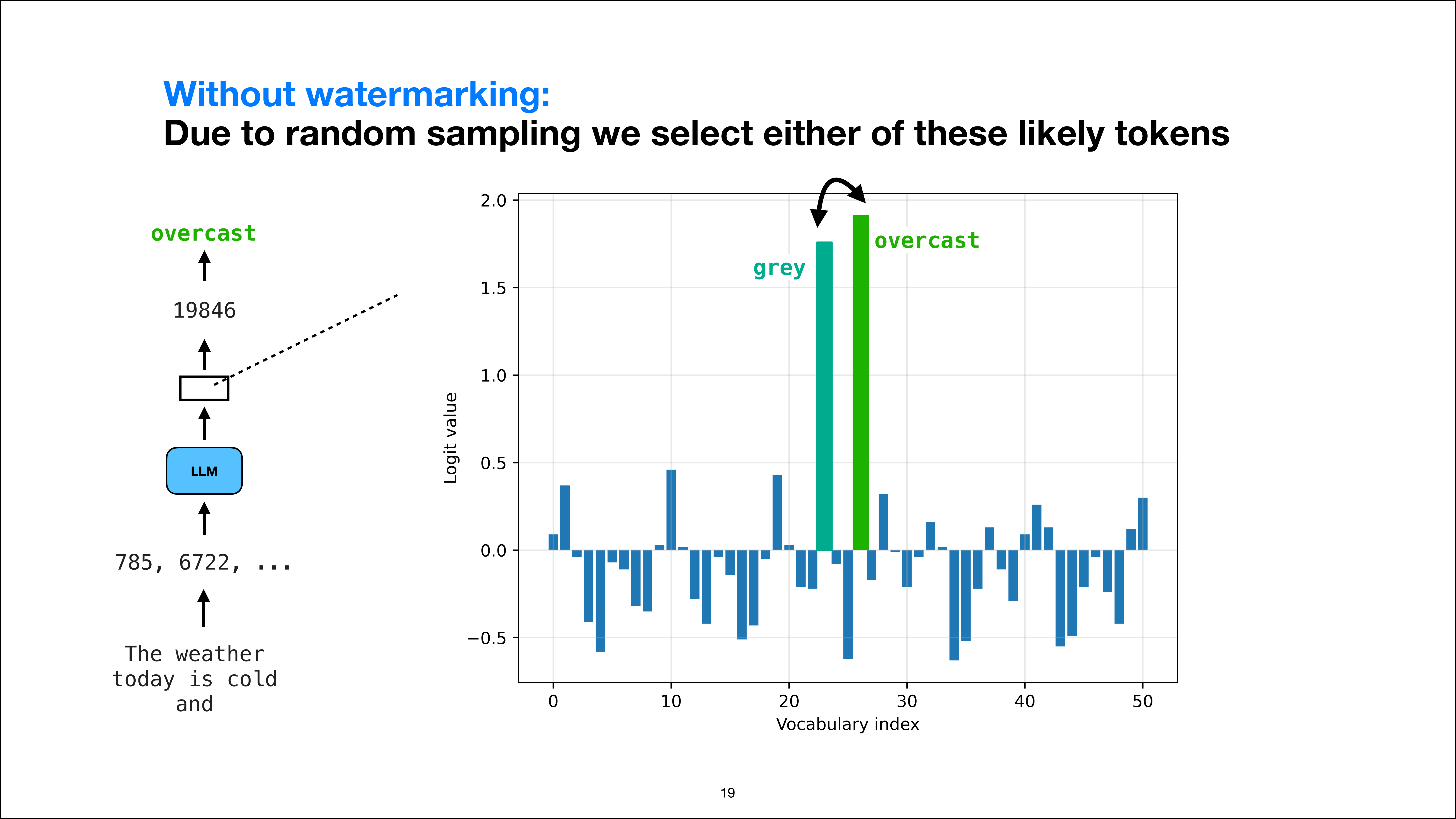
So, we mentioned that we select the highest-scoring token when sampling. Or we use this probability sampling, which will lead to one of the highest-scoring tokens being selected most of the time. Now here’s another example without watermarking. I changed the prompt slightly. Now the prompt is: today’s weather is “cold,” and a possible answer could be, for example, “gray” or “overcast”. So in contrast to the “Berlin” example, I would say “gray” and “overcast” kind of are interchangeable.
They are both reasonable next tokens for this prompt, given the goal of completing this text or writing the next token. So it’s almost like a coin flip which one we want to select. There is not really an objectively worse one of one or the other. So when we do the random sampling, because they also have relatively high scores and their scores are similarly high since they are both plausible tokens, we might get one or the other.
So almost half of the time we would get “overcast”, and almost half of the time we would get “gray” if we repeat the sampling multiple times. And that’s how LLMs often end up with different answers if you provide the same prompt. If you use the same prompt and you ask the LLM multiple times, you often get slightly different answers. And that’s because at certain positions, two possible tokens are almost equally likely, so it will choose one or the other.
And that token would then influence all subsequent tokens, and so forth.
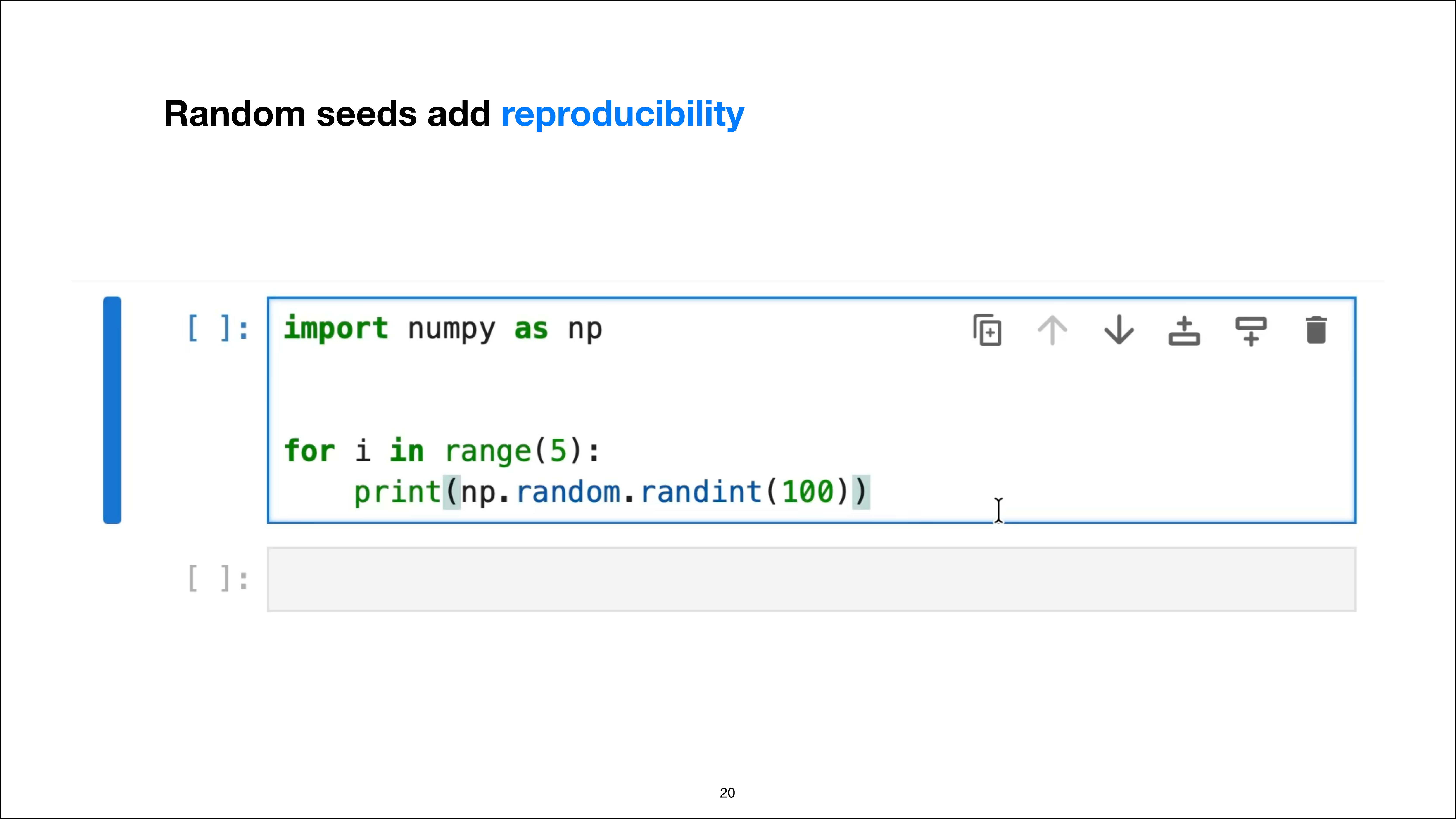
Now, I wanted to briefly talk about random number generation. So, for example, if we use a random number generator like this, it will generate a random sequence of numbers. If I run it again, the sequence of numbers is different here. So you can see every time we produce five numbers, they are different. If I set the random seed here, like one, two, three, and I run this multiple times, we still get random numbers, but they are now all the same, right?
So they are still random. If we use a random seed, we still get random numbers that are different from each other, but they are reproducible. So whether we use a random seed or not, we still get random numbers. But with a random seed, we get a reproducible sequence of numbers. So keep this in mind: this is just like a little primer, and we will use this concept in a few moments.
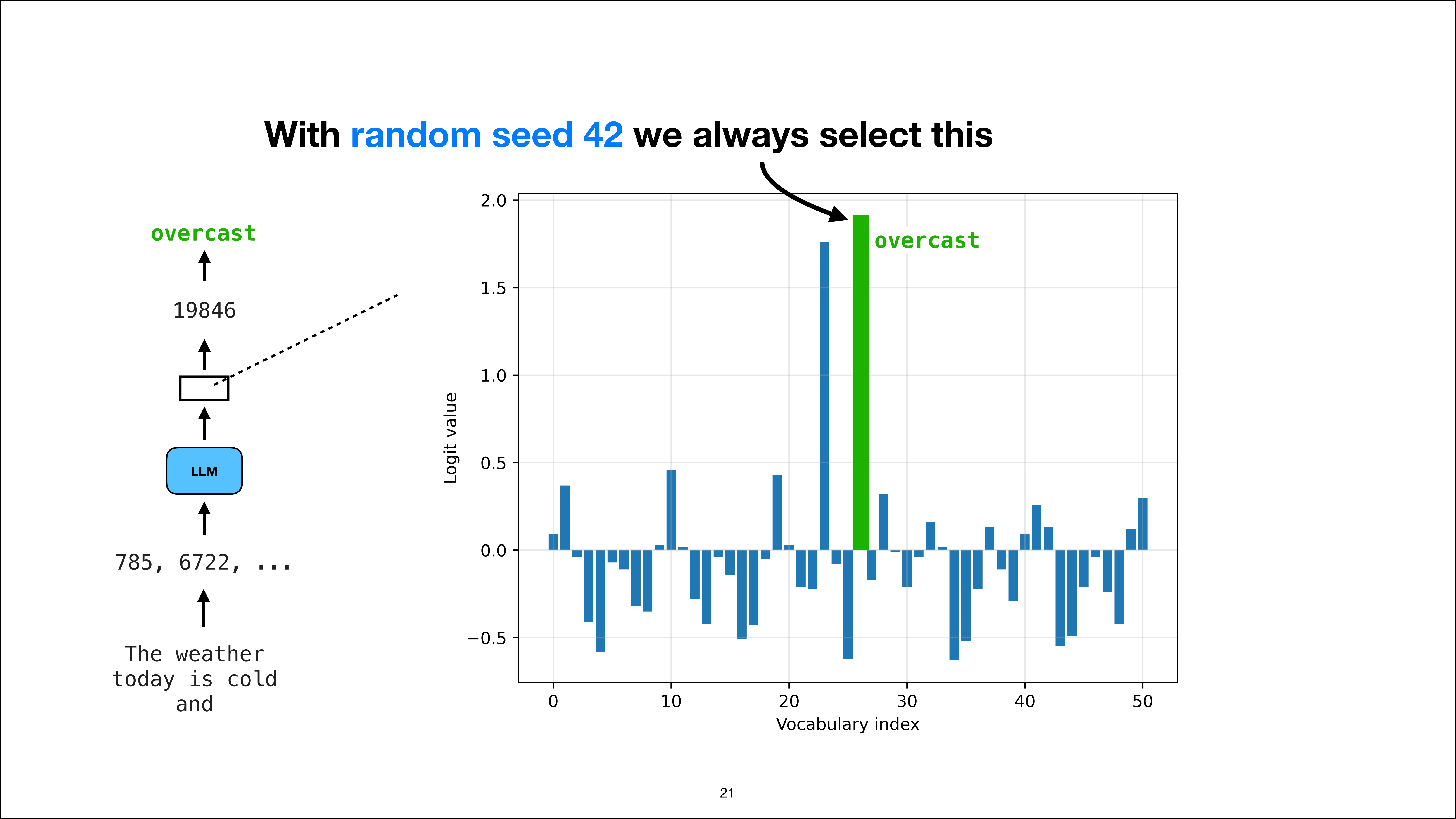
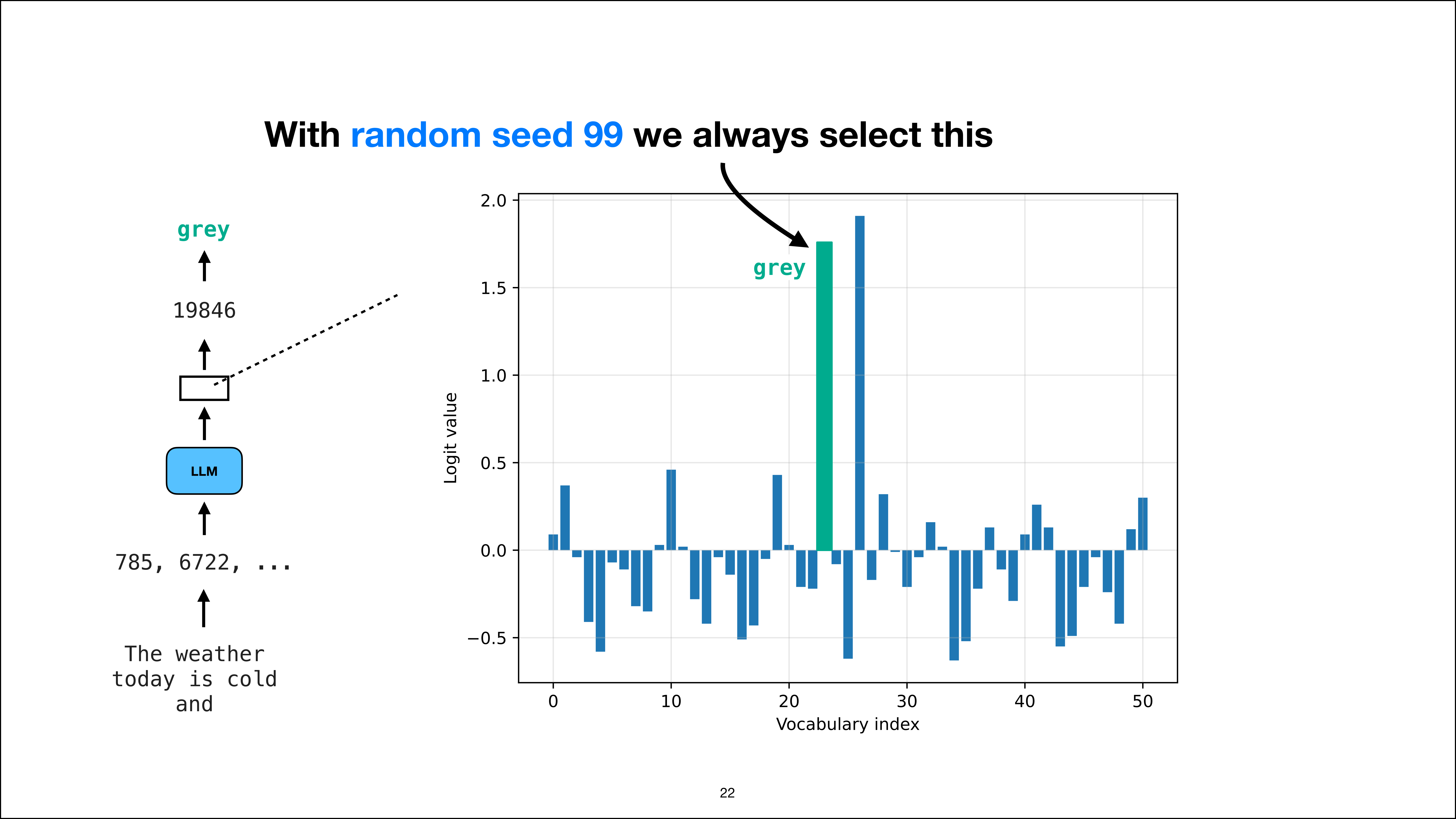
So, for example, I mentioned before that we might get either “gray” or “overcast” if we randomly sample. Now, if we use a specific random seed like 42, we would always, for example, select “overcast”. I mean, it’s still a random selection, but we make it deterministic. In this case, given this prompt, the model will always select “overcast”.
If we use a different random seed, the model might select “gray”. Every time we sample, it will always select “gray” as the next token. So it’s still random sampling, but we are making it deterministic based on the random seed.
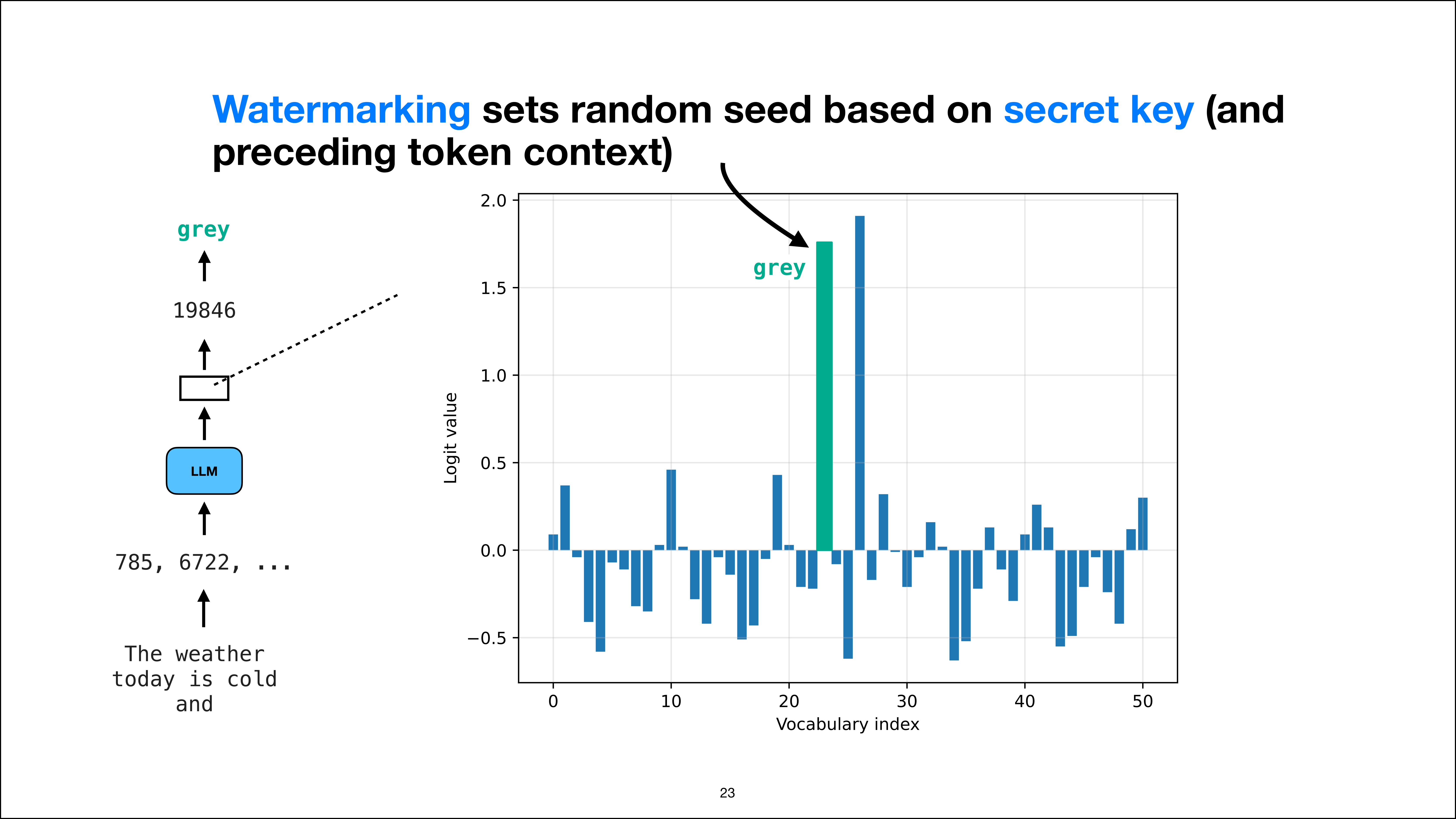
So, in watermarking, Claude watermarking is kind of like the idea that it sets a random seed. But this random seed, instead of being like a number that is fixed based on, I don’t know, someone writing down a fixed number, they’re using a secret key that is essentially like an API key, a secret key, and from that key, together with the four previous words, they derive this random seed essentially.
But the idea is that if I go back one slide, it’s the same as here: there’s essentially a fixed random seed, and that random seed always selects the same next token. Okay, so instead of using random seed 99 here, for example, they have a secret key and also use information about the previous tokens to derive this random seed. But more on that later.
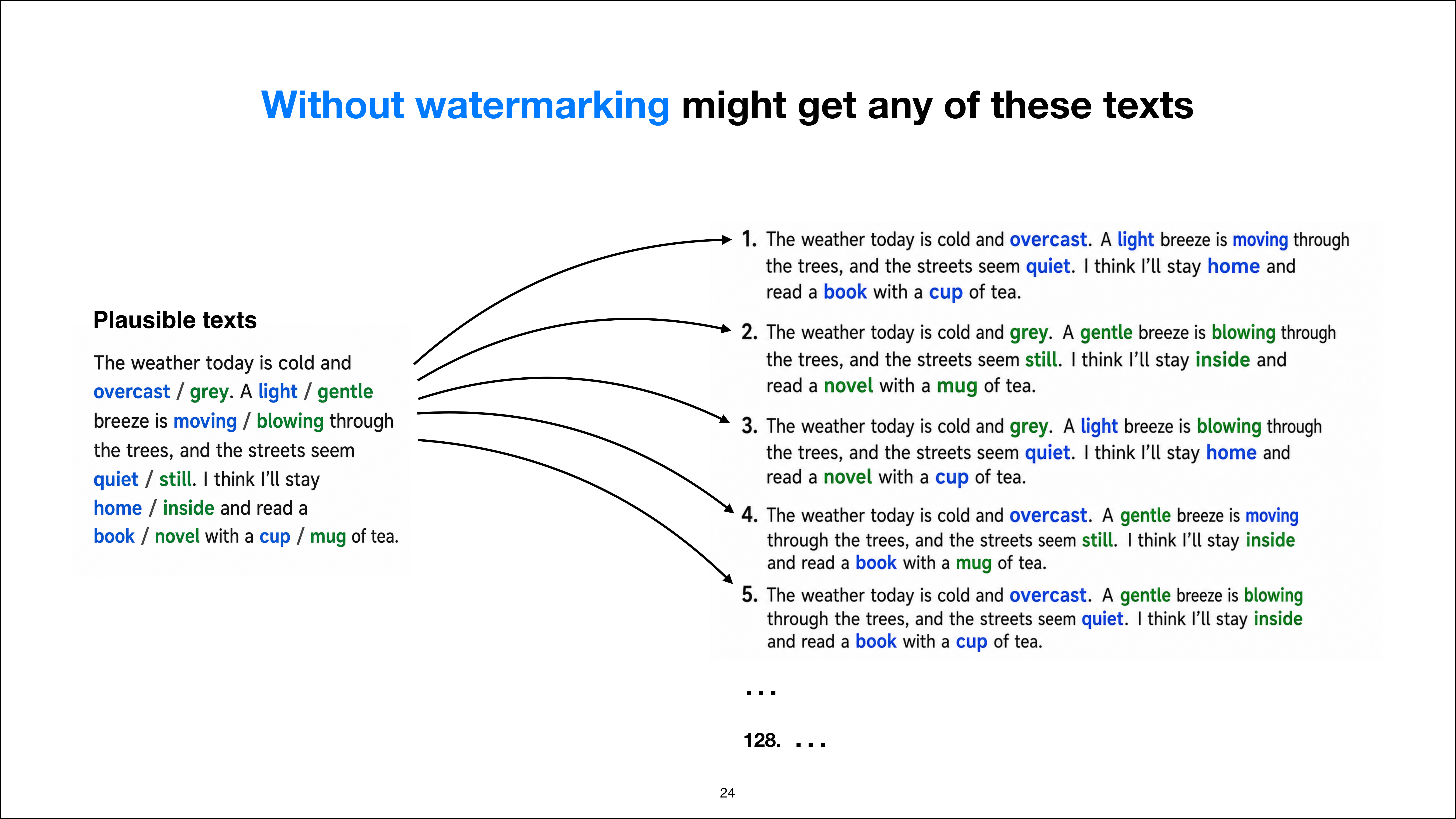
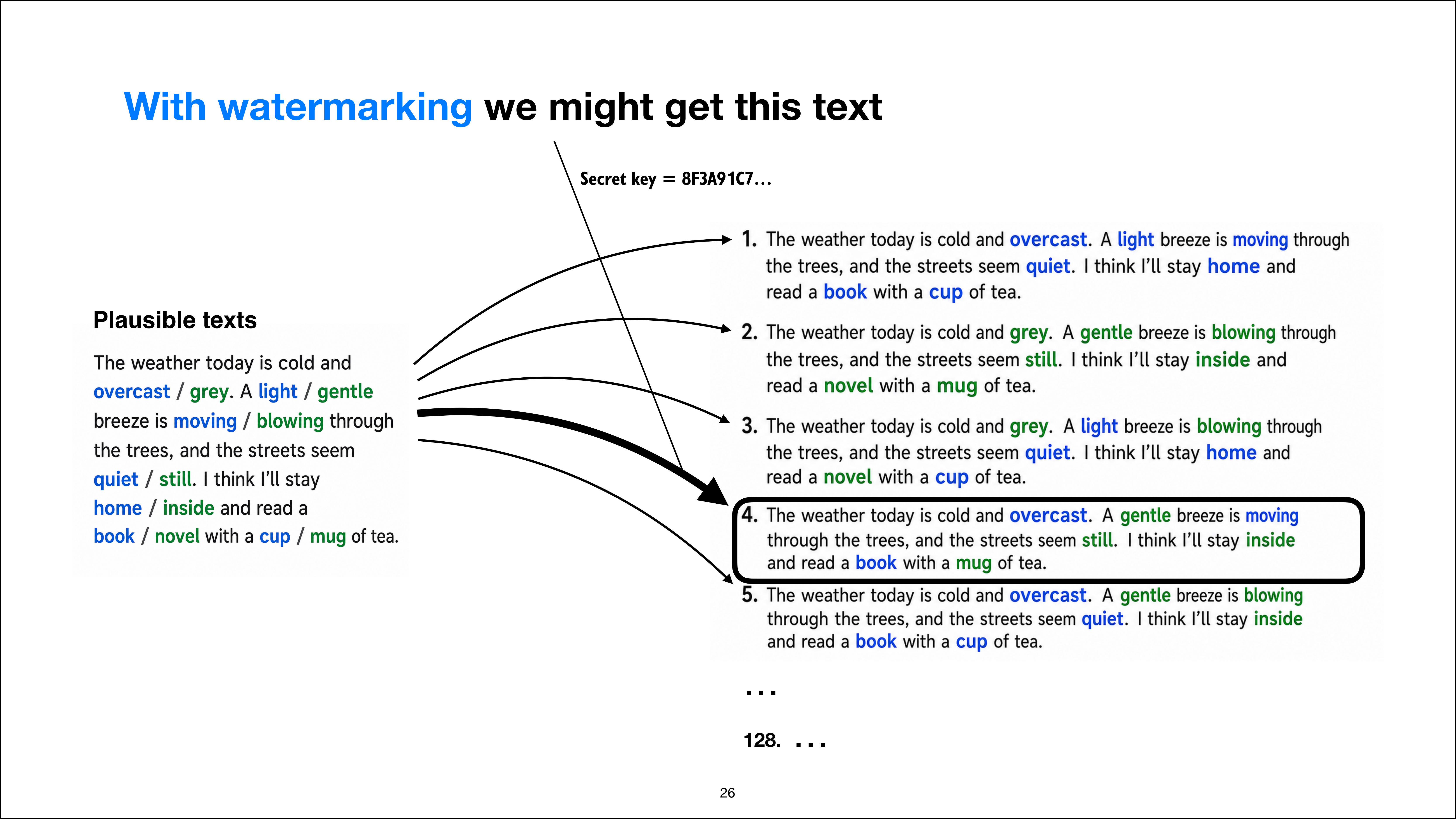
So the idea is that watermarking makes the text generation more deterministic in certain positions. So, for example, if we have these plausible texts on the left side. So if I have a text that says,
> The weather today is cold and
I may either pick “overcast” or “gray”. And the next sentence could be,
> and then “light” or “gentle”
They’re both interchangeable again.
> And then breeze is “moving” or “blowing” through the trees, and the streets seem “quiet” or “still”.
Which means basically I could say either “quiet” or “still”. So there are certain positions in the text where we have token choices where they are almost equally likely, like we have seen before. So that means if we are, this is without watermarking, if we are running the prompt, or given the prompt through the LLM, we might sometimes get this answer here, sometimes this answer, and so forth.
And based on the number of positions, we might have 128 possible answers here. And of course, the longer the text, the more positions we have where we can have terms interchangeably, the more combinations, or the more output texts, there are. So, for example, again, one possible output text could be
> The weather today is cold and overcast. A light breeze is moving through the trees, and the streets seem quiet. I think I’ll stay home and read a book with a cup of tea.
So that is one possible text. Another possible text is
> The weather today is cold and gray. A gentle breeze is blowing through the trees, and the streets seem still. I think I’ll stay inside and read a novel with a mug of tea. By the way, it’s also actually raining outside. I don’t know how good this microphone is, but it’s kind of a very fitting context here.
But yeah, the bottom line is that you can see there are two very reasonable texts here being generated, and there are more combinations. So they are all reasonable. There isn’t one that is necessarily better than the other. They’re just, you know, slight variations. And if we don’t use watermarking, we might get either one, or it’s just random, right? Because of the random sampling, we might get one or the other.
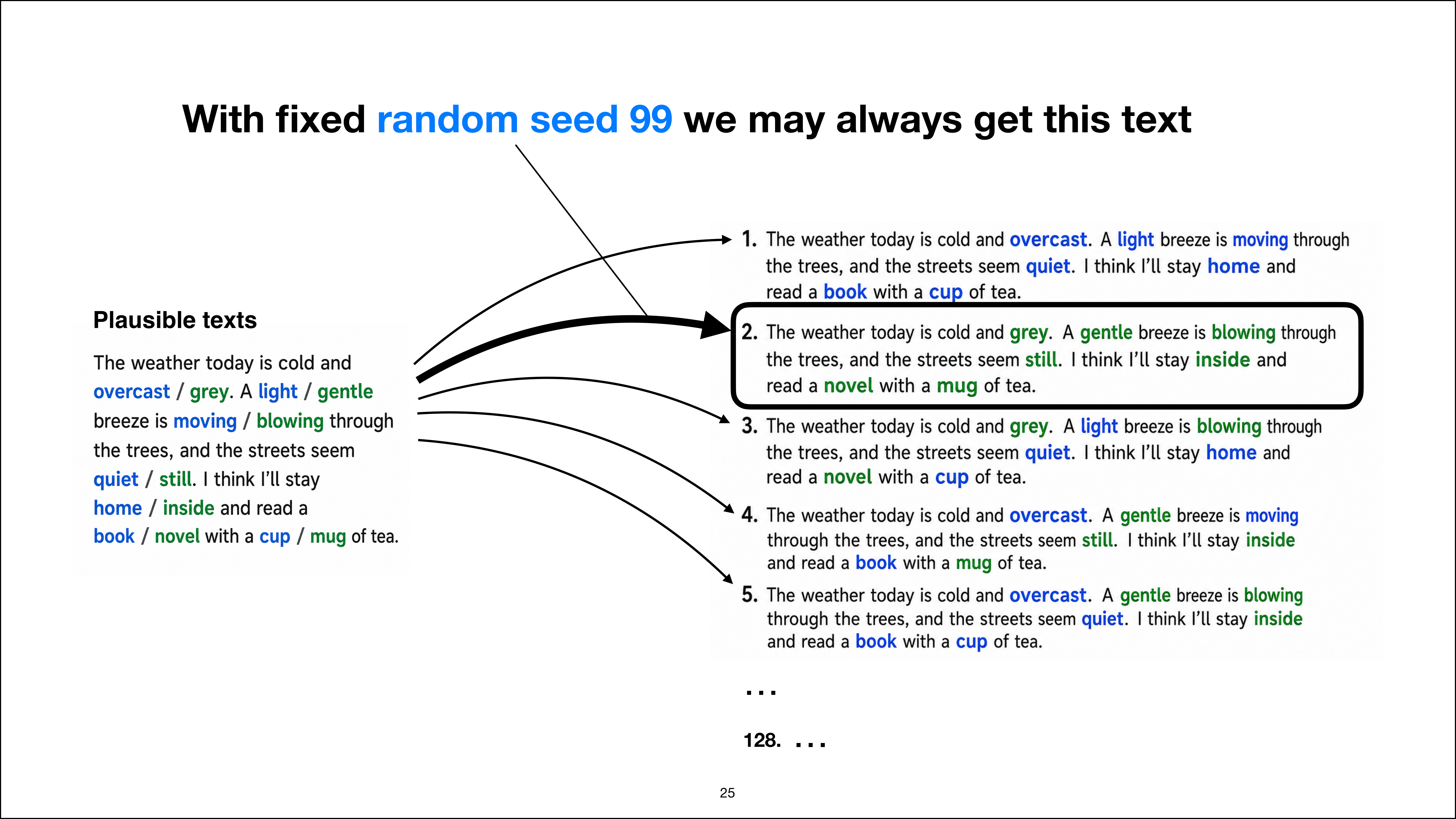
Now, if we fix the random seed, as I mentioned before, for example, if the random seed is 99, we might always get this text here. So, using a random seed, we can kind of fix which answer we get, because then the random sampling is still random, but it’s deterministic in the sense that it’s reproducible. It’s always going to be the same then. Okay, so that is still without watermarking, now with a random seed.
And the watermarking is essentially doing the same thing. Now, instead of just using a simple random seed, they have a so-called random key, where this random key is involved in selecting the text, essentially. But what we can already say is that, in the Claude blog post, they say the watermarking shouldn’t make the text worse. If we look at this mechanism, yeah, it makes sense why it would not make the text worse.
By the way, I’m not defending watermarks here. I’m just trying to explain. So please don’t kill the messenger here. But what I’m trying to say is that the watermarking is nothing else for the end user than fixing a random seed and making this sampling kind of deterministic, if that makes sense.
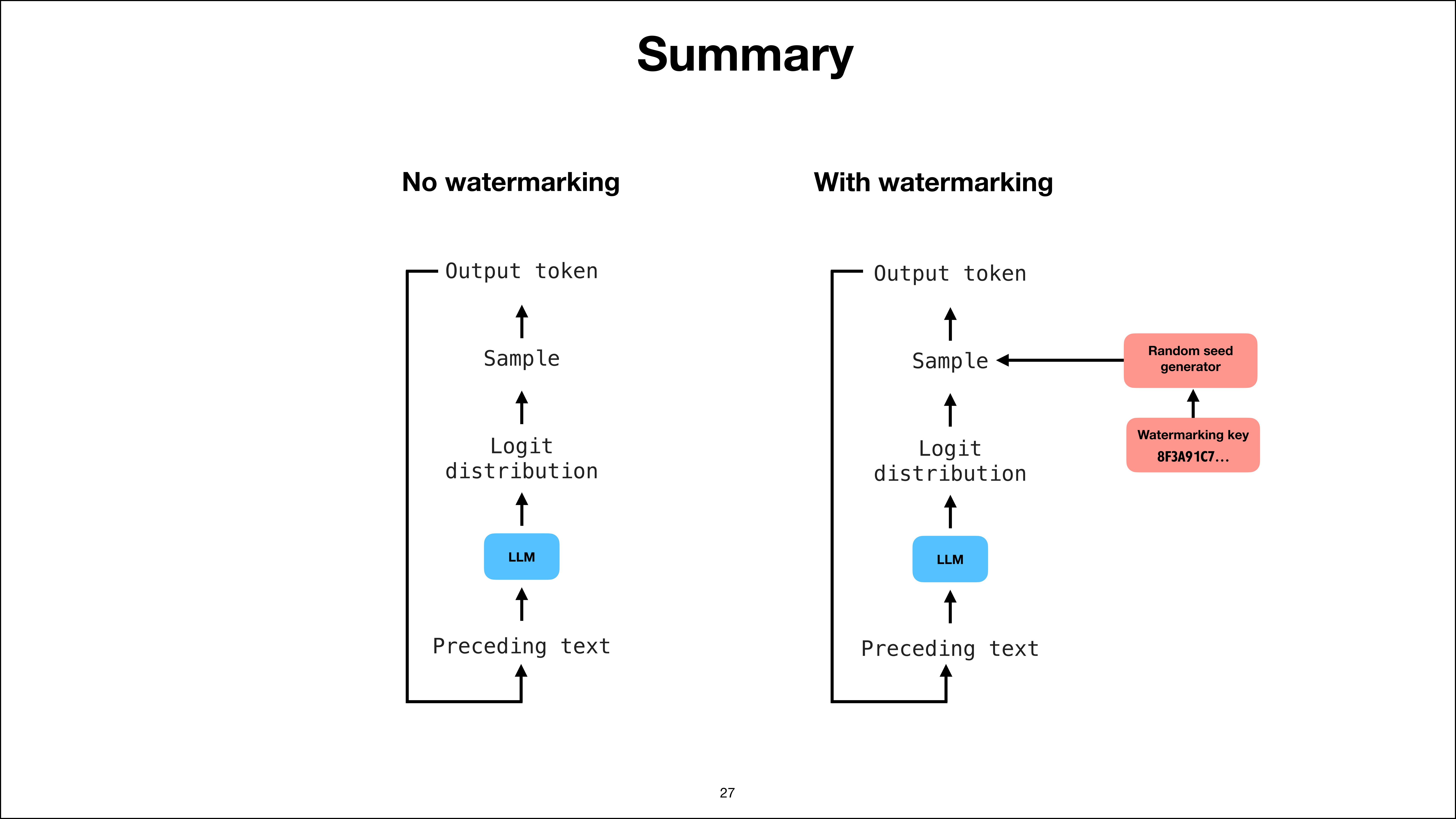
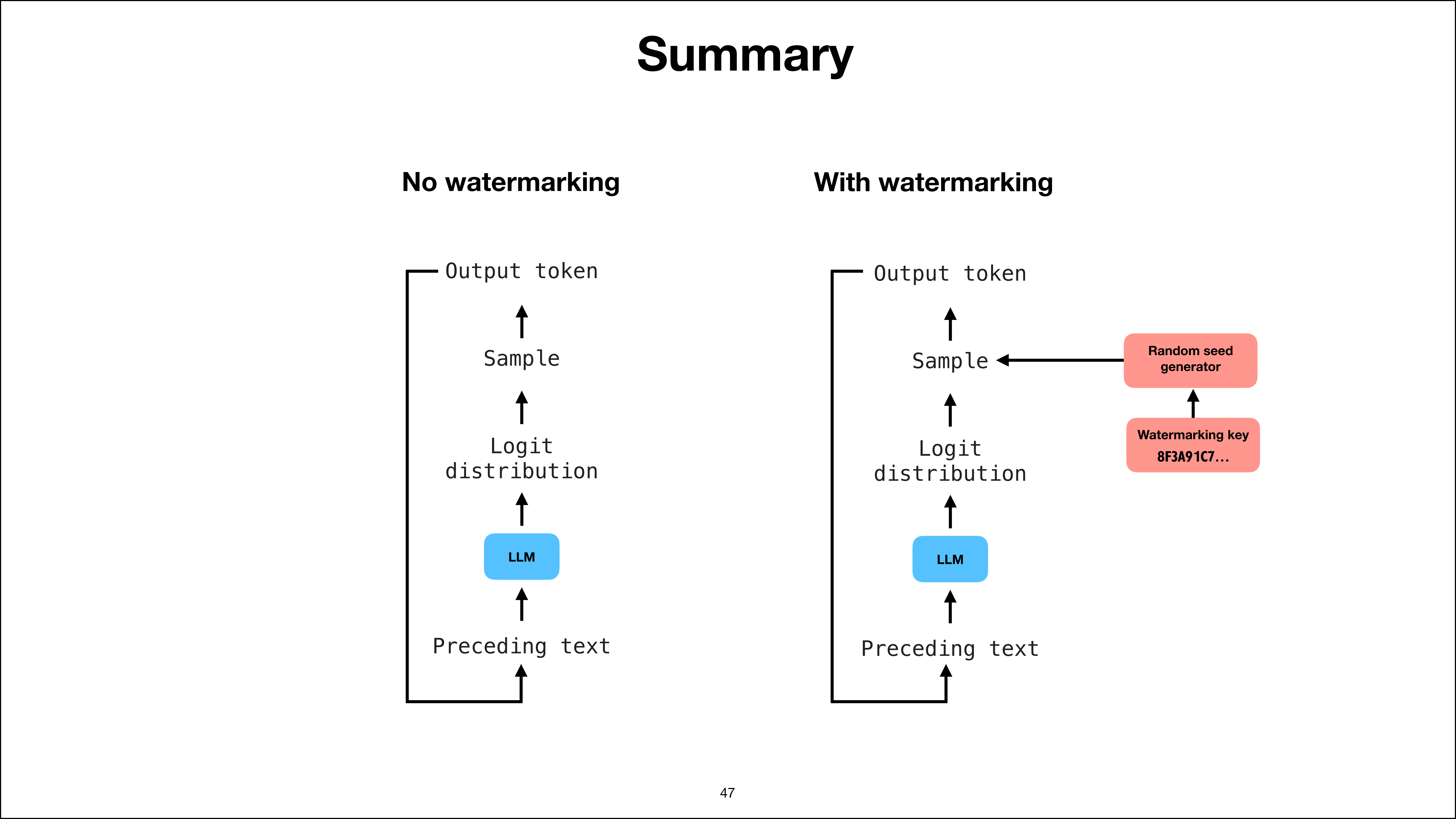
Okay, so the summary so far is without watermarking. We often sample without a random seed because I know most people don’t even use one. I honestly don’t think you can necessarily do it with the Claude and OpenAI APIs. I know you can do it in Ollama, but I also always had some problems with that because I used Ollama in one of my books for the bonus material to generate some texts.
I was fixing the random seed, but it still wasn’t always deterministic, and so forth. So it’s tricky. Your mileage may also vary, depending on the software version and so forth. Anyways, so without watermarking, we have this random sampling. With watermarking on the right-hand side, we still have the random sampling. But in addition to just a random sampling being fully random, we have this watermarking key.
And this watermarking key is passed to the random seed generator to set a specific random seed, making this deterministic. But it’s essentially very similar, and like I mentioned, there’s a lot of benefit in terms of understanding things from scratch. And now we know essentially where this watermark is applied to. So this is essentially applied to the sampling. It’s not applied inside the LLM, which is actually cool knowledge.
So they don’t need to train a new LLM for that. They can just use an existing LLM, and they just apply it at this sampling stage. They don’t have to retrain anything or anything like that. So yeah, that is actually interesting, right?
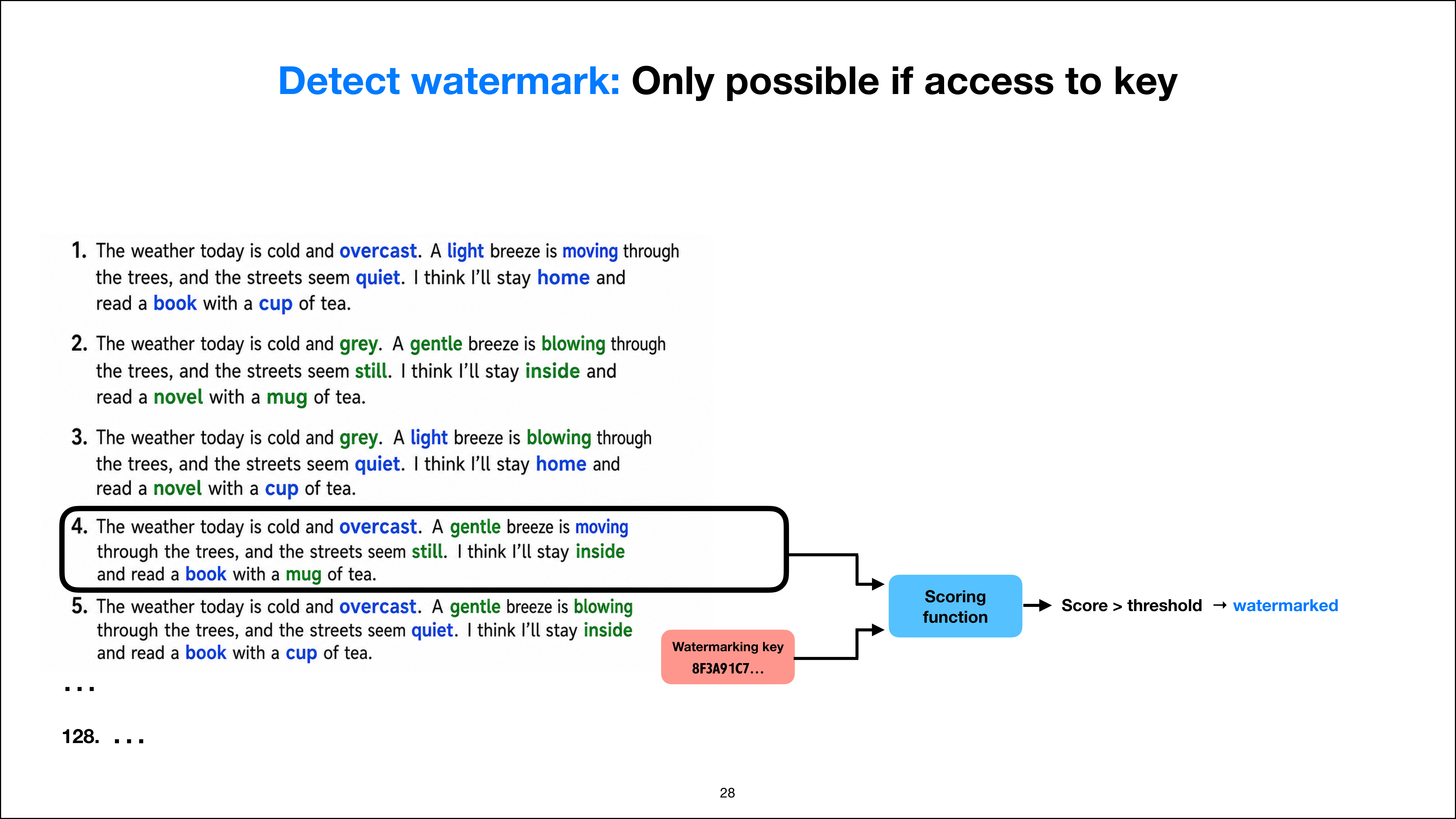
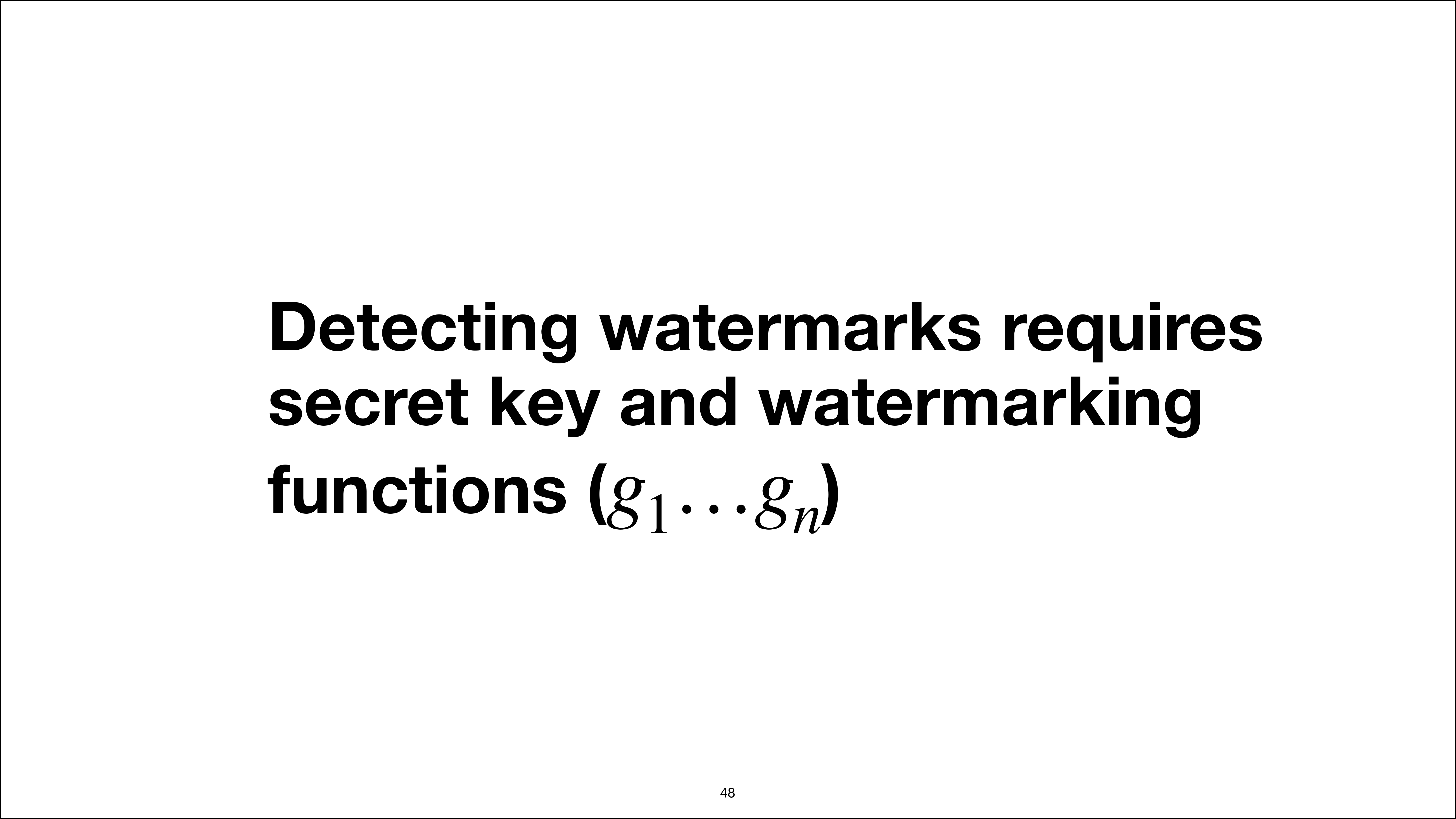
But we are not quite done yet. I would also like to talk about how we can understand or see whether text is watermarked. So detecting the watermark is only possible if we have access to the key. So, for example, if we have these different texts, and essentially, after the text was generated, you find some random text on the internet (for example, you find this text number four here on the internet somewhere), you want to know: is this watermarked?
Well, it’s impossible to know because, in order to know, you would need the watermarking key. You need this scoring function, and then you have to score basically the text with a scoring function. And then the idea is that if the score is above a certain threshold, then the text is watermarked. Otherwise, it’s not watermarked. But as the end user, we can’t do this because we don’t have this key. So the key is not available to us.
Only Anthropic will have the key. However, in this blog post, they mentioned that they are providing it, of course, or they’re going to develop an API for that that they will make available. I don’t know. Honestly, I’m not affiliated. I don’t know the details. I was just reading this in this blog post. That’s all I know. So that API might as well be private for some companies, like, let’s say, X or Substack Notes, when they want to label AI-generated posts.
They may make it public for end users to use. Who knows? We will have to wait on that. But yeah, so the bottom line here is that watermark detection is only possible if we have this watermarking key or, of course, the API that they are going to develop.
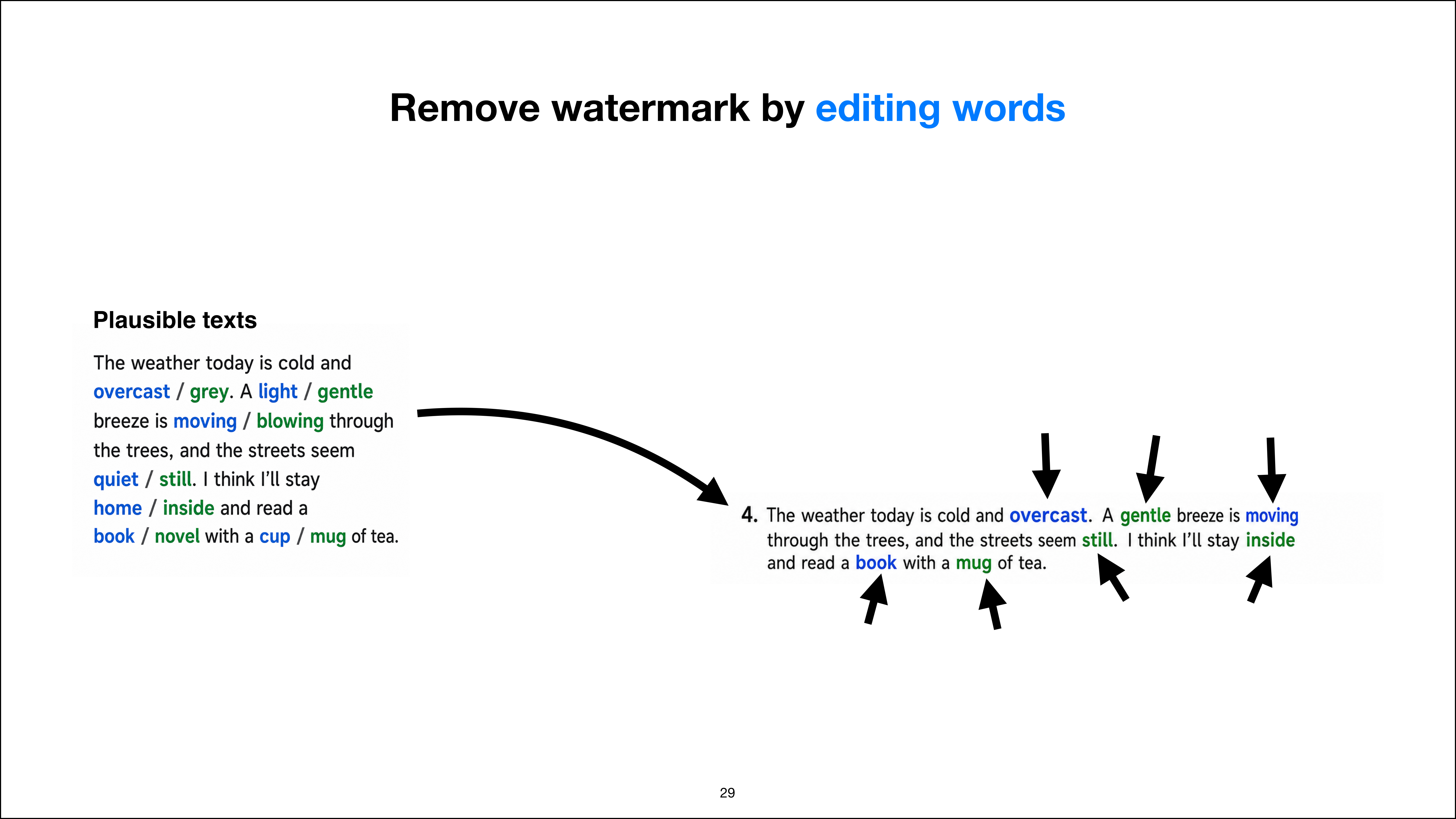
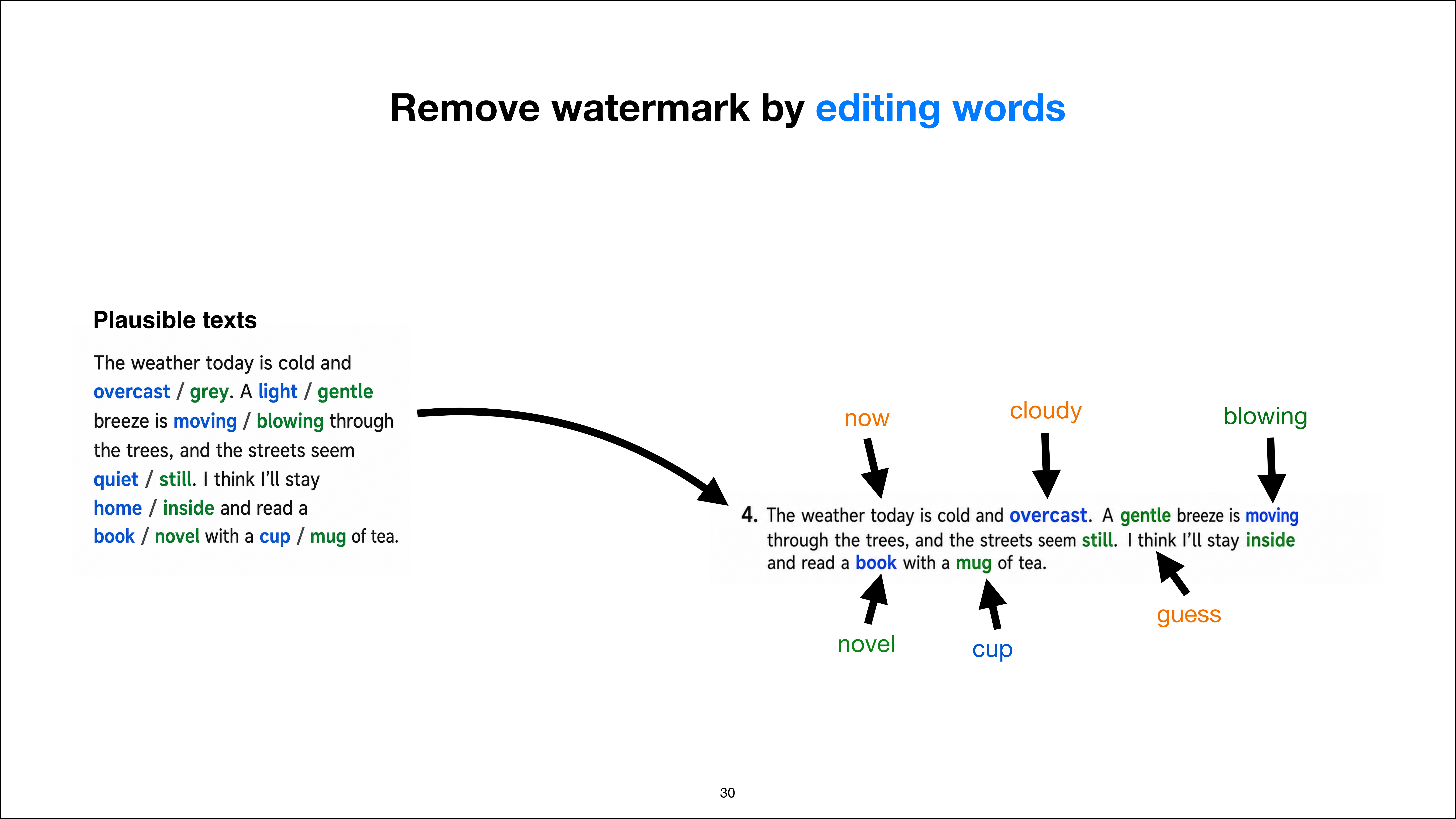
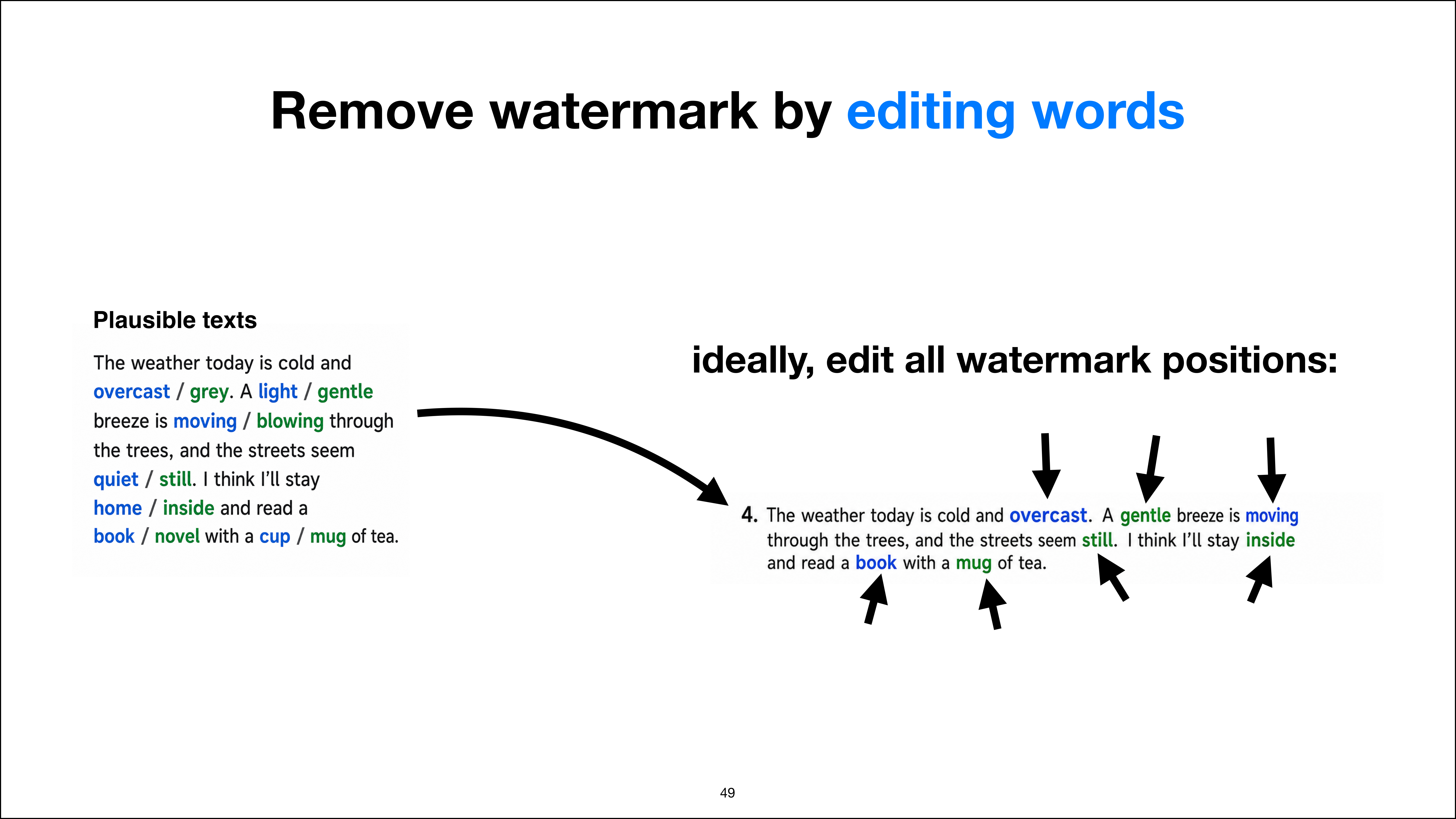
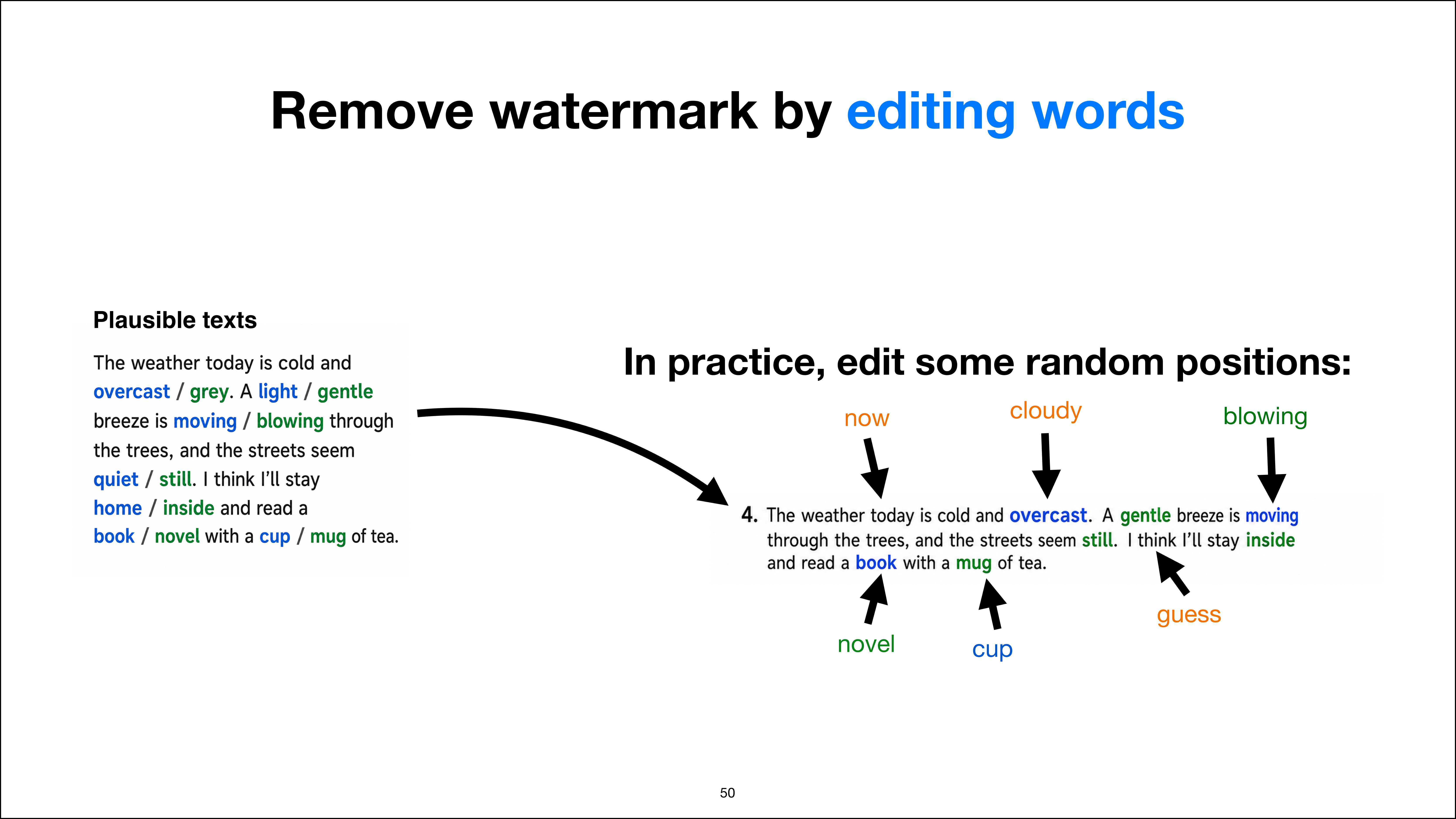
Now, removing the watermark is interesting. So now that we know how the watermarking works, we also know the shortcomings. I mean, this is really highly dependent on specific tokens in certain positions. So, for example, in this given text, if these colored words or tokens are the watermarking positions, we know that we could remove the watermark by editing this, right? If we change all the words at these positions, we would be 100% able to defeat this watermark.
Now, the problem, though, is that we don’t know, right?
So we don’t know where these words are because we haven’t generated the watermark. So we don’t know which positions to look at. So the practical scenario here is that we could just randomly edit the text. So we would randomly change a few words and hope that we change enough positions to edit the watermark. So that would be one way to remove it. And since we also don’t know which are the highest-scoring ones, because that would require us to have access to the LLM and rerun the prompt through the LLM to find out which words are the highest-scoring, we can kind of only guess.
So for example, we might say, oh, we replace “overcast” with “cloudy” because we don’t know that “gray” was high-scoring, you know? So in this case, it might be intuitive to say “gray”, but there might be cases where it’s not so intuitive. So what I’m trying to illustrate here is just some general text editing where we are modifying positions, but we are still kind of guessing what a watermark position is.
So since we don’t know, we added just a few words here and there. And if we added enough words, that would also defeat the watermark.
So yeah, that was the watermarking in a nutshell. I mentioned that there is a scoring function to find out whether something is watermarked. And I want to do it as a bonus here. It’s already a long video, but as a bonus here, I wanted to briefly also explain how this scoring function works because that is also interesting information. It’s a bit complicated. It’s not essential to understand how the scoring function works.
But the reason why they do it the certain way they do is to make the detection cheaper. Because otherwise, if I go back one slide or two slides, if you wanted to check if something is watermarked, if even they wanted to check, they would have to rerun the prompt to get these scores and then apply this watermarking random seed to get this text and then compare. And that would be very expensive because then essentially every text you want to compare, you would have to rerun the LLM.
You have to know which LLM, and that would be really unfeasible because you often also don’t even know the prompt, right? So yeah, so they have like a trick that they use to, yeah, I would say, modify the sampling so that you don’t use or don’t need the LLM later on for the scoring stage. And in the blog post, they mentioned that they derived this method from a paper.
It was a Nature paper, and this method is called SynthID-Text. So that was like a paper that came out maybe one or two years ago. It was by Google, and they use a similar technique they call Claude watermarking. I don’t know, sorry, I don’t know if they use exactly that technique, but that’s the one they mentioned.
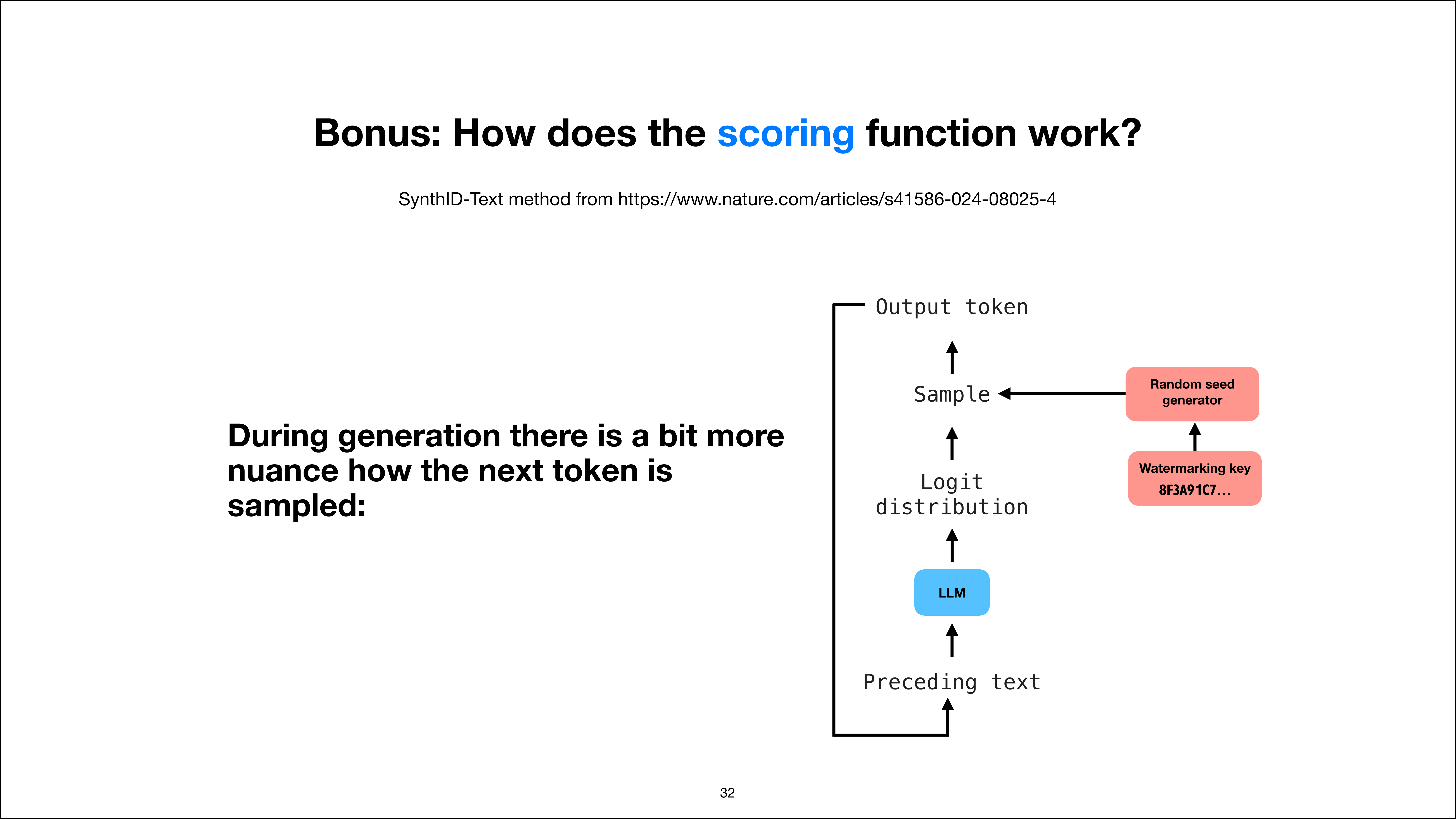
So how does it work? So before we looked at the slides, we looked at the regular, let’s say, overview here, where we have some text. We put it through the LLM. We get this logit distribution and then we sample from the distribution and get the output token. And here, during the sampling, we use the watermarking key and the random seed generator. So this is still correct. This is still what’s going on, but there is a bit more, I guess, nuance to how this token is sampled.
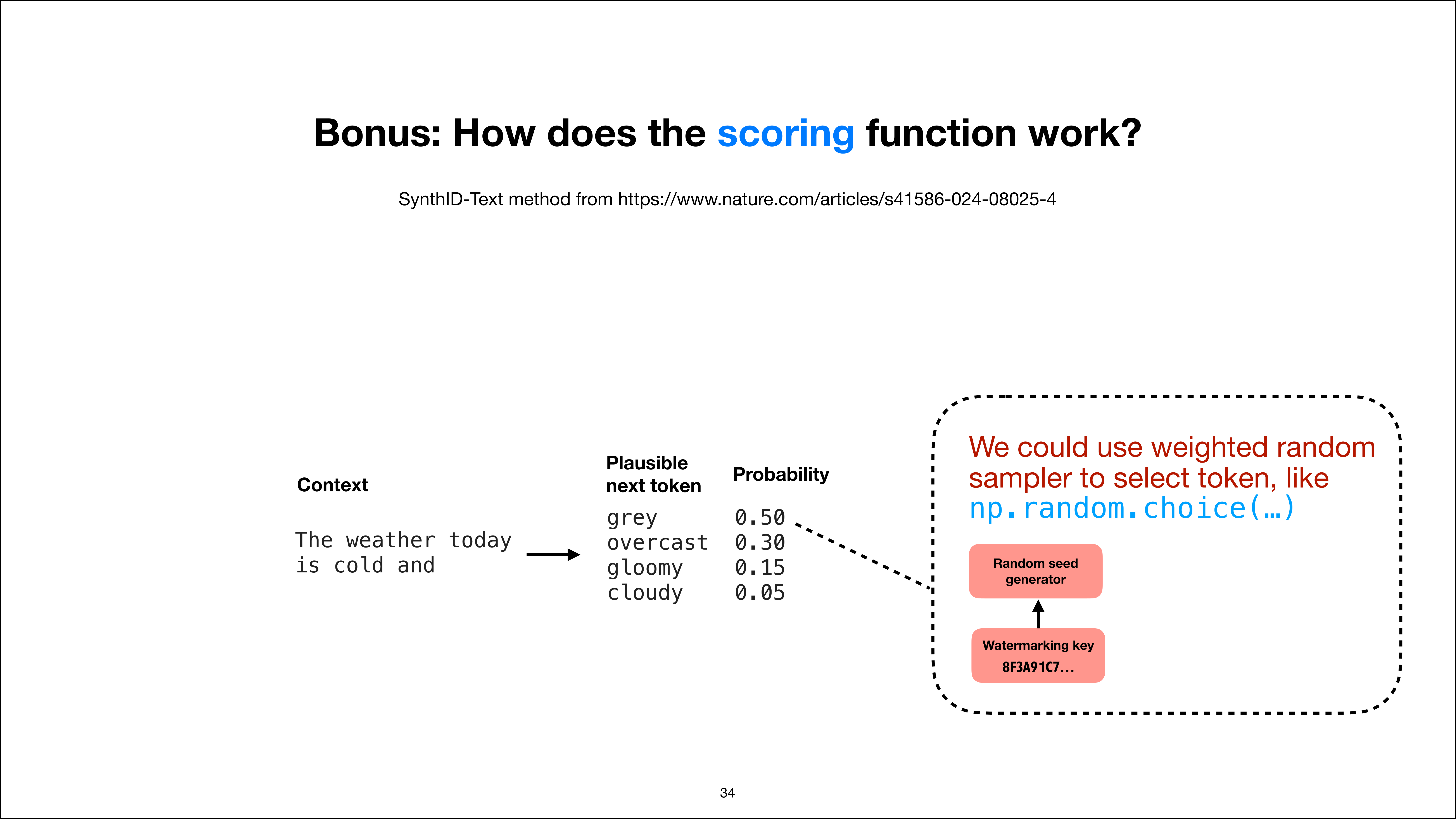
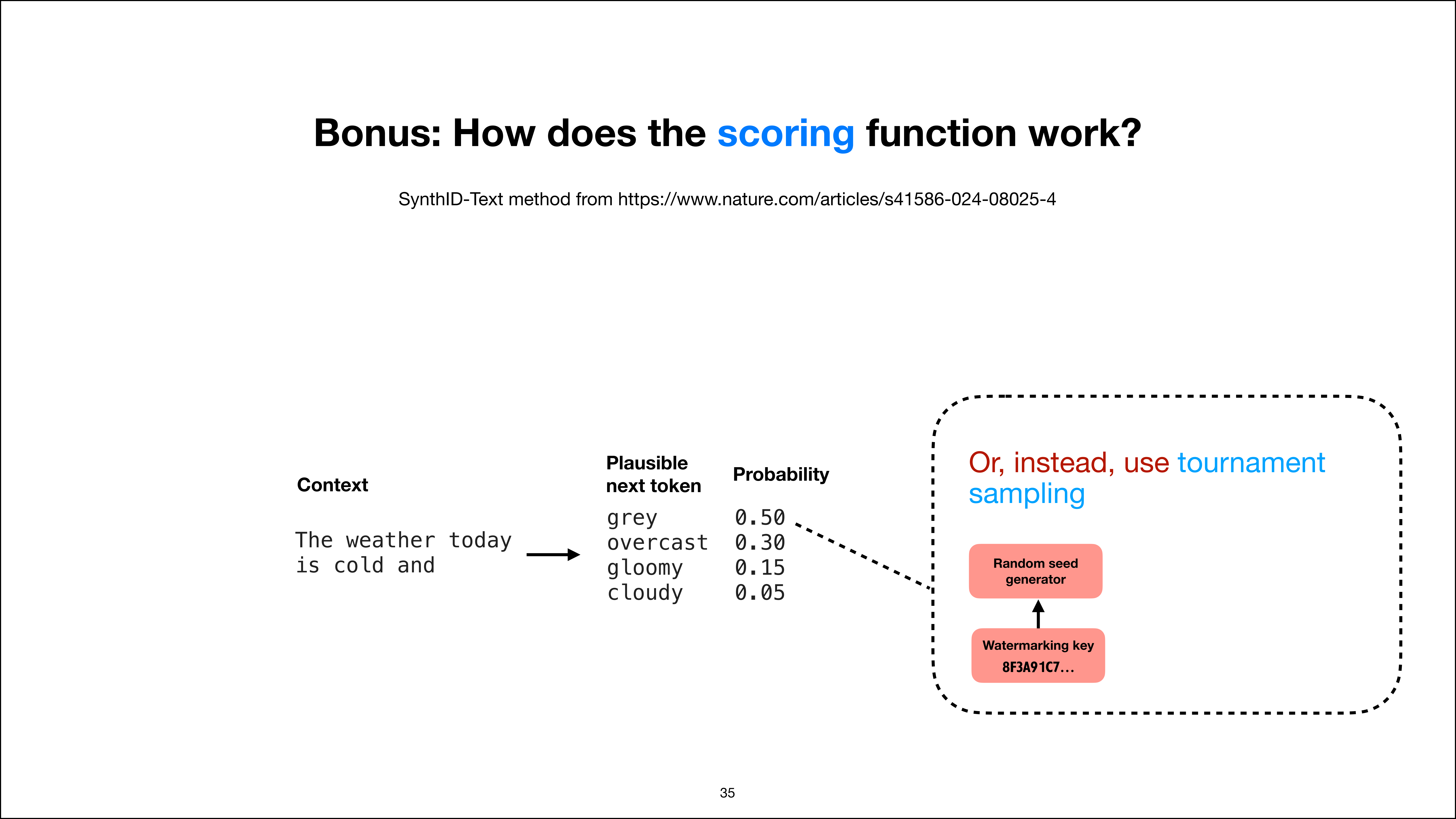
So they’re not just using, let’s say, NumPy’s random choice. They’re using something a bit more sophisticated here.
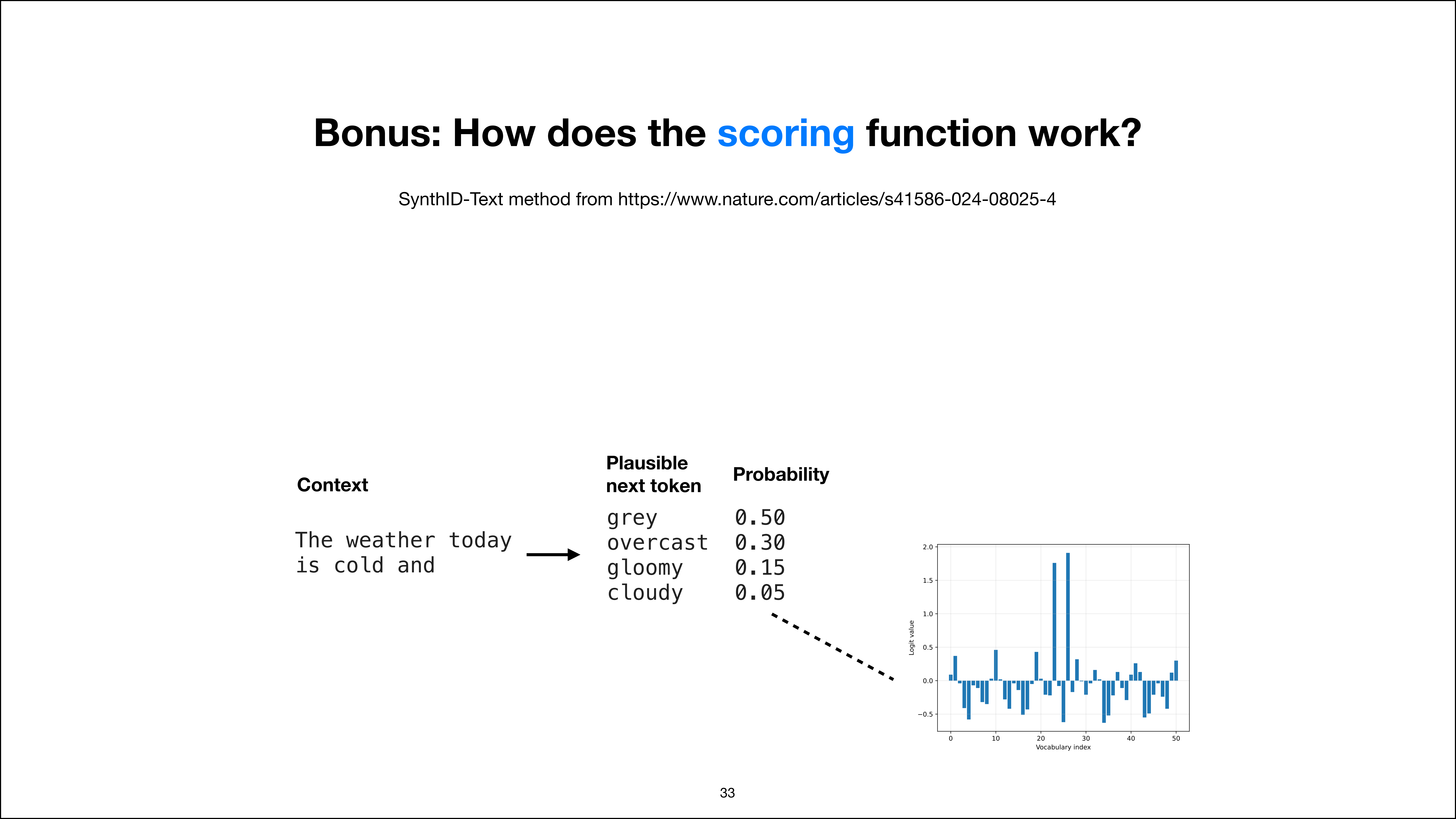
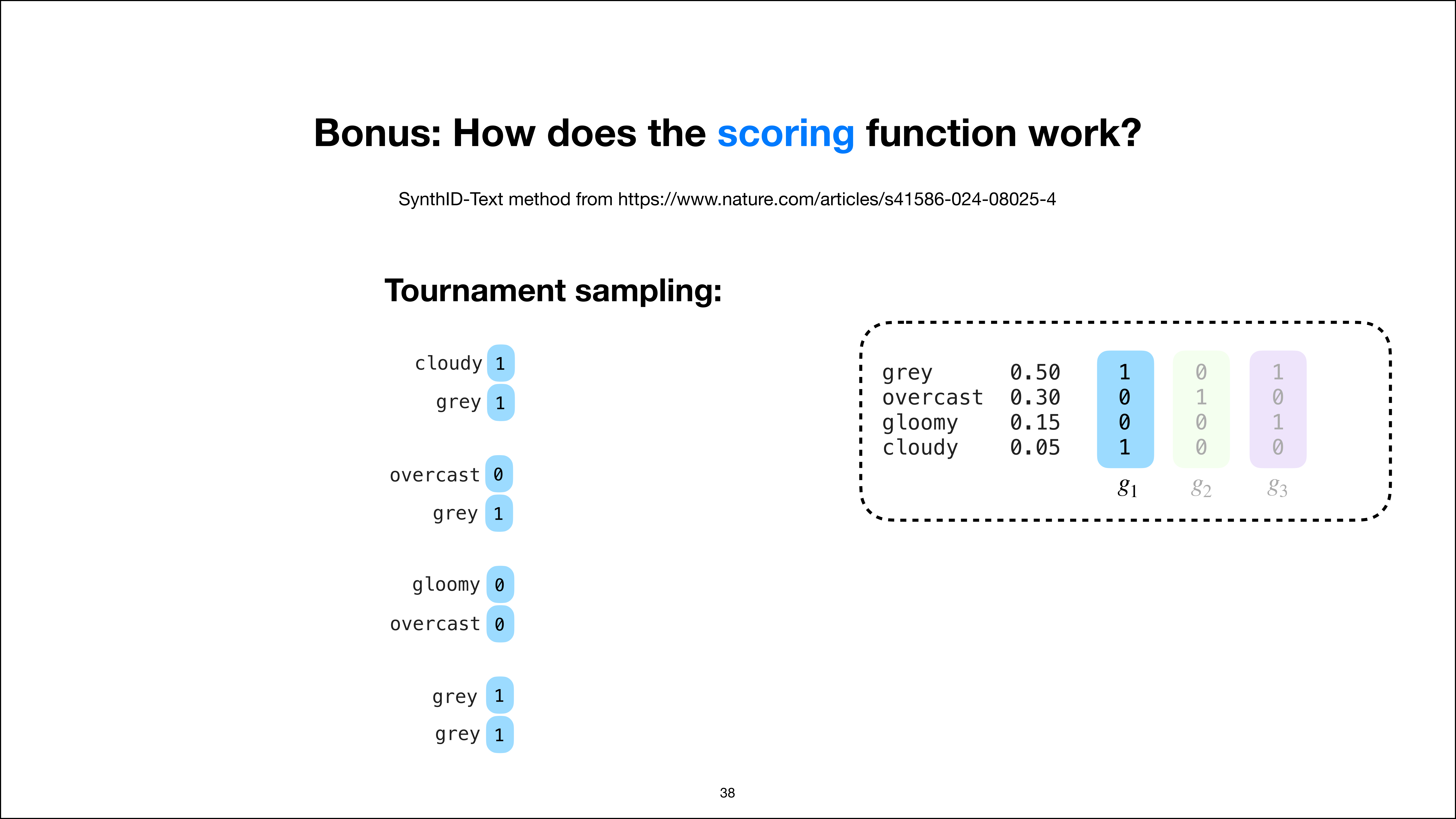
So assume, again, our context is “the weather today is cold,” and we want to generate the next token. So, for example: “gray”, “overcast”, “gloomy”, “cloudy”. “Gray” is 50% probability, “overcast” is 30, “gloomy” is 15. Let’s say “cloudy” is 0.05 and the rest is, let’s say, 0. Here it looks, of course, a bit different. Let’s say that’s “gray” and “overcast”. I’m just reusing this figure. But now imagine these are the most likely ones, like “gray” and “overcast”, and everything else is just very small, except “gloomy” and “cloudy,” maybe.
So essentially, think about just a very small vocabulary for this example of four words instead of all these 50 words here, just to make it even simpler. Now, as I mentioned before, we could use ‘sNumPy’s random choice with these probabilities to sample the next token.
And we could use the watermarking key with this random seed generator to make it deterministic and get the certain watermark that we want. But as I mentioned before, this would be very expensive. Not the sampling itself. That doesn’t matter. This is pretty cheap. But the detection later on would be very expensive if we are trying to check random text on the internet.
So instead, what they use, they also use it during the sampling, during the generation, so that it can be reused later during detection. What they use is called tournament sampling. So this is instead of using something like random choice, they use a concept called tournament sampling. And so how does that work? It might look a bit complicated, but it looks really more complicated than it really is, to be honest.
So you might have to, I guess, stop the video at some point and just sit with the figure a bit. But I think it is actually simpler than it looks like. It’s like once you get the hang of it, it’s pretty straightforward. But let me try to explain here. So what we have is we have still this context, and then we have these probable or plausible next tokens with these different probabilities.
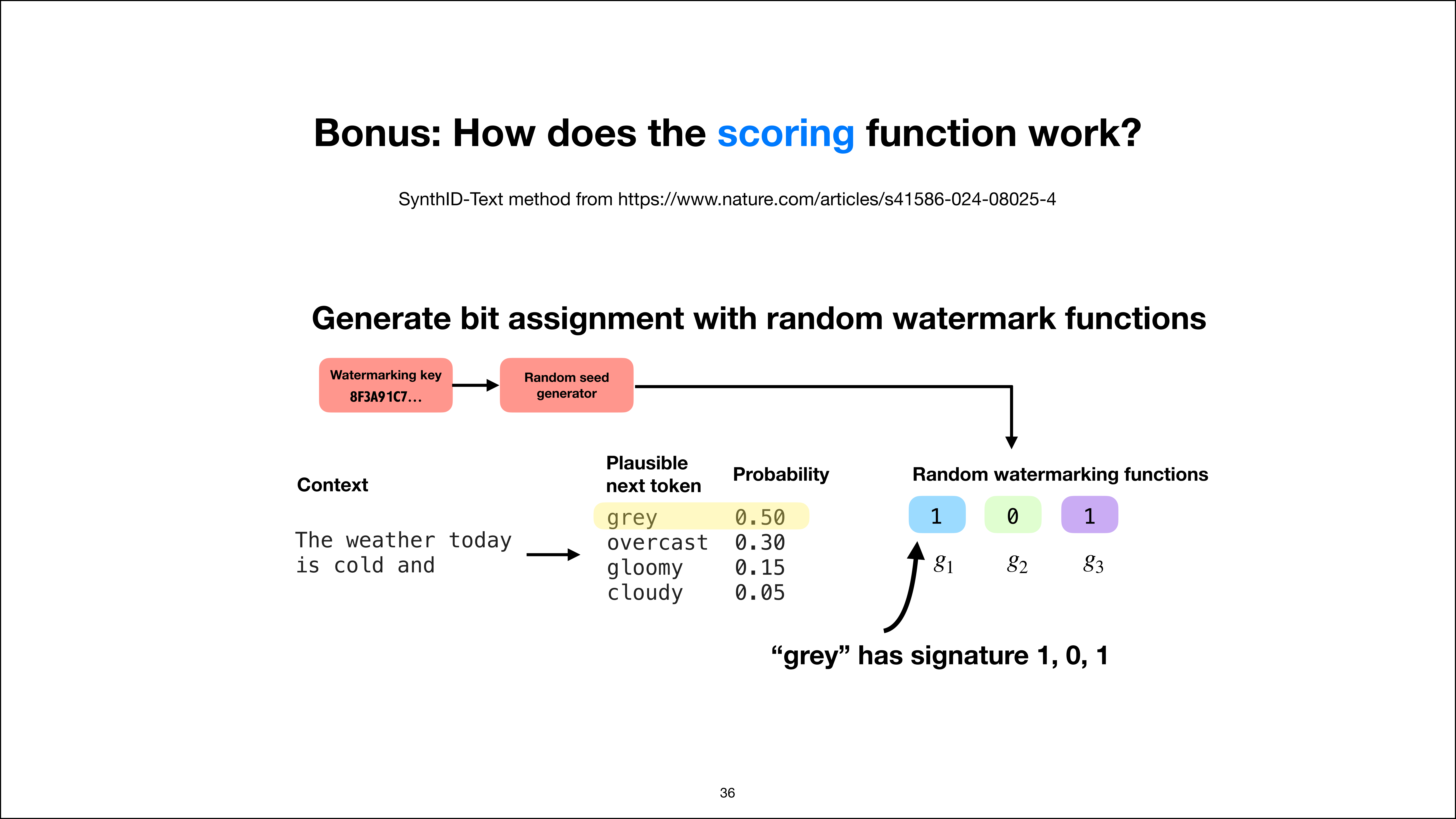
Now they have something they call random watermarking functions.
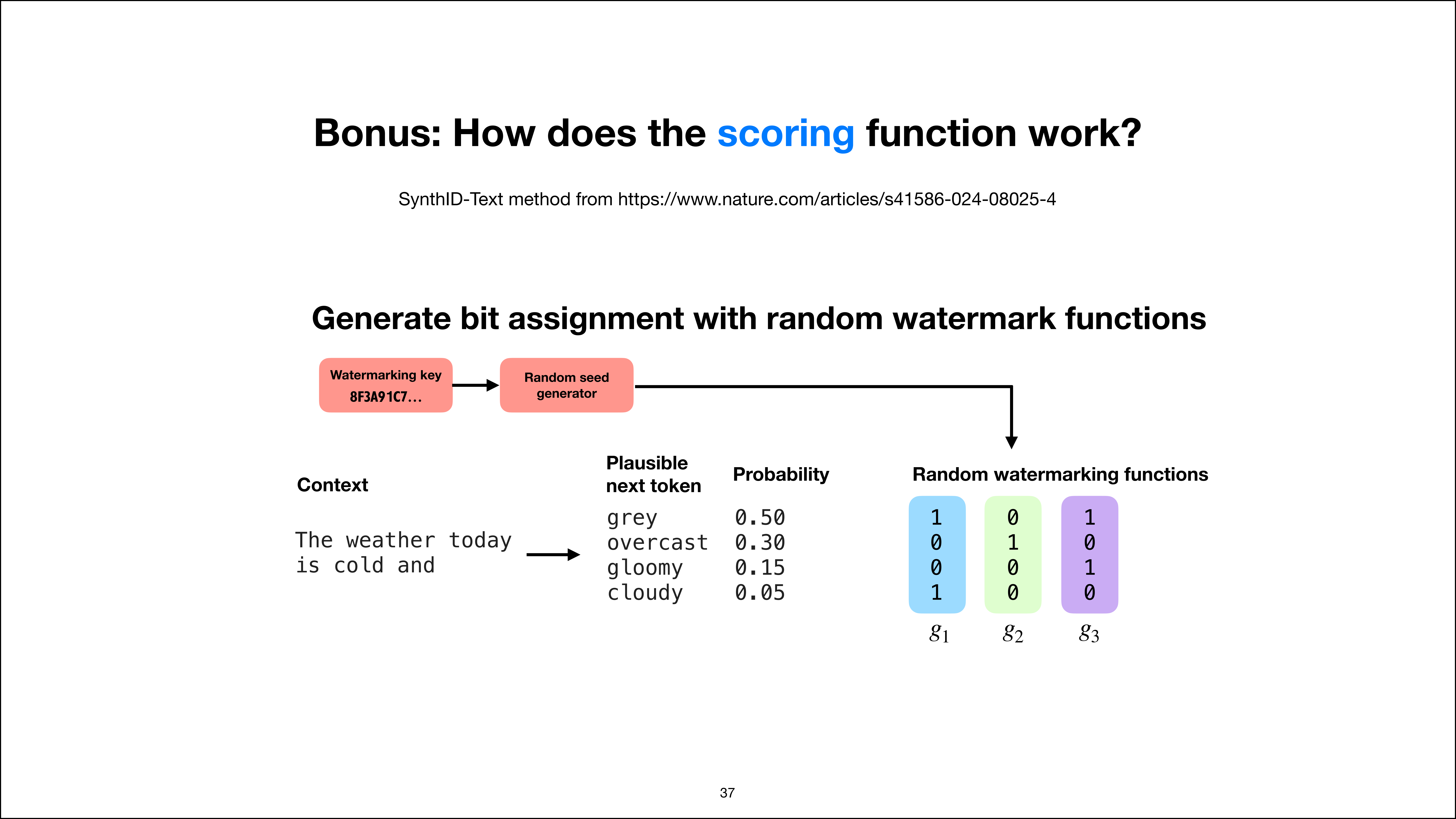
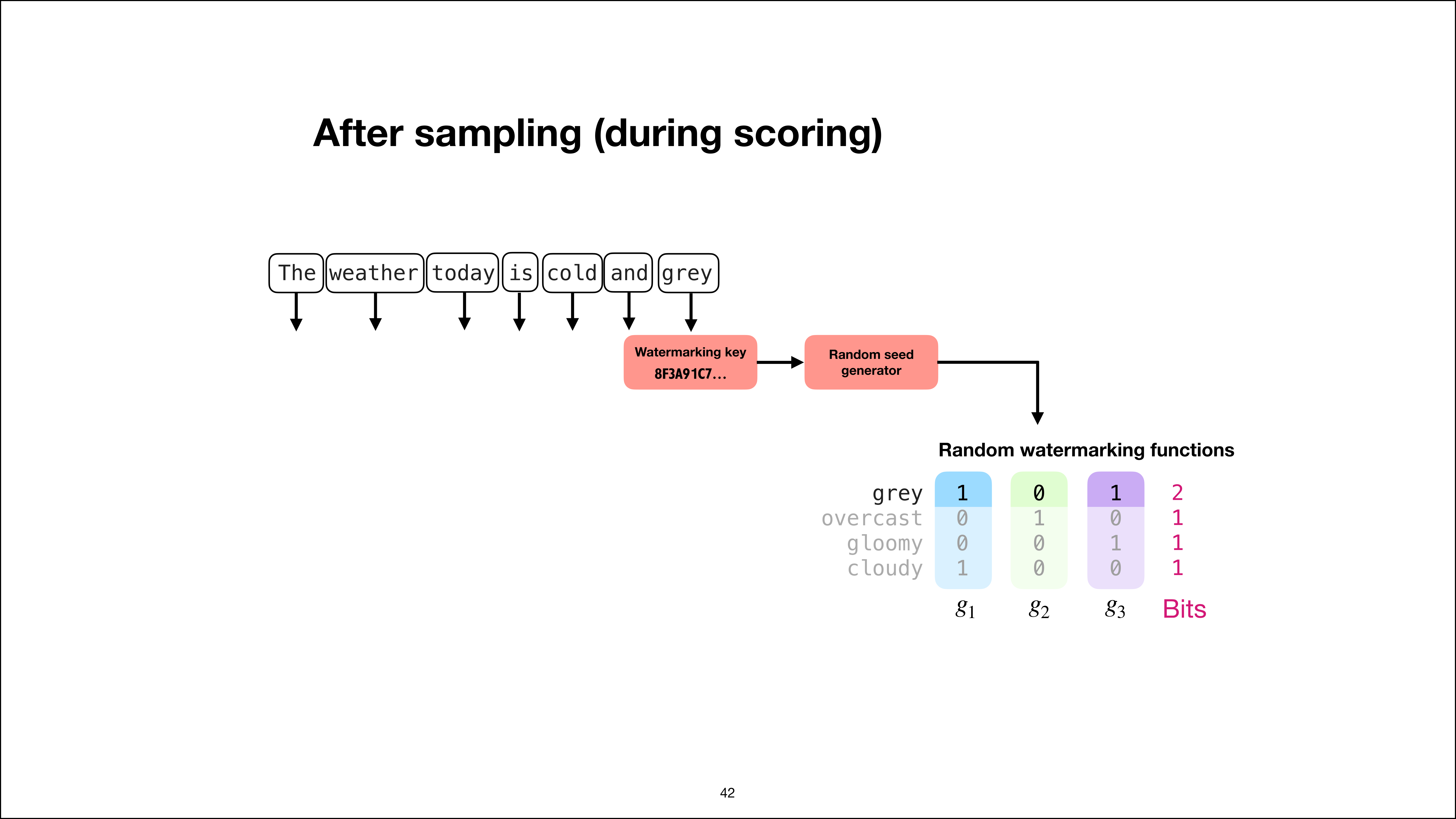
Here we have three watermarking functions, G1, G2, and G3. In reality, they might have 30, 50, or even more. Here I’m just using three because that is simpler on this slide. It’s just smaller, you know, like it fits better on the slide. Now, if we look at this word “gray”, this might give us a signature 101. With that, I mean, if we use this watermarking key to generate this random seed, and we have three functions, G1, G2, G3.
If I put the word “gray”, what I’m skipping here is that usually you put the word “gray” together with the four or three previous words from the context. So it’s “cold” and “gray”. If I put that into G1 together with this watermarking key, I get the value one. Why? Well, that’s just how this function works. It’s like a random function. The random function either returns zero or one. In this case, with this random key and this token, it returns one.
With the same key, but a different function, you get the value zero. And then here you get a one again. So if we have more functions (of course, 30 functions), this will be a very long string of ones and zeros.
It’s basically like a bit string, like if you have bits of zeros and ones. Okay. So this is for “gray”. So we get the signature 101 through using these watermarking functions. Now we can do the same thing for all the other ones. So we can do it for “gray”. We can do it for “overcast”, “gloomy”, and “cloudy”. So each one has a different signature here. So, for example, “overcast” is zero, one, zero.
“Gloomy” has zero, zero, one. “Cloudy” has one, zero, zero. Okay. So we have these bits here now. The next step is a so-called tournament sampling where we just pair them.
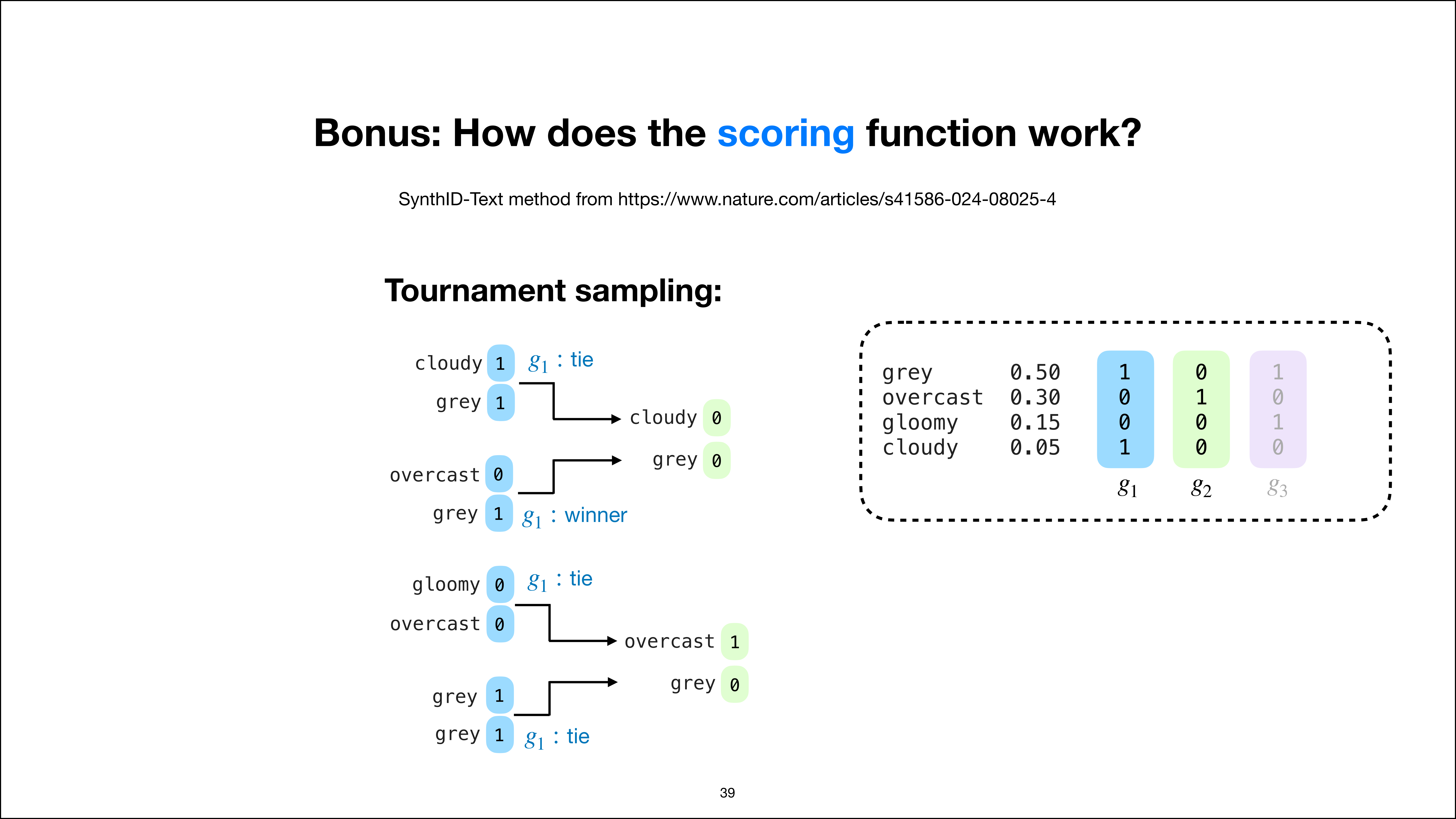
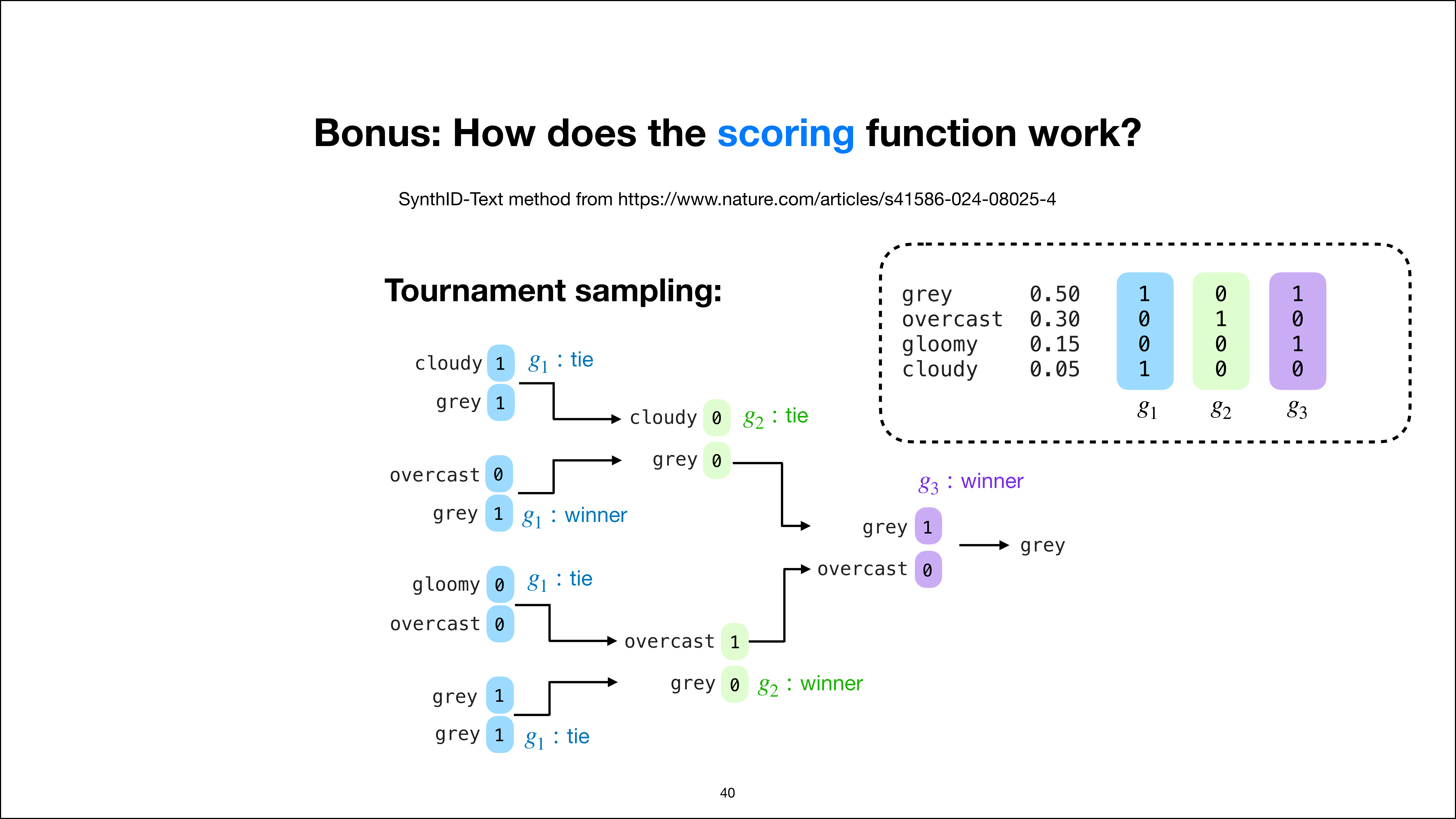
Like, you know, like a soccer tournament, the knockout (KO) stages, or like the playoffs in American football, you always have two teams playing against each other. And that’s kind of like the same idea. We have a pair of tokens, and they’re playing against each other, essentially. And the scores, they come from these functions here. So we start with the first function in the first round. So we have “cloudy” and “gray”.
So we look up here: “gray” is a one and “cloudy” is a one. Okay. So one and one. “Overcast” and “gray”. So “overcast” is zero, “gray” is one. So we have zero, one. “Gloomy” and “overcast”. So here we have “gloomy” zero, “overcast” zero. So zero, zero. And then we have “gray” and “gray” again, because we are running out. So we don’t have enough of the others. So we have one duplicate.
So this is chosen randomly. And so you have one and one here. Now we look at the results. So this is a tie. In the case of a tie, we also select randomly using, you know, the random seed and the watermarking key. So here, “cloudy” survives. And from this one, G1 is, according to G1, “gray” is the winner because it has the one. So “gray” survives. And then here, “overcast” and “ gray “ are a tie, randomly selected, and “gray” also randomly selected.
So we have now “cloudy” and “gray” and “overcast” and “gray”. And we play the next round in this tournament. So in this next round, we use G2. So according to G2, “cloudy” has a zero here. “Gray” also has zero. “Overcast” has one. And “gray” also has zero, sorry. And so, the next stage of the tournament again.
So we have a tie. We randomly select “gray”. And here we have “overcast” as the winner. And so we have “gray” versus “overcast” in the final. And then we look again at the scores. So “gray” has a one. “Overcast” is a zero. So “gray” is the winner. And that’s how the token “gray” is sampled. What is the watermarking key doing here? So the watermarking key, if I go back a few slides, is selected for generating these scores using these random watermarking functions.
So the watermarking key determines essentially what values we get at these stages. So the watermarking key is still very important. Otherwise, these signatures would look different.
So we now have sampled the next token. And that’s just how this modified sampling procedure works. We could have used NumPy’s `random.choice`. But the shortcoming of that is that if we want to score random text on the internet, we would have to rerun the LLM. With this technique, we don’t. I will show you in a moment. So this technique sounds like really weird and cumbersome, but it has the advantage that we can now score random text more easily without having to rerun the LLM.
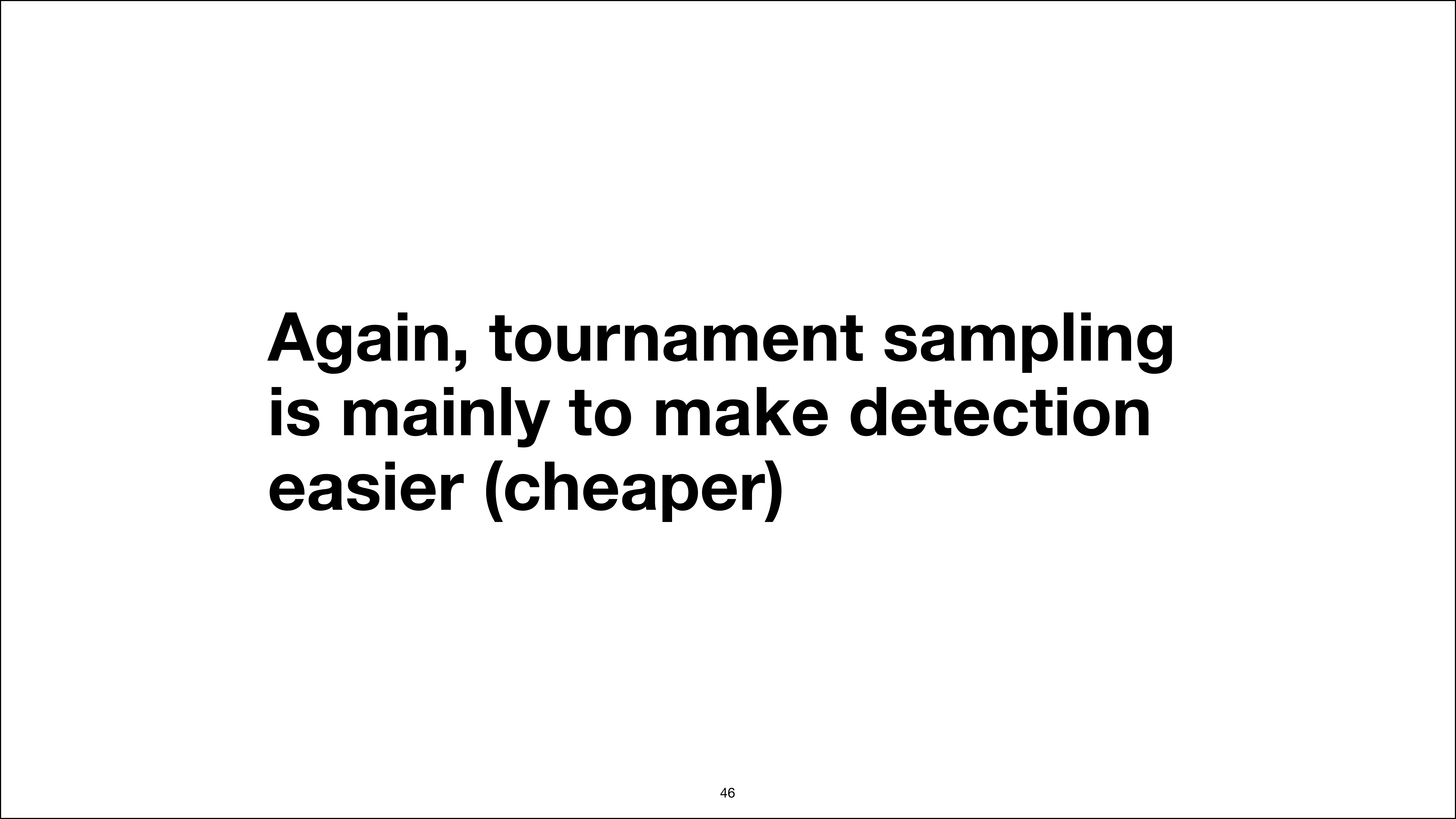
So it’s essentially just to make the detection easier and cheaper.
So, for example, if we have a new text. So I’m just using the same text here, but let’s assume it’s new text. So this is after the sampling, when we are scoring. And let’s say we are discovering this text on the internet. And the text is the weather today is cold and “gray”, and we want to know if this is LLM-generated or not. So we would, or Claude/Anthropic would, have the watermarking key and these functions: G1, G2, and G3.
And it would put this text through these functions. For the one position here for “gray”, we would get 101, similar to what we got during the generation process. So this is the same as before. And this has, if we add up these bits, two bits, right? One and one here. So it has two bits of information, let’s say, for simplicity. This is just a really simple illustration.
But let’s assume we get a score of two here for the “gray” in this position. If we had a different word here, “overcast,” in this position, we would get one if we get “gloomy,” like we also have one, and “cloudy” one. So I’m just summing over each row here, right? So that’s just like a score we would get at each position. And here I’m only looking at the last position.
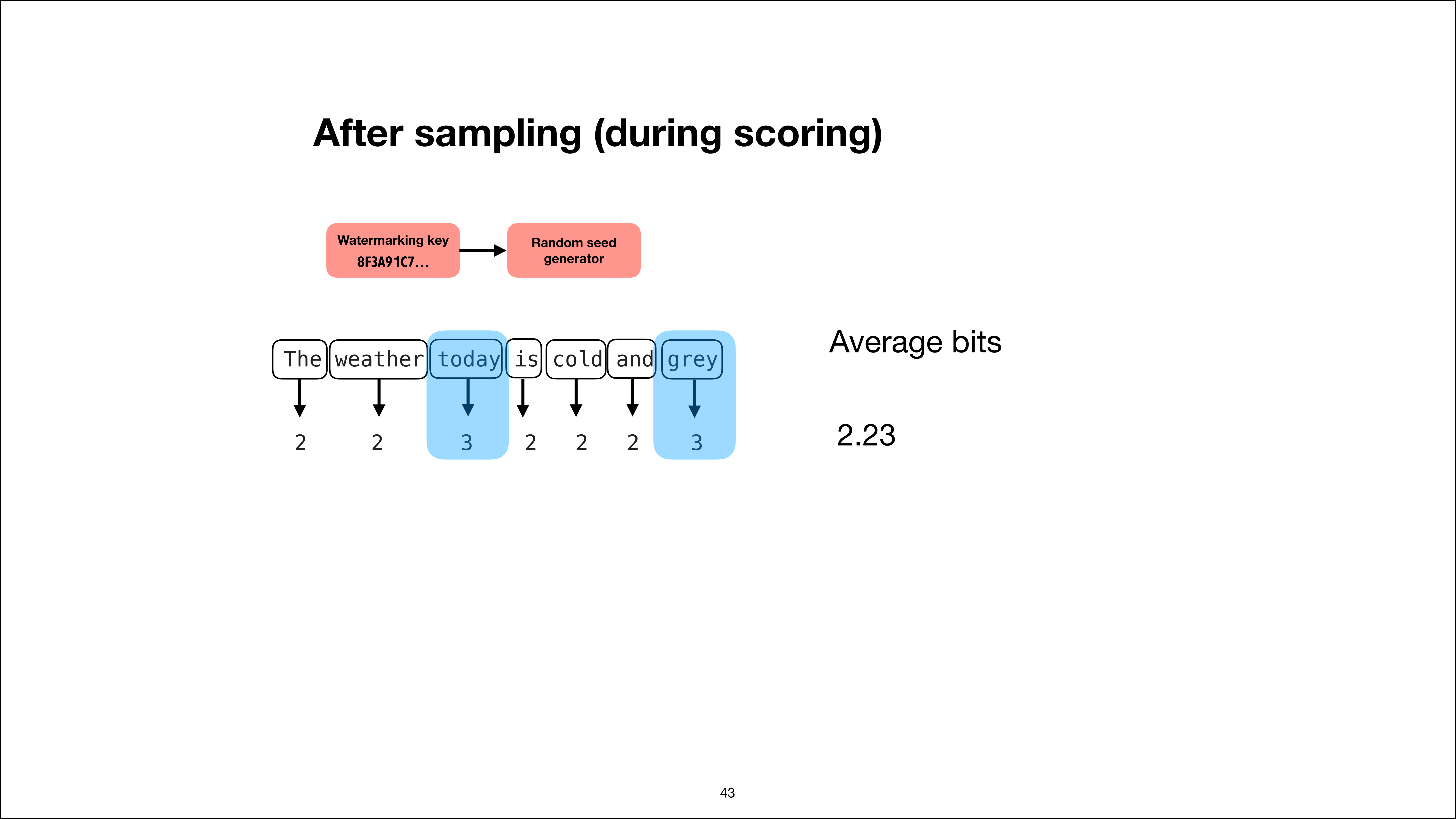
If I would do this at other positions, I would get a different score at different positions. So, for example, let’s assume at the first position I get a two. Here I get a two. For “today”, I get a three. For “is”, I get a two. “Cold”, two. And “gray”, three. So here I’m applying these watermarking functions as I’ve shown on the previous slide.
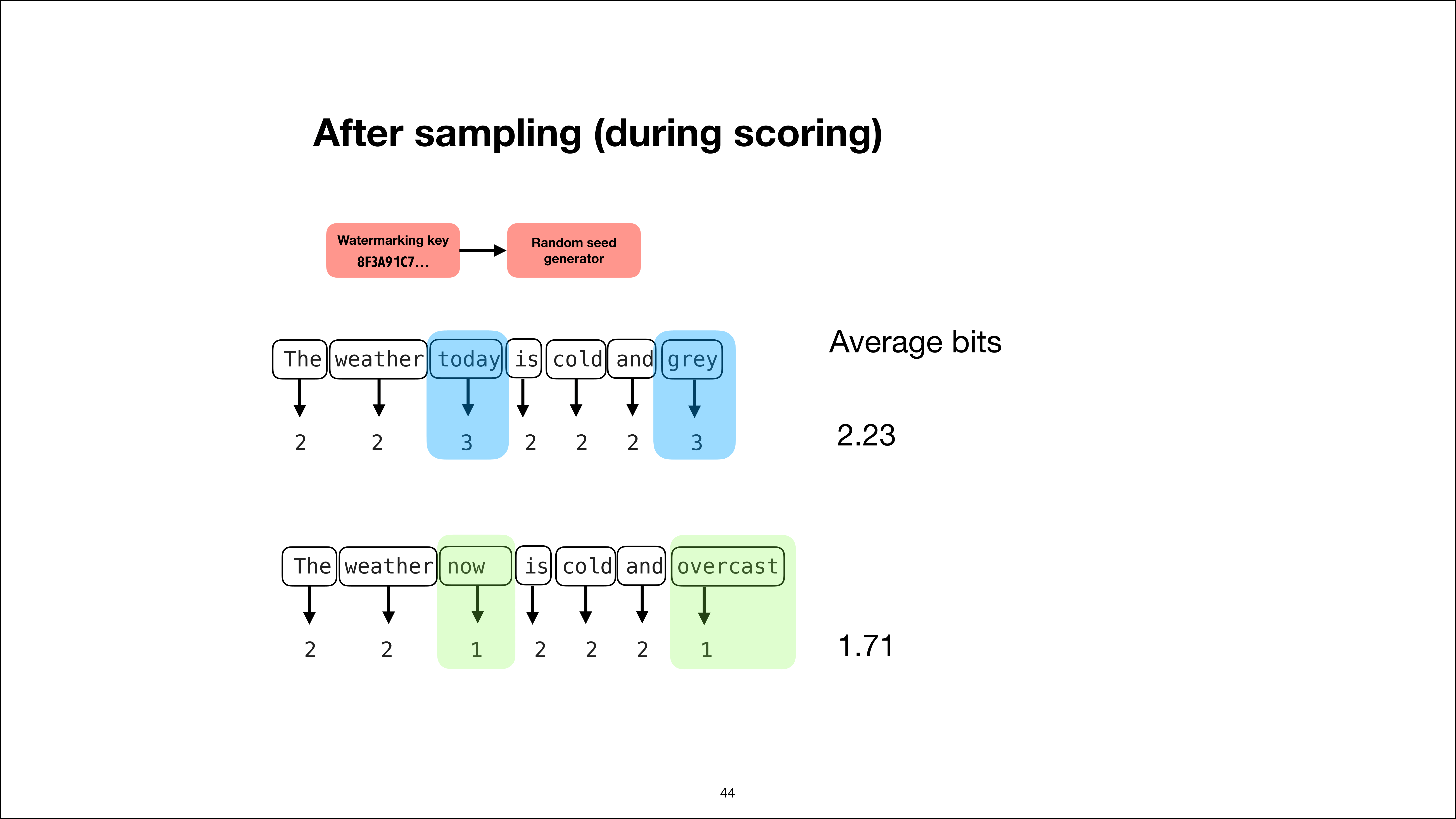
And I’m just adding up these numbers across the three functions. And the watermarking functions are very cheap. So you can just quickly run them on the whole text and get these scores. And then based on that, I can compute the average bits. So if I just average over all these values here, let’s say I get 2.23.
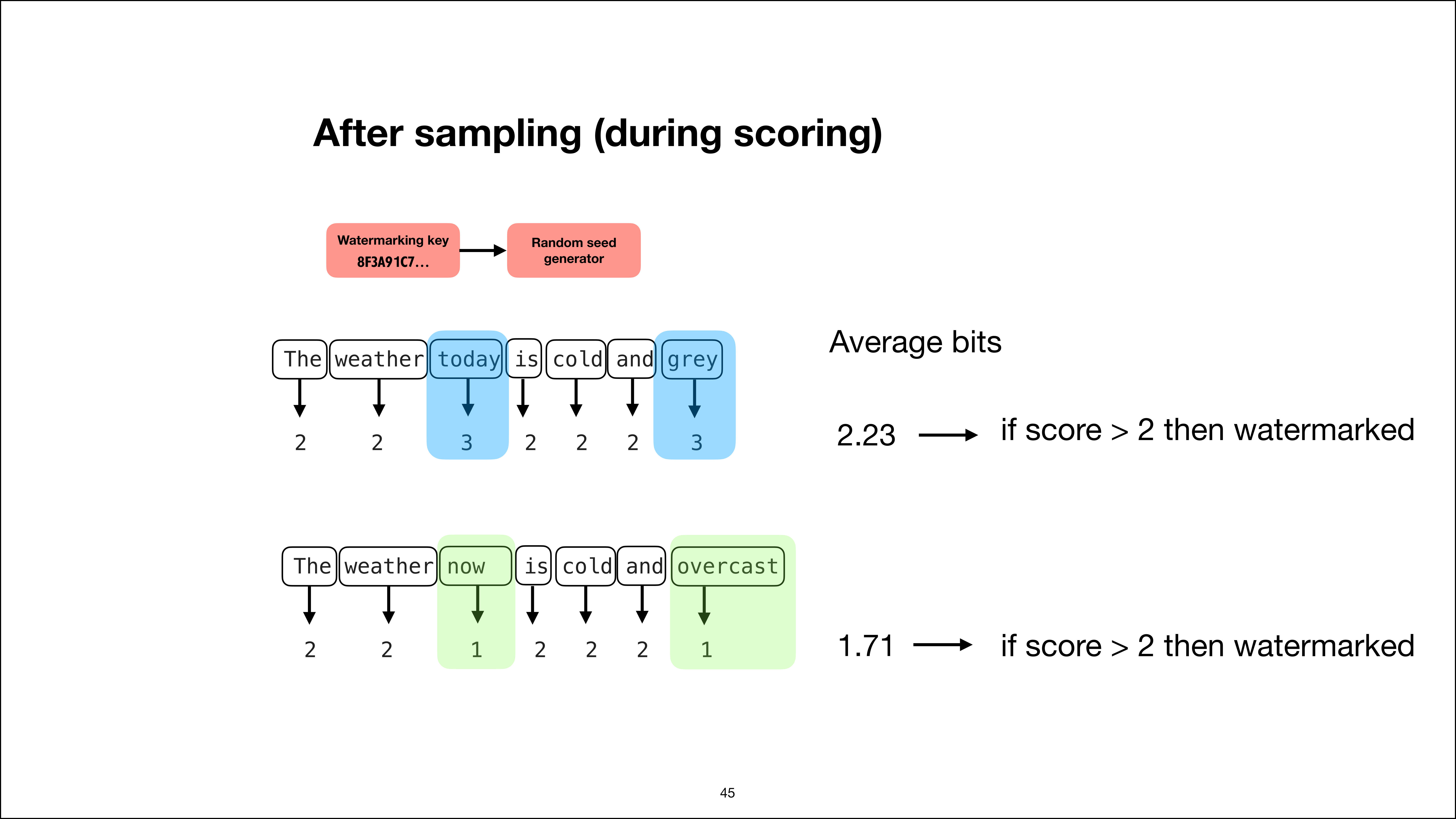
Now, if I have slightly different text, so here I swapped “today” with “now” and “gray” with “overcast”. These now get a score of one and one. And if I average over this whole string, then I get a 1.71. And so for that, I don’t need an LLM. All I need is the watermarking key, the random seed generator, and these functions, G1, G2, and G3. And that’s all I need.
I don’t need the LLM. And I can get this score here. And what they do is apply a threshold.
So, for example, I mean, they don’t use this exact threshold. But for example, we can say if the score is greater than two, then the text is watermarked. If the score is smaller than two, it’s not watermarked. So here, if the score is greater than two, it’s a yes. So yes, this is watermarked. In this case, 1.71 is not greater than two. So this text is not watermarked. Okay. So that’s just the way we can then detect whether random text on the internet is watermarked or not.
It’s essentially just applying these watermarking functions and then averaging over the scores and applying a threshold. Okay.
So again, the tournament sampling is mainly to make detection easier and cheaper. We could also use something like NumPy’s random choice with a random seed or to make the sampling deterministic. But then again, it would be hard to score any text on the internet.
So yeah, the summary is still the same, though. The thing that is different between no watermarking and watermarking is that we are controlling this sampling here with the watermarking key. And inside that, we have this tournament sampling. And yeah, as I mentioned before, detecting the watermarks requires the secret key and the watermarking functions G1 to Gn.
And again, removing the watermark, because I think that’s maybe interesting to some people, would ideally involve editing all the positions here. But since we don’t know which positions are watermarked and internally, they choose the positions so that they have equally likely tokens at those positions. And there might be positions where that’s not true. So here, for example, for “trees”, we might not even have an alternative word that is high scoring so they don’t watermark that position.
So they only do the watermarking at certain positions essentially. Since we don’t know which positions to kind of defeat or remove the watermark, we would...
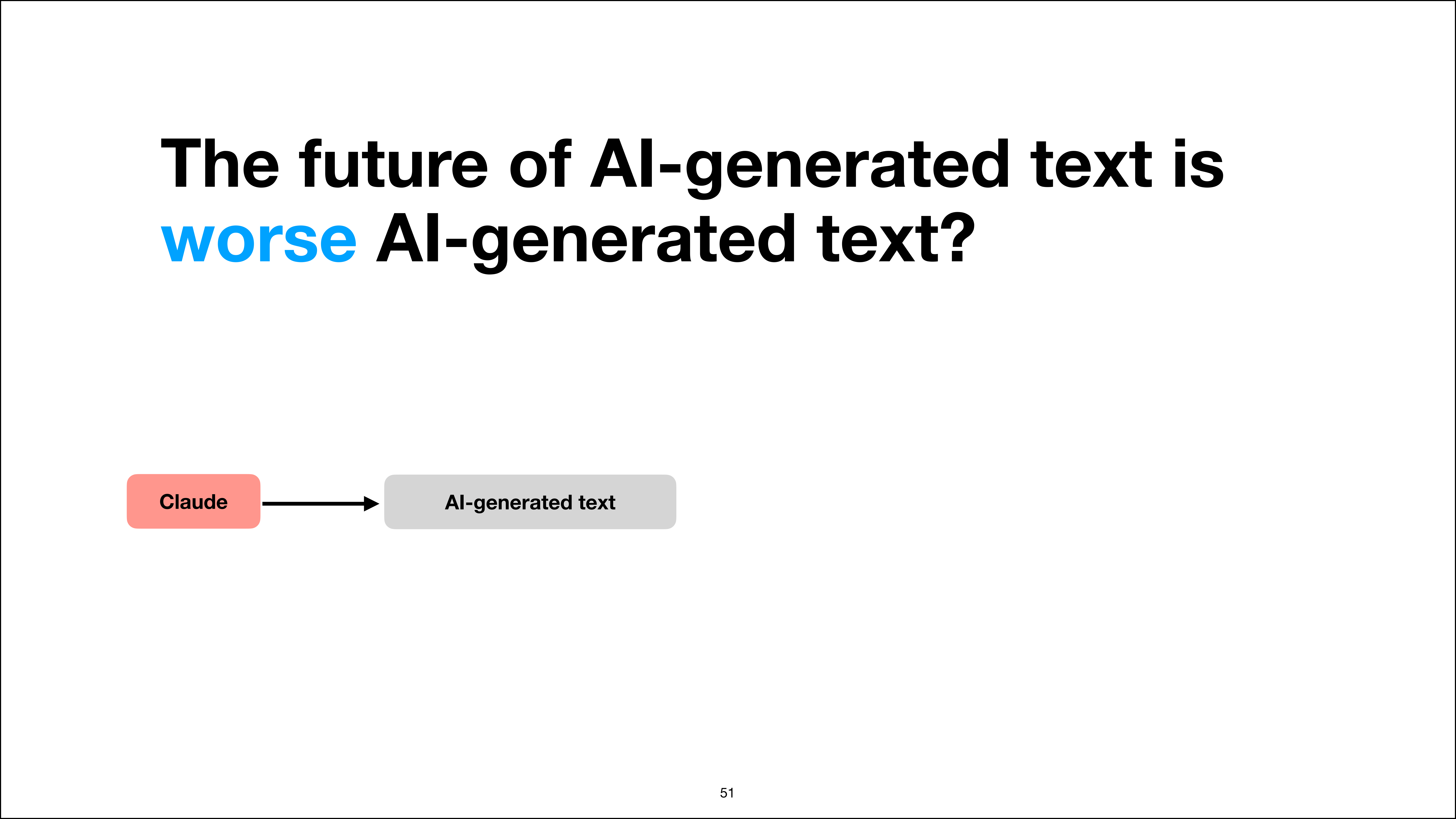
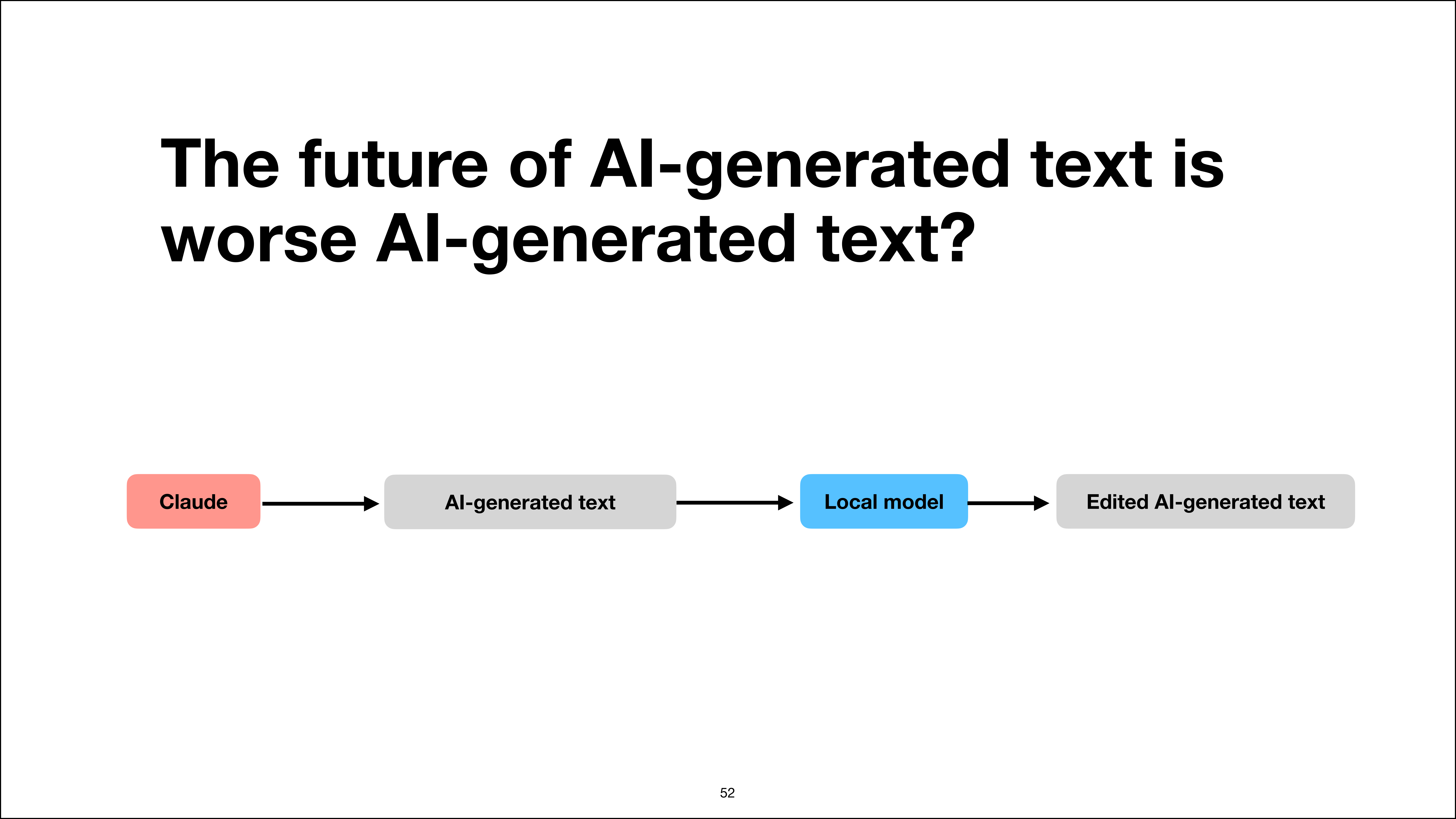
…might result in worse AI-generated text. So I think if there’s a person who likes to use AI-generated text everywhere on the internet, let’s say there’s a news website that likes to use AI-generated text to write the news, I don’t think watermarking will necessarily stop them from doing that. They will probably still want to generate AI-generated text because that’s part of their workflow. So I think my guess is that they’ll use another model.
They’ll just use a second model to edit the text to get the so-called edited AI-generated text. So it’s complicating the pipeline. Instead of getting the text directly from Claude, it’s now using Claude to generate AI-generated text, passing it through a local model, and then having edited AI-generated text, which is likely not watermarked anymore. So why a local model? I just think a local model because I think all the providers- the proprietary LLMs, not only Claude, but also Google— I mean, Google wrote this paper, right?
So I’m thinking that they are also watermarking Gemini text. And I think OpenAI is probably already doing it or will do so as well. I mean, I’m just speculating, but I’m imagining everyone will probably do something like that because there’s like an EU regulation that requires that. And that’s, according to the blog post, apparently why Claude is doing it. Yeah, so I’m thinking local models may not, at least not yet, implement this watermarking.
So I think people will just use a local model and then generate edited AI-generated text. And my guess is it will be slightly worse than the original text because for the local model, you might now be using a smaller model. So, I mean, you could also technically just use the local model directly to generate text. But in my view, editing text is simpler than generating text. So for the generation of the text, you might use a very expensive high-end, I don’t know, like the highest, most expensive Claude model for complicated text.
And then you use a cheaper local model to make these surgical edits, essentially. That’s probably what’s going to happen. And why worse? So if we look back at this graphic where we just added random positions, you might be just changing words for the sake of changing them. And then it risks making the text worse. So you might still have generated text, but it’s kind of like it’s edited awkwardly.
But anyway, so my goal here was to explain how the watermarking works and not, let’s say, the worldwide ramifications of that. But I hope this kind of behind-the-scenes, under-the-hood look is useful. The watermarking is not as complicated as it might seem, but I think it was still 52 slides, so it was also not super trivial. So I hope you found this little lecture useful. And yeah, until next time, see you then.
PS: If you like more explainers in this style, I don’t post videos to YouTube regularly, but I have accumulated over 300 videos over the years, which you can find on my YouTube channel here.
The Food and Drug Administration (FDA) is proposing to reclassify digital breast tomosynthesis (DBT) systems, product code OTE, which are postamendments class III devices, from class III (premarket approval) into class II (special controls), subject to premarket notification. FDA is also proposing a new device classification regulation with the name "Digital Breast Tomosynthesis System," to identify these devices along with special controls that FDA believes are necessary to provide a reasonable assurance of the safety and effectiveness of these devices.
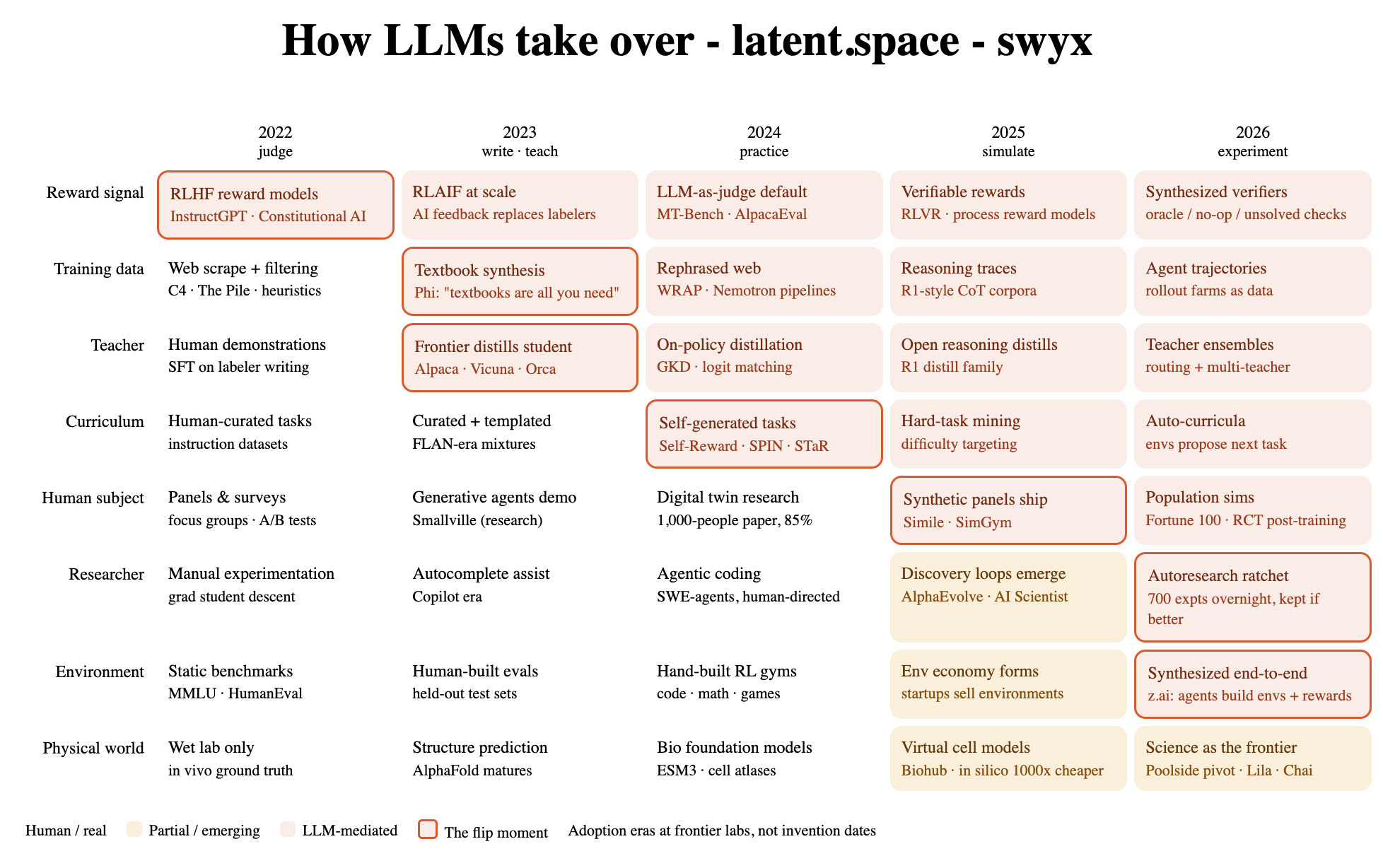
By AI standards today is a pretty quiet Friday, so it’s time to take a step back and reflect on what is really going on. If you read our 2025 reading list, and followed our coverage of Z.ai GLM, understood the Poolside pivot, been following our AI for Science themes, and tuned in to today’s Simile pod, you not only are one of the biggest readers of Latent Space, you will probably also arrive at this mental model:
Every year since 2022, one more component of the pipeline that produces machine intelligence has flipped from human-made to model-made. Not gradually, and not evenly — each flip has a patient zero, a paper or product where the synthetic version first became load-bearing at a frontier lab, and from there on, the future is simply here but not yet productionized.
And if you squint, what we used to call “synthetic data” and “synthetic rubrics” and “AI researcher” and “end to end RL environments” is just increasingly ambitious human simulation - 10% worse, but 100x cheaper and 10,000x faster.
Stage 1: The reward signal (2022)
The first thing to go synthetic was, counterintuitively, the judge. InstructGPT established the now-canonical trick: collect human preferences once, train a reward model, and let the policy optimize against the model rather than the humans. From the policy’s point of view, the thing dispensing approval was already an LLM. Constitutional AI pushed further and had the AI critique itself against a set of principles (RLAIF), and Lee et al. later showed AI feedback matching human feedback at a fraction of the cost. By the time LLM-as-judge became the default eval methodology (MT-Bench, AlpacaEval), the entire approval apparatus — reward, critique, evaluation — ran on models judging models.
Stage 2: The training data (2023)
Microsoft’s Phi series made the argument in its title: Textbooks Are All You Need. A small model trained on LLM-synthesized, textbook-quality data punched far above its parameter count, and phi-1.5 confirmed it wasn’t a fluke. Apple’s WRAP generalized the move: don’t just generate data, rephrase the entire web with an LLM, and pretraining gets roughly 3x more efficient. From there the pipeline industrialized — NVIDIA’s Nemotron-4 340B shipped with a permissively licensed synthetic data generation pipeline as a headline feature, and by 2025 reasoning-trace corpora (chains of thought generated by strong reasoners) had become a standard pretraining and mid-training ingredient. The corpus, the thing that was supposed to be the irreducibly human input, was now substantially model-written.
Stage 3: The teacher (2023)
Weeks after ChatGPT’s API opened, Stanford’s Alpaca demonstrated that a $600 fine-tune on GPT-generated instructions could clone much of a frontier model’s behavior. Vicuna did it with shared conversations; Orca did it with rich teacher explanations rather than bare answers. The technique matured from imitation into a proper training discipline — on-policy generalized knowledge distillation fixed the train/inference mismatch — and reached its cultural peak when DeepSeek-R1 shipped a family of distilled models alongside the flagship, making “the teacher is a model” the default assumption for every small model release since.
Stage 4: The curriculum (2024)
Stages 1–3 made the inputs synthetic; stage 4 is where the loop starts closing on itself, because the model begins deciding what to learn next. The pieces existed early — Self-Instruct (models writing their own instruction sets) and STaR (models bootstrapping their own reasoning traces) are both 2022 — but the flip came when Meta’s Self-Rewarding Language Models and SPIN showed a model could generate its own tasks, judge its own outputs, and improve past the ceiling of its human preference data. Curriculum design — historically the most artisanal part of ML, the taste-driven choice of what to train on next — became something models do to themselves.
Stage 5: The researcher (2026)
The assistance era (Copilot, then SWE-agents) kept a human choosing the experiments. The discovery era did not. DeepMind’s AlphaEvolve evolved genuinely new algorithms in 2025, and Sakana’s AI Scientist (now in Nature!) sketched the full paper-writing pipeline. The big moment was Karpathy’s autoresearch in March 2026: a deliberately minimal ratchet loop where a coding agent modifies a real LLM training setup, runs a five-minute experiment, keeps the change only if validation loss improves, and repeats overnight. His own extended run stacked 700 experiments into 20 kept improvements, cutting time-to-GPT-2 from 2.02 to 1.80 hours — real, transferable code changes found while he slept.
Stage 6: The environment (2026)
RL’s scaling bottleneck moved from the model to the environment: you need thousands of executable, verifiable, professionally realistic task worlds, and humans can’t hand-build them fast enough. We covered this recently in our z.ai / GLM-5.3 issue: Z.ai built pipelines that synthesize environments end to end — research agents mine real work patterns and convert them into long-horizon environments with hidden state, a judge agent attempts each task to confirm it’s solvable, and verifiers are synthesized without seeing the reference solution, then stress-tested with oracle, no-op, and unsolved-state checks until their binary reward is reliable enough to train on directly. As the GLM-5.3 release puts it, the entire environment, judging, and verification stack is synthetic all the way down. The same week, Ornith-1.5 shipped claiming end-to-end self-improvement — the model proposes its own tasks and generates its own RL rollouts. The gym, the referee, and the scoreboard are all models now.
Stage 7: The human subject (2025)
If models can be the judge, teacher, and environment, the remaining human role in the loop is subject — the source of preferences, behavior, and demand. That’s the layer Simile is replacing. The lineage runs from Joon Sung Park’s Generative Agents (Smallville, 2023) through Generative Agent Simulations of 1,000 People, where digital twins built from two-hour biographical interviews reproduced their source humans’ survey and behavioral responses 85% as accurately as the humans reproduced themselves two weeks later.
The big hurdle to overcome: frontier models are trained toward being agent models, which makes them bad simulations of real people — so Simile post-trains on interviews, transaction data, and registered RCTs from the Open Science Framework specifically to recover human bias, inconsistency, and causal texture, and reports early scaling laws for simulation quality. With SimGym at Shopify simulating shopper trajectories and Tencent’s billion-persona approach at the crude end of the spectrum, the focus group, the user study, and the A/B test panel are becoming inference workloads.
Stage 8: The physical world (2026, in progress)
The last row of the grid never quite turns red, and that’s the point. Poolside’s reverse-execuhire letter drew the line precisely: the world’s problems split into intelligence-bound ones (solvable by scaling cognition, soon commoditized by open weights) and experiment-bound ones, where “no amount of intelligence substitutes for real-world experimental feedback — 100,000 brilliant minds won’t cure cancer without a wet lab.” Their bet is that AI’s durable value accrues to whoever owns the experimental loop: AI as “the world’s most valuable scientific discovery engine.”
The bio side is running the same play from the other direction. CZ Biohub is imaging the Human Cell Atlas into a virtual cell — because in silico is roughly 1000x cheaper and faster than in vivo — and extending toward a virtual immune system, with Chai, Xaira, and Lila’s data-center-shaped labs filling in the AI-for-science stack. The physical world is the one component that can’t be fully synthesized — only compressed, cell by cell, into models.
The exponential starts at the diagonal
Read the grid one more time and a second pattern appears underneath the first. Every flip was preceded by the same objection — model collapse, hallucination stacking, garbage in garbage out — and every flip happened anyway, at the exact moment a verification mechanism made the synthetic version trustworthy: aggressive filtering for Phi’s textbooks, judge-vs-judge agreement studies for LLM evals, unit tests and proof checkers for RLVR, oracle/no-op checks for z.ai’s verifiers, registered RCTs for Simile’s twins, the wet-lab loop for the virtual cell. The synthetic frontier doesn’t advance when generation gets better. It advances when verification does.
Which suggests where it goes next. The gray triangle remaining in the bottom-left of the grid — physical experiment, embodied ground truth — is exactly the region where verification is slowest and most expensive. The models learned to write, then to judge, then to practice, then to experiment. The remaining question of the decade is how much of reality they’ll need to touch — and how much they can get away with simulating.
10% worse, 100x cheaper, 10000x faster… and improving on ALL three dimensions fast.
Agents, Harnesses, and the Shift Toward Environment-Centric Training
The center of gravity is moving from prompts to environments: the most substantive thread here was again GLM-5.3’s sandbox-scaling interpretation: same base model, but better long-horizon performance from richer executable environments and SAO-style counterfactual credit assignment. This aligns with other work shared today: Google’s EnvHarness / EnvRigger adapts static environments using a plugin layer and policy-diagnosed reshaping, improving held-out performance by up to 9 points with 9.8% fewer execution steps.
Benchmarks are getting more task-specific and harder: FACET creates executable terminal tasks from agent skills and validated 6,078 tasks; SWE-bench Science introduces 119 scientific software tasks where even Claude Code + Opus-5 is under 50% pass@1; CADBench finds top models at only 24.6% pass rate across realistic Fusion 360 tasks; and AI4AI-Bench tests recursive self-improvement over 10 research repos, with the best model only at 0.288 average score.
Inference-serving correctness in RL got an important systems result: vLLM’s IsoExec addresses rollout/training logprob mismatches caused by floating-point non-associativity, enforcing bitwise parity across TP/EP/SP layouts. On Qwen3.5-35B-A3B with DAPO on 8xH100, logprob diff reportedly dropped from 1.6e-2 to 6.7e-7 at 25.3% overhead.
Research Highlights: Routing, Recirculation, and Robotics
Inference-time architecture ideas: a DeepMind paper on Recirculation got attention for feeding contextualized deeper-layer activations back into earlier processing at inference time, without retraining. The summary cited improvements including -60% contextualization errors, -23% perplexity, and +21% GSM8K in reported experiments (thread).
Model routing got a more principled treatment: Pandora’s Router from Google DeepMind frames routing as an optimal search problem with costly inspection, rather than assuming routing estimates are free. The claim: it matches exhaustive-estimation quality while calling expensive estimators less often, including settings with specialist LLMs and variable inference-time reasoning.
Qwen3.8-27b has the highest level of “agency” I’ve ever seen in a local model (Activity: 1334): The post claims Qwen3.8-27B running locally on a single RTX 3090 with Unsloth Q4_K_S quantization, q8 KV cache, and 150k context performed unusually capable autonomous agent workflows: using Playwright plus existing SSO/session cookies to navigate university systems and retrieve a course schedule, and separately processing a social-media video via download, frame extraction, transcription with Whisper, and image enhancement. The image is a screenshot of the model reporting use of an Outlook/OWA Playwright profile, Microsoft “stay signed in,” and Duo browser-trust cookies to access school systems, making the technical significance less about raw model quality alone and more about local LLM tool-use agency plus high-risk credential/session handling. Comments were impressed but cautious: one user explicitly worried about giving an agent enough access to potentially perform destructive actions like withdrawing from university, while others framed it as evidence that advanced local agentic systems are already here but unevenly distributed.
A commenter asked for implementation details behind the reported agentic behavior of Qwen3.8-27B, specifically the agent harness used—e.g. Claude Code, Hermes, or another framework—and how tools were exposed via MCP servers, browser tools, Python, filesystem access, etc. They also asked what inference backend served the model, such as llama.cpp, and how it was able to autonomously download video, extract frames, and install Whisper.
There was technical concern about the reliability of the referenced quantization: one commenter noted surprise that “the quant is that good,” while mentioning reports of looping behavior at that quant. This suggests the model’s apparent agency may be sensitive to quant level and runtime behavior, especially for long-horizon tool use.
A safety-oriented thread questioned giving local agents broad system access, with one commenter saying they would not trust agents like Sol or Fable with unrestricted permissions. The concern was not about local inference itself, but about autonomous agents with enough privileges to perform impactful real-world actions such as modifying accounts or workflows.
Qwen3.8-27B took a serious hit to knowledge vs 3.6 (Activity: 779): The post reports that Qwen3.8-27B / Qwen3-8-27B appears to regress vs Qwen3.6-27B / Qwen3-6-27B on offline, no-tool-call factual recall: the author’s private “mildly obscure” trivia/prepper benchmark showed failures across quantization levels and sampling settings, consistent with lower scores on Artificial Analysis’ Omniscience knowledge benchmark. The reported degradation is specifically about knowledge stored in weights and hallucination/fact recall under airgapped inference, not coding/tool-use; commenters note Qwen3.8 is stronger at tool calling, web search/fetch workflows, coding, and agentic behavior. Commenters broadly frame this as an intentional tradeoff: newer Qwen 3.x models may be optimized for coding/agentic tasks rather than being “mini Google” factual stores, with Gemma 4 suggested as a better fit for trivia/random-fact recall. One user confirmed regression on niche visual/history/geography tasks such as stamp or old-photo location identification when web tools are disabled, but considered the tradeoff acceptable given improved tool use.
Several commenters frame Qwen3.8-27B as shifting away from memorized factual recall toward coding, tool use, and agentic workflows. One user testing a niche “knowledge” workload—stamp identification and historical/location inference from old photos—reported that with web search/fetch tools disabled, Qwen3.8 performs worse than Qwen 3.6, but becomes more useful when allowed to retrieve information externally.
The perceived regression is described as an intentional tradeoff for a 27B model: reduce obscure memorized knowledge while preserving enough reasoning ability for problem solving and agents. Commenters suggest using models like Gemma for factual/trivia-heavy tasks, while reserving Qwen3.8 for coding/tool-calling scenarios where users report stronger performance.
One technical speculation was that future models may separate base reasoning from domain knowledge via neural plugins/LoRA-like modules: e.g., adding Japanese-language capability or finance-domain expertise as attachable components rather than baking all knowledge into the base model. This was proposed as a way to keep base models smaller or more specialized while allowing opt-in domain expansion.
Qwen 3.8 27b - PI AGENT vs OPENCODE (Activity: 510): The author compares PI Agent vs Opencode using a local llama-server backend on an RTX 3090 with Qwen3.8-27B-Q4_K_M.gguf, ctx-size=100000, flash-attn=on, n-gpu-layers=99, DeepSeek-style reasoning, and a vision mmproj module. They report PI Agent producing better outputs, using fewer tokens, avoiding Opencode’s apparent 32k output-token ceiling/freezing behavior, and delaying context compression until ~90k tokens vs Opencode starting around ~67k when total context is 100k; they also recommend enabling vision so the model can visually assess generated outputs, with CPU/RAM offload acceptable for screenshot evaluation latency (~3s vs ~0.3s GPU). The test was inspired by a prior LocalLLaMA post about generating a bouncing-ball animation: reddit.com/r/LocalLLaMA/comments/1j7r47l/.... Commenters questioned whether a one-shot HTML/animation task is a meaningful harness comparison and suggested multi-step tool-heavy workflows instead. Another user reported PI + local Qwen3.8-27B felt competitive with Claude Code on a roughly one-hour aurora-prediction app build, though both models judged Claude’s initial result slightly better before PI iterated.
A commenter argues that one-shot HTML generation is not a meaningful benchmark for comparing PI Agent vs OpenCode; they suggest using multi-step tasks with extensive tool calls to evaluate the harnesses’ planning, editing, and recovery behavior.
One user reports a subjective head-to-head between local Qwen3.8-27B running in PI and Claude Code on building an aurora predictor app. They felt runtime was similar; both agents judged Claude’s first result slightly better, but after asking PI/Qwen to upgrade its version, the user preferred Qwen’s presentation. The resulting app reportedly integrated multiple satellite instruments and provided 30–60 minute aurora warnings.
Another commenter suggests adding the DeepSeek harness to the comparison, implying the evaluation should cover more agent runtimes than just PI Agent and OpenCode.
2. DeepSeek V4 Flash Benchmarks and Serving
DeepSeek-V4-Flash-Vision-Exp (Activity: 722): The image is a technical benchmark table for DeepSeek-V4-Flash-Vision-Exp (image), comparing it against DeepSeek V4-Flash-0731 and Opus-4.8 on text-agent and multimodal-agent evaluations. It shows broad gains over the prior DeepSeek Flash release, including 83.9 on Terminal Bench 2.1, 75.9 on Toolathlon-Verified, and 64.3 on Chartography, while Opus-4.8 still leads many text-heavy benchmarks; Vision-Exp appears more competitive on multimodal tasks such as Agents’ Last Exam and ZeroBench. The main technical reaction was that the reported DeepSWE improvement of roughly +4 points over 0731 is considered unusually large. Other comments were mostly hype or tribal reactions rather than substantive analysis.
DeepSeek’s announcement says DeepSeek-V4-Flash-Vision-Exp is live via the DeepSeek API with model='deepseek-v4-flash-vision-exp', matching DeepSeek-V4-Flash text capabilities while adding multimodal input. The model supports Chat Completions, Messages, and Responses APIs, with mixed text+image inputs via base64, external URLs, or the Files API; images are billed as up to 384 tokens each at V4-Flash pricing. Docs: vision guide.
Several comments focused on benchmark movement: one noted DeepSWE reportedly improved by 4 points from 0731 to Vision-Exp, while the announcement claims a “major leap” on multimodal agent benchmarks, bringing performance close to Opus-4.8. The technical implication discussed is that Vision-Exp may retain V4-Flash’s agent/reasoning/world-knowledge text performance while substantially improving visual-agent workflows.
DeepSeek also launched a Files API for image reuse: users can upload an image once, reference it by file_id, and avoid resending image payloads across requests, reducing bandwidth overhead. One commenter asked whether the model weights would be open and noted they could not yet find them on Hugging Face, implying that availability appears API-only at the time of discussion. Files API docs: files_api.
The boring way to run Deepseek V4 Flash-0731 130-150 tks - 16x5060ti 16GB over 2 PLX88096 switches (Activity: 621): The image is a terminal GPU-monitoring dashboard validating the post’s unusual 16× RTX 5060 Ti 16GB inference rig: all GPUs are visible, nearly full at roughly 15.2–15.7 GiB / 15.9 GiB VRAM, and assigned to vLLM worker processes for DeepSeek V4 Flash-0731. The setup uses two Broadcom/PLX PEX88096 PCIe switch islands with patched NVIDIA 610.43.02-p2p, Resizable BAR/BAR1 set to 16 GiB per GPU, and custom all-reduce/DSpark pipeline parallelism; reported throughput is about 100–150 tok/s single-user generation depending on TP/PP layout, with concurrency scaling up to 727 output tok/s aggregate for TP4/PP4 at 16 users. The image also shows the tradeoff/oddity of the build: the GPUs appear connected at PCIe Gen1 x8 and are mostly idle at the captured moment despite high VRAM residency, implying the screenshot is more a topology/memory residency proof than a live utilization benchmark. Commenters were less focused on the benchmark table and more on the physical absurdity of the build, asking for “a photo of the setup” and calling it a “mad setup.” One notable skeptical/funny technical reaction was that “a little vibe coding” likely hides substantial custom distributed-inference work.
Sometime around Christmas 2025, AI engineers noticed a change in agents. They started to work! It’s hard to pin down exactly why. Maybe we finally had holiday downtime to try the newest agents with the newest models. Maybe the models had crossed some capability threshold. Maybe the wrappers around the models had matured.
What I’ll argue in this post is that it was the confluence of the last two. The model and the harness improving together and then their curves of improvement crossing at the right moment. And that dynamic helps to explain what comes next: models keep absorbing the harness into their weights, engineers keep deleting what got absorbed, and what remains is a harness for human attention rather than for the model.
Lukasz Kaiser, one of the people who invented the Transformer, said on “Unsupervised Learning” in June:
“The change last winter, last Christmas — it’s a little hard to pin down. I mean, the harness changed and a little post-training changed and then new pre-trained models came… but it felt like a big jump which is not that easy to pin down what did it.”
The answer to “What happened?” isn’t solely in the model weights. It’s in the system that grew up around the weights.
The answer is in the agent harness.
Think back to November 2022, when ChatGPT was the most advanced AI tool. The only capability at its disposal was next-token prediction and some Reinforcement Learning from Human Feedback (RLHF) that allowed it to act like a helpful assistant. No tools, no search, and no reasoning.
The original ChatGPT was confined to its training data and the prompt you sent it. No more, no less. It was a brain in a vat.
The agent harness is a way for the LLM to break free from that confinement and interact with real digital information space.
What a Harness Actually Is
An agent harness is everything besides the model weights that makes the agent work. The environment, tools, context and guardrails that surround the model. Without the harness the model is a brain in a vat. It can take an epistemic action, but needs the harness to actuate that decision in real digital space.
The harness is like giving the mind of the model a body. With the harness, the model can perceive (context), act (tools), persist information (memory and compaction), and enforce its boundaries (permissions and guardrails).
Harness 1.0: The Past, “The Bolt-On Era”
Two curves run through the path of model / harness evolution. What the harness asks of the model, and what the model can deliver in practice.
The gap between these two curves is equal to the effectiveness of an agent, and the closing of that gap is what I’ll argue led to the tangible improvement in agents that Lukasz Kaiser referenced.
Here’s how the gap closes, in stages:
ReAct, “The Harness on Paper” (October 2022): ReAct is a prompting technique to get models to reason through prompting. It’s the agentic loop on paper, external to the model weights. It defines the idea of an “agent loop” where a model reasons -> acts -> observes -> repeats. Again, the ReAct loop exists only as a prompting method. Prompting is the only reasoning method that exists at this time and no one calls it a “harness.” Toolformer (Meta, Feb. 2023), that same winter, hints that tool use could be trained in rather than prompted. It’s a bit like Alan Turing’s idea of the computer before it was instantiated in a physical substrate. A powerful idea that is only later made manifest. (ReAct predates ChatGPT by a month — October 2022 vs. November 2022). Both the curves are near zero at this point. The gap is small because we are just getting started.
AutoGPT/BabyAGI, “Premature Autonomy” (Spring 2023): With AutoGPT/BabyAGI, the harness curve sprints ahead of the model capability curve. Both hand the model full autonomy, asking the model to act as an “autonomous employee,” but the models at this point are still little more than brittle next-token predictors. A loop doesn’t add capability to a model. A loop amplifies the capability a model has, and below some threshold the loop amplifies errors rather than reliability. Consider the power of compounding in the negative: 95% reliability per-step over a 20-step task results in a ~36% average success rate. The harness hands the model an assignment it has no realistic chance of completing. This is where the gap is at its widest and the next 18 months are a reaction and attempt to close that gap.
Cursor/Copilot, “Retreat to Human in the Loop” (2023 - 2024): The first AI-powered IDEs recognize the failure-mode of giving the model too much autonomy. They close the gap by pulling the harness curve down below the model curve. Don’t give the model the loop directly; give the human the loop and empower the human to orchestrate the loop while the model speeds the human up. The first version of Devin tries to hand the autonomy back to the model. A test from the team at Answer.AI shows that is still premature, with a ~15% success rate. It’s evidence that the move from the IDEs to retreat from full autonomy is not cowardly, but the correct move. However, while the prevailing tactic is to pull the harness down below the model, models continue to improve. Near the end of 2024, with the introduction of o1 — the first reasoning model — for the first time the gap inverts and we begin to see the first signs of a model capability overhang.
Claude Code, “The Curves Cross” (February 2025): The inversion at the end of 2024 sets up an opportunity that someone has to seize: if the model is now ahead of the harness, then a harness intentionally riding the brakes of the model is leaving capability on the table. Claude Code is the first coding agent built to seize that opportunity. It abandons the IDE for the terminal, gives the model bash and file read/write access, and replaces the need for human approval on every change with permission rules. The model is handed the loop again, and this time it understands the assignment. Boris Cherny and team build Claude Code with the next model’s capabilities in mind, not the current one. It is such a hit not because it’s the first product to give the model autonomy, but because it’s the first product to do so at the right time. That time is the crossover point where the model has gotten reliable enough to succeed with autonomy. Claude Code grows to roughly $1B ARR within six months, all because Anthropic seized the opportunity available when the curves begin to meet.
What happens next is that the curves don’t just meet, they begin to braid together.
Harness 2.0: The Present, “The Co-Training Era”
Today the harness matters, and in a way we can measure.Harness-Bench ran the same model over the same 106 tasks in different harnesses, and scores ranged from 52.4 to 76.2: a 23.8-point spread with zero change to the model. Half the agent is the harness.
OpenAI achieved a similar result on ARC-AGI-3 with harness changes. Adding only retained reasoning and compaction, GPT-5.6 Sol’s ARC-AGI-3 score tripled from 13.3% to 38.3%.
What’s happening under the hood is that Reinforcement Learning (RL) has moved inside the harness. From OpenAI’s codex-1 release announcement in May 2025: “codex-1 was trained using reinforcement learning on real-world coding tasks in a variety of environments.”
The two curves join and start to braid as one unified system.
This is the dream of Toolformer manifesting in reality. Rather than a tool prompted from the outside, now tool calling is trained from within the environment of the model.
Then, as the models are trained in the environment of the harness, they start to absorb the harness capabilities into the model weights, learning how to auto-compact with knowledge of their own context window, for example.
GPT-5.1-Codex-Max launch:
“The first model natively trained to operate across multiple context windows through compaction.”
Once the models absorb the harness capabilities, the harness can shed the scaffold. It’s production by reduction. Thariq Shihipar from Anthropic said that the team recently deleted 80% of Claude Code’s system prompt.
The measure of the pace of agent harness evolution is how much of the harness you get to delete, while retaining the same capability level. This is the future we need to build towards as AI engineers.
This, then, is the loop of model / harness evolution: train -> absorb -> shed -> repeat. The model climbs to the next thing it can’t do yet.
The jump that Kaiser pointed out is hard to pin down because it’s not a discrete event. A pre-training leap is noticeable because you can articulate it in a model card. A model / harness co-evolution jump is less so, because there’s no documentation of the evolution process. That’s the answer to the jump last Winter: it happened in the space between the model and harness working together.
We need to ask: if every harness capability will eventually get absorbed into the model, what does that leave us with?
Harness 3.0: The Future, “The Attention Era”
Keep deleting everything that the model can absorb. Imagine what your agent looks like at the conclusion of that process. What are you left with in your hand when you’ve deleted everything?
What do the model weights absorb next? Multi-agent orchestration, tool selection, memory...to name a few possibilities. Researchers are building self-improving harnesses that can themselves be trained in a similar way to models.
What’s left at the end of this deletion and absorption process are the human-centric agent capabilities. Things like permissions, identity, trust and legibility. A model that absorbs permissions into itself has dissolved permissions. Absorption doesn’t end the harness. Absorption inverts the harness.
The harness becomes the agent’s interface to the human that operates it.
The harness was born as the human interface to the model. We grew from chatbox to IDE to the terminal. If the model absorbs the computer-facing capabilities, the next stage of evolution becomes one layer of abstraction up. The harness becomes the model’s interface to our human attention.
“The only fundamentally scarce thing is the synchronous human attention of my team.”
Tokens became abundant and reliable, yet we remain bottlenecked on scarce human attention.
We see sparks of this already, with Anthropic’s long-running agent progress files and agentic approval queues.
The gap between the model and harness curve doesn’t disappear when the model absorbs the harness. It migrates across the human boundary and creates a new pair of curves with a new gap. The new gap is the space between what the agent asks of the human, and what the human is able to answer.
The Attention-Interface
I predict that within a year, every company building agentic AI will ship a human attention policy surface in the way that every agentic AI company shipped AGENTS.md.
AGENTS.md tells the agent how to work with your codebase. The attention-interface will tell the agent how to work with you. It will govern when it’s allowed to interrupt you, when it should keep working, which decisions it can make alone and which decisions need your approval. And like everything else in the agentic system, it will become a learnable component of the system that can learn with more data. Every correction becomes useful data.
The model began as a brain in a vat. The harness gave the brain a body, then the body started to dissolve into the brain. What’s left for us to build is the thing no future model will ever absorb. The interface to the one true scarce resource: human attention.
Time to catch up on why this Second Summer of simulation is working!
From creating Smallville, the landmark 2023 paper on Generative Agents that showed AI characters could remember, plan, socialize, and develop emergent behaviors, to now building foundation models of human behavior, Joon Sung Park is trying to answer a much bigger question: what if we could simulate the world before making decisions in it? In this episode, the Simile co-founder and CEO joins us to unpack the path from generative agents to digital twins, why today’s frontier models still fail to capture how humans actually behave, and what it would take to eventually simulate all 8 billion people on Earth.
We go deep on Simile’s approach to modeling human behavior: long-form interviews, observational and transaction data, randomized controlled trials, population-level and individual-level models, and post-training on the causal mechanisms behind why people make decisions. Joon explains how his research created digital twins that reproduced human behavior and attitudes 85% as accurately as people reproduced their own responses, why models optimized to be rational can be bad simulations of irrational humans, and why understanding “social physics” may require changing model weights rather than simply prompting frontier LLMs.
We also explore the much larger ambition behind simulation: testing products and policies before deploying them, finding counterintuitive paths toward desired outcomes, modeling emergent behavior across entire societies, and potentially tackling problems like climate change, democratic instability, and UBI. Joon reflects on scaling laws for simulation, the economics of data-center-scale simulated worlds, the connection to Thomas Schelling and psychohistory, why simulation is surprisingly similar to painting, and whether we might already be living in one.
We discuss:
How Smallville and Generative Agents led to Simile
Why Joon’s team asked: “What if we can just recreate the world that we live in?”
Why useful personal agents require deep models of their users
Memory architectures, Markdown files, and the limits of prompting
“Social physics” and behavioral foundation models
Why web data captures what people say more than what they actually do
Interviews, transactions, observational data, and randomized controlled trials
Why predicting the future matters less than understanding how to shape it
How Simile creates representative simulated populations
Simulation versus prediction and the connection to Foundation’s psychohistory
How to evaluate simulations instead of simply stacking LLM hallucinations
Creating digital twins of 1,000 real people and reaching 85% behavioral accuracy
Why frontier models can struggle to reproduce real human behavior
Why good simulations need to reproduce human biases and mistakes
Post-training models on randomized controlled trials
Population-level versus individual-level simulation
Scaling laws for human simulation
The long-term ambition to simulate all 8 billion people on Earth
Whether simulations could help solve climate change or detect collapsing democracy
Thomas Schelling and the history of agent-based modeling
Why future simulations could require an entire data center
Multi-agent simulations and what happens when simulated people interact
Replacing expensive human panels with synthetic populations
Why market research is only the starting point for simulation
Why Joon sees simulation as surprisingly similar to painting
Using simulation to study questions like UBI
Whether we are already living in a simulation
Why AGI and simulation may be the twin technologies of advanced civilizations
00:00:00 Introduction and Joon’s Path from Art to AI
00:01:46 Smallville, Generative Agents, and the Origins of Simulation
00:05:03 “Let’s Just Create a World” and the Future of Personal Agents
00:09:53 Social Physics and Behavioral Foundation Models
00:14:08 Prediction vs. Simulation: How Do You Shape the Future?
00:16:59 How Simile Models Real People and Populations
00:25:35 Evaluating Simulations, Digital Twins, and 85% Accuracy
00:30:23 Post-Training Models to Reproduce Human Behavior
00:40:04 Scaling Laws and Simulating 8 Billion People
00:43:10 From Schelling to Society-Scale Agent Simulations
00:46:13 The Cost and Economics of Simulating the World
00:52:05 Real-World Use Cases, Synthetic Populations, and the Market
00:57:27 The Future of Simulation, Painting, and UBI
01:04:23 Are We Already Living in a Simulation?
01:06:08 Building Simile and Hiring
Transcript
Introduction: Joon Sung Park, Simile, and the Story So Far
Vibhu [00:00:00]: Today, we have Joon in the podcast. Excited to kick this one off. Very exciting company. I wanna kick off and ask you the question, talk us through the story of your life. How have you gotten here?
Joon [00:00:13]: Yeah, for sure. I’m really excited to be here. A story of my life. So I was born in Korea, and I lived there for a good 11 years or so of my life, and then my family moved to Boston. So we moved when I was 11, and my parents were doctors, so they were going through their postdoctoral studies. My dad was a surgeon, so he was doing his sabbatical years at the Boston Children’s Hospital. So I grew up there, not too close to tech. I was very much a music and artsy, painting kind of guy.
Vibhu [00:00:49]: Painting.
Joon [00:00:49]: Exactly. I got into painting a little bit later, in high school, but that’s what I used to do. And then I grew up mostly in the East Coast after Korea. So I lived a good number of years in New Hampshire, and then I went to college in Pennsylvania. And I got into more of this tech scene, in college. So I was originally trained to be an artist. I thought that would be my professional career. So it wasn’t a hobby. It was like, “Hey, let’s make a living out of this.” And then gradually, I got really interested in this idea of, hey, the greatest artist often creates their own medium, and the best medium that we had available today was in computation. So I decided to go deeper into that, and one thing led to another, and we can go deeper into this, but I decided that research was something that I gradually got interested in, and here I am.
Smallville, Generative Agents, and the 2023 Breakout Paper
Swyx [00:01:46]: So there’s a lot that you packed into the research components. You had one of the best papers of 2023, which was the generative agents paper, commonly known as the Smallville paper.
Swyx [00:01:58]: Feel free to call back to anything else that you mentioned, but most people would have heard of you from this. Do you have any statistics on how many people have, like, read it? arXiv gives you something, right? Some stats.
Joon [00:02:10]: Yeah, it’s a good question. How many people have read it, I’m not sure.
Joon [00:02:14]: I know we do keep track of citations, and they are going up quite fast.
Swyx [00:02:23]: Yeah, Google Scholar has 7,200 citations.
Vibhu [00:02:25]: I feel like it made a bigger hit than that, and it was a pretty instrumental paper. It got cited so many times.
Swyx [00:02:34]: It is frequently the answer when people ask, “What is the best paper you’ve read recently?” It’s this one.
Vibhu [00:02:39]: I thought the memory component was pretty underrated. It was a very good early memory system, and one of the biggest papers.
Foundation Models and the Search for Killer Applications
Joon [00:02:47]: Yeah, so maybe I can talk a little bit about how this particular paper came together. So when I got into research, it was back in 2020 when I started my PhD program at Stanford, and that was the year, when we were about to get GPT-3 to be available. So we already had GPT-2, and you could sense that there was this new class of models that was just becoming available in the market, and the team got very intrigued. And the general consensus was, “Well, is this model going to be useful for anything?” “It’s really strange that these models are not trained to do any particular task.” But we decided to take a bet. So a large group of scholars at Stanford, and it was led by one of my co-founders, Percy Liang, and we came together
Swyx [00:03:35]: Who coined foundation models.
Joon [00:03:36]: Who coined the term foundation models. We wrote this paper, where that term came from called Opportunities and Risks of Foundation Models. And during that process, really the thing that I started to think deeply about was, here is a model that is fundamentally new in our ecosystem. The reason why this was new was it wasn’t, again, trained to do anything in particular, but its premise was it could do anything and everything. It was like a stem cell, if you were to take a biology analogy. And I got really interested in this idea that, well, if we were to really think about what are the killer applications that this particular technology would enable, what would that be? Many of my colleagues were using this for simple classification, simple generations. Interesting that these models can do that, but from an interaction perspective, not that interesting. We’ve known how to do that for many decades. And what we came down to was these models are trained on this very broad data from the web, right? So these are human behavioral data. It’s social media, Wikipedia, all these data. So if you poke at the right angle, then you could see human behavior that would just pop out that’s quite realistic, and we’ve never seen that before.
The Time Machine Game and Recreating the World
Joon [00:04:45]: So that got us really interested. The exercise that we decided to do, with this particular group of colleagues, Michael Bernstein, Percy Liang, and myself, who ended up becoming my co-founder at Simile, we sat down and we played this game that we call the time machine game.
Joon [00:05:03]: Imagine we were to get on a time machine and fast-forward 10 years and look back. What would have been the single application that will have mattered that would be the most interesting and inspiring? And when we thought, “Well, what if we can just recreate the world that we live in?” it’s really hard to get more ambitious than that. Like, let’s just create a world.
Joon [00:05:24]: And that’s where we started. And initially, we had this paper that was a precursor to the generative agents paper called Social Simulacra.
Swyx [00:05:32]: Before you go further, were there other candidates for the most ambitious thing in the time machine exercise? What was number two or number three?
Personal Agents, User Models, and Why Simulation Came First
Joon [00:05:44]: There is a close second that we were considering, which ended up becoming more of these automation tools, especially the vision around really personalized agents that would do things for you.
Swyx [00:05:59]: That’s also happening.
Joon [00:06:00]: It’s also happening. But it was interesting for us, right, in that the reason why, we decided to go with the idea of simulation, one, I was a huge science fiction nerd, and this idea of creating simulation, I was personally really just fascinated. I loved the idea. It’s really cool to see, like, a game town like this and just see these agents live in it. But at the same time, my bet was if you were to create a really amazing personal assistant out of this technology, what you need first is an amazing model of your users. So I told a model, “Hey, can you go buy late dinner for me?” And it orders Hawaiian pizza, and I do not like pineapples on my pizza. Then it totally failed. The way for it to not make that mistake is only by having a deep understanding of who I am. And I gave a very simple and dumb example here, but you can imagine how this core understanding of people is instrumental. This is how, if we have our family and closest friends, they have a good mental model of who we are. That’s the basis of our social connection. So our bet also was this technology around simulation, creating accurate representation of people ought to precede the more complex agents that would automate the world that we live in. So that was the bet. But that was a very close second, and I’m still very much fascinated by it. I think there’s a lot of interesting work that’s going around. My hot take here, though, is I don’t think we’ve seen a true personal assistant that’s useful, in ways that meet the ambition of that particular line of work. I think there are early applications that are interesting, and if you talk to even ChatGPT nowadays or Claude, they know a lot about us. So a lot of the generation it’s doing, I do think it’s much more tailored, but I think the ambition is quite large in that field, and I don’t think we quite have all the right ingredients just yet.
Swyx [00:08:01]: So OpenClaw and these personal agents, what do you want to see from them that they don’t currently have?
Memory, Markdown, and the Limits of Prompting
Joon [00:08:09]: I do think it’s slowly getting there, but I do generally want them to have much deeper understanding of the person. Right now, you look at the models. OpenClaw, what it’s leveraging is a Markdown file, and I think it’s quite clever, right? So if you look at the generative agents paper, this was the same intuition that we had, where initially when we were creating the memory architecture for the generative agents, and, like, this is, like, back in 2022, so we didn’t really quite have the idea of even agentive architecture or the term agent. But the intuition that we shared with some of the work that’s coming out today was we initially thought, “Well, do we want to make the memory into, let’s say, knowledge graph? Do we want to train a bespoke model?” All of these things. And what we decided to do was, “No. Just forget about all this.” These language models are quite good at modeling text and understanding and reasoning about text. So just put everything in a Markdown file or a text file. You’re done. I thought that was quite interesting that we could do that, and there’s a lot of strength in doing that. But also, there are limitations. It’s the way you retrieve and make sense of data that’s extremely large, it takes a lot of work. So I think that technology is getting better. I also do, however, think, there are certain things you just cannot shape just by prompting the model. So to some degree, you do need to touch the parameters of the model itself. So there is this work that I do think does need to happen, and it is happening. The question is, how far can we take it? How do we source data, and how do you also create an ecosystem where people are continuously feeding data to this model so it’s learning about you?
Vibhu [00:09:50]: What’s the intuition between why you need to do it in the model?
Social Physics and Behavior Foundation Models
Joon [00:09:53]: My intuition behind the actual when do you train or even post-train a model versus just prompt a model is if the model has to learn the underlying physics of the world that it’s operating in. So it has to learn new social physics. The places where it doesn’t have to train are the places where it already has the physics. We trust the physics. It already has the base statistics, but it’s just trying to react to an environment. Then I think you can just prompt your way into getting the actions out of it. I don’t think the models that are out in the open have yet learned the complete mapping of social physics of humanity. This is one of the core theses of Simile, right? And one of the core reasons why that is the case is if you look at the data that the model was trained on, these models were trained on the web data, like, whatever was available on the web. And these are really interesting data sets, but they are fundamentally the self-exposed attitudinal data with some behavior data that’s sprinkled around here and there. And it has yet to learn the really deep behavioral nature of people, not just what people say they do online, but what they do in real life. And this is one of what I would consider to be the dark knowledge of humanity that we haven’t quite captured. And it’s these data that would also need to get factored into the model creation.
Vibhu [00:11:21]: You call it behavior foundation model.
Vibhu [00:11:23]: There’s a good one-liner here, but outside of that, what type of data do you need? What are you changing on the model level? How do you go about modeling, doing a behavior foundation model?
The Three Data Buckets: Interviews, Behavior, and Causality
Joon [00:11:35]: We think about data in three buckets. So one bucket is interview data. It’s quite interesting. Rich qualitative data is interesting. It’s not behavioral, but we would literally ask people, “Hey, tell me the story of your life.”
Vibhu [00:11:53]: It’s just what we’re doing here exactly.
Joon [00:11:54]: The question that you all asked at the beginning of this interview literally is the question we also ask. And we ask our participants to go a little bit deeper, than how far I went. Maybe I can give more of my life story in lieu of this. But the reason why that data is interesting is by learning about this very long-tail information about people, you get a lot of texture around this model, like, this person as a model. So even understanding their childhood memory or even their trauma, their first love, these things, quite informative in ways that’s really hard to predict. So that’s one. Then there are two tranches of what I would consider to be the behavioral data. One kind of behavioral data is observational. So these might be like transaction data, or these might be data that you can get by scraping the web, right? So you can imagine why these data sets would be interesting, right, because they give you the base statistics of people’s behavior.
Joon [00:12:55]: But then there is the last category of data, that I personally think is perhaps the most important, which is the data that describes the causal mechanism, the whys of people. Some of this is covered by the interview data, the qualitative, because people talk about why they made certain decisions. But really, where you get to see the most behavioral aspect of this is in randomized controlled trials, like RCTs. Imagine you have the same setup, but you have a few different variables that you are trying to tweak. Can you get realistic human behavior out of it in ways where, imagine you had this particular option. Imagine you’re even trying to choose whether you’re going to drink coffee or not. The day you drink coffee versus the day you didn’t drink coffee, does your behavior change? That’s a data set that describes a causal mechanism. This is quite important in modeling people. The reason why this is important is oftentimes when people come to us, or not just to us, but the reason why people are interested in simulation isn’t because they want to predict the future. If you’re trying to win against the stock market, predicting the future is interesting.
Prediction vs. Simulation: Shaping the Future
Joon [00:14:08]: But most people, most decision-makers, what they want to know is, how can we shape the future? It doesn’t really help you to hear that your sales are going to tank in two quarters. They’re just gonna say, “Wow, that sucks.” What they want to know is, well, what do we need to do now to avoid that future? That’s the causal mechanism. And this is also very hard data to come by, right, because the world is our ground truth, but it happens once. So in a very controlled setup where everything is equal except for one variable, this kind of data set rarely happens. So this is a reason why this data set is both hard to come by and quite important if you’re trying to model human behavior.
Swyx [00:14:50]: So behavior, I think, is the hardest data set to acquire. What is out there? What is even possible? You’re not going to know a lot of details about my life. I don’t even have data for myself on my own health or habits, and I just don’t log everything. So how can you have that data?
Joon [00:15:14]: So we run a lot of randomized controlled trials.
Swyx [00:15:17]: But you put people in the lab, they watch them sleep, or what?
Joon [00:15:20]: We do care a lot about the consent process. People know that we invite them to be a member of this community to both share data and have themselves represented in different forms. But we bring a lot of people to the lab, or virtual lab, where we design experiments that would pose them real behavioral decisions. And often in these experimental setups, what makes the difference between what is attitudinal versus behavioral is whether the stake in your decision is real. That’s ultimately what makes it behavioral. So in these setups, we are inspired by our colleagues in social sciences, psychology, and so forth. So when they run studies, the techniques they utilize is imagine there’s an online store that you’re inviting people to come by. Then whatever they purchase in this experiment, they actually get that item delivered. Like, these are the things that make the stakes real. So we run a lot of these experiments, and we also do partner with firms. Right now, we also have customers who are quite excited to at least give us a glimpse of the behaviors that their users exhibit so that we can get a little bit deeper understanding of how people behave in these different platforms.
How Customers Use Simile: Populations, Queries, and Experiments
Vibhu [00:16:39]: I think on the customer side, they have a lot of data about their users, who has bought. They have the action data.
Vibhu [00:16:47]: Can you walk us through an example of what someone comes to you for? What questions would they want solved? Do you customize a model for them? Do you have something off the shelf? What does that look like?
Joon [00:16:59]: Today, when people leverage our models, it’s often to better understand the population of their interest. So usually, the start of the relationship, we come together and hear about what population they want us to model, right? So it might be that if you’re a CPG company that’s selling to all of the US, then maybe it’s fairly straightforward. You want to model the gen pop of the US. But at the same time, if there is a vertical or if there’s a market that they’re trying to go into, imagine, they want to better understand, let’s say, people in their 20s and 30s living in California. That’s a much more specific population. So we hear about this population, and we go recruit these people, with consent, and with incentives, and we collect some of their data and create a model of these people. Then what our product allows you to do is query them. So it can take as input a filter that is a description of the population that you want to talk to, just like the one I just mentioned, and an environment. The environment can literally be survey questions, behavioral experiments, It can be A/B testing. Oftentimes, the core use cases are things like concept testing, to start with. But also, people sometimes want to do focus groups or one of the fun use cases that we also serve is even modeling things like earnings calls for public companies.
Joon [00:18:21]: So these are the use cases that we often start with.
Swyx [00:18:23]: Concept testing, is that an established term? I’ve never heard of concept testing.
Concept Testing, Gallup, and Politics
Joon [00:18:27]: Yeah. So it has to do with they have, let’s say, different messaging, different products, different ideas.
Swyx [00:18:32]: It’s like a marketing exercise.
Swyx [00:18:33]: Okay, got it. Got it. Politics?
Joon [00:18:36]: We do, have a strategic partnership with Gallup, and of course, Gallup is deep into policy space and so forth. Right now, we have not worked deeply with politics, like that area just yet, however.
Swyx [00:18:49]: I’m curious if there is demand or if they really would have different needs that somehow fundamentally don’t mix with your existing, users or people.
Joon [00:19:00]: I think there’s certainly demand.
Joon [00:19:02]: But we are very much mindful of how this technology gets adopted and the societal impact that we’ll end up having with this technology. And I do see politics as an area where a company has to be particularly thoughtful about the way they operate and make impact. So this is where we also want to make sure that we form enough of guardrail and perspective on how to leverage this technology before we go on to serve markets like the politics.
Swyx [00:19:29]: I’ll give people an example. one of my favorite shows is The West Wing. I don’t know if people have watched.
Swyx [00:19:34]: One of the key storylines is, like, the president has, multiple sclerosis, but they haven’t. they need to figure out how to disclose it. So they run a poll with a fake governor and ask people to respond on the poll,
Counterfactuals, Polling, and When Simulation Is Useful
Swyx [00:19:47]: They try to make decisions based on the results of that poll on, like, how well they’ll be received, like where, how should we play this?
Swyx [00:19:54]: And I’m like, well, I think those counterfactual things, I would use a simulation for this if I could trust it.
Joon [00:20:01]: For sure.
Joon [00:20:02]: In that show, how’d it go?
Swyx [00:20:04]: In that show, it was, like a foregone conclusion. They were like, “We know it’s bad. We just don’t know how bad.” And then the poll came back. It was like, “It’s really bad.” And then they just did it anyway.
Joon [00:20:14]: Part of it is to show, right? So you’re, you’re looking at the idea
Swyx [00:20:17]: Maximizing drama.
Joon [00:20:18]: How bad could it be? Oh, it’s horrible.
Swyx [00:20:20]: And to some extent, I think that is part of the trick of the, or the challenge or with being a customer of yours, which is that if I know it’s. if I roughly know and can intuit
Swyx [00:20:35]: What the effect is going to be, do I need you? What sensitivity of it, of effect do I need in order to make a decision, right? So for example, if I, my approval rating is 50%
Swyx [00:20:48]: And I, they have this negative piece, news item comes out, and it drops to 30.
Swyx [00:20:52]: If it drops to 20, if it drops to 40, do I care? No. It, I know it drops. It’s negative. So when do I care about simulations?
Joon [00:21:01]: You do something that’s clearly bad, that’s not popular, and people don’t like you, like, yeah, it’s like
Swyx [00:21:05]: You don’t need a simulation.
Joon [00:21:07]: Yeah. Well, so there are a couple of things. one is, there are use cases where, like every day, developers, designers, policymakers, marketers, every single day, they create assets. They create new products. And turns out, it’s many of the decisions in hindsight is obvious. Yes, of course this is bad, but we still run those studies because understanding the magnitude and understanding how acute something is quite difficult, even if, we feel like, of course, like this makes sense. this is the reason why we make so many mistakes. Like, every time somebody goes online and say something that has huge backlash, you look at that and like, “What an idiot.” However, it’s tough. That’s one. There’s also another aspect here, which is, again, this is the reason why simulation is different from prediction. In simulation, in the ideal case scenario. So what simulation is trying to show is it’s trying to show each step of the way or each step that we need to take to get to a certain outcome, right? So in the most advanced simulations, sometimes the next step that we’re suggesting might be quite counterintuitive. The analogy that I sometimes give, and I ground it in a more realistic example, but, I, as I mentioned, I’m a huge fan of science fiction, and I don’t know how, many of the audience members have read, like, things like the Foundation series by Asimov.
Simulation as a Path, Not Just a Prediction
Swyx [00:22:37]: Oh, yeah. We’ve mentioned psychohistory a number of times.
Joon [00:22:39]: Okay, fantastic. So I might be, talking to the right crew. If you read Foundation series, literally the first act is there’s a group of scientists who have found out that, “Oh, our galactic empire is going to collapse, and we’re going to have 30,000 years of unrest.” And they run psychohistory, the simulator that tries to teach them, “Okay, how can we keep this unrest to a 1,000 years?” And they plan this out, and the first step of that plan is to get the scientists who say, “Okay, this is coming,” exiled into this random place in this, galax- galaxy.
Swyx [00:23:18]: Terminus.
Joon [00:23:19]: Exactly. And that’s so counterintuitive. Like, what a strange move that you literally sent the group of scientists who was raising voice around this potential collapse of galactic empire into nowhere. How is that the right first move? Well, it turns out in this particular simulation, that was the move.
Joon [00:23:40]: It’s these things, right? And the reason why these reasoning is possible is because you’re showing the step function or each step that results in a particular outcome. So really what simulation allows you to do in its highest form is you give it not a problem or question, like what would people answer to the survey? That’s not what we do. What we tell it is, “Here is a goal that we have. In the context of foundation, we want to keep the unrest to a 1,000 years. What is the path that we need to take now to get to that particular future?” And that’s what simulation allows you to do. Now, translating that into real market, imagine you’re a automobile company and you’re about to release a, EV, and you’re trying to understand, well, how do we market EV, to make sure that our stock price goes up? But what if the answer comes down that, well, you can market your EV in XYZ way, but that might change people’s perception around the cars that’s not EV and make your overall sales to go down. Not very intuitive, especially all you’re trying to optimize is EV salesss, and that’s the only thing that you’re tracking, then that might result in a completely wrong solution, or at least different solution than what you would have expected, whether it’s right or wrong.
Joon [00:24:57]: That’s the power of simulation.
Swyx [00:24:58]: For listeners, we covered a similar topic with Mikhail Parakhin from Shopify, where they are working on SimGym. I don’t know if he ever talked to you about it. it’s very similar.
Joon [00:25:07]: I
Swyx [00:25:07]: The goal is increased conversion, but then the journey is very unusual.
Joon [00:25:12]: Journey is unusual.
Swyx [00:25:12]: Yeah. The-- He’s trying to look for interventions on a shopping trajectory, which is similar to what you’re saying. Like, it’s not about the attitudinal, is your word for it.
Swyx [00:25:24]: It’s about behavior.
Joon [00:25:25]: It’s about behavior.
Swyx [00:25:25]: And that’s exactly the difference, right? It’s, like, not about the near-term direction about-- but it’s more about, like, how do you affect multiple turns of interactions.
Vibhu [00:25:35]: You had a good quote at the start about this as well. It’s not about people wanting to know the outcome. It’s about how they can change it, change the way to get there, something like that. But I wanna take it back to how do we know this is grounded? Like
Grounding and Evaluating Digital Twins
Vibhu [00:25:47]: How do you run evals? How do you test that simulations come through? if I was to do the same thing that you described with, say, your favorite LLM, Opus, GPT-5.6, have some agent to map out these things
Vibhu [00:26:02]: How different are the answers we would get if I give it the same goal, the same objective, make a decent system? You’re saying that you need to change the model weight. You have your own solution to this. But how far off are we, and how do you check if it’s grounded? you have some interesting stuff on your site that points to how you run real evals, but if you could take us through that side. I think that’s one of the big concerns that people have. They’re like, “LLMs hallucinate.”
Vibhu [00:26:27]: “You’re just hallucinating layer after layer,” right?
Joon [00:26:30]: The way we do this, and this is the paper that we worked on after the generative agents paper that really became the, at least for Simile and also the field of simulation and synthetic panels, really became the foundation. Yeah, this is the paper. the paper is called Generative Agent Simulations of 1000 People. Here’s what we’ve done. For this paper, we brought 1,000 people that’s representatively sampled from the US to a virtual lab. And what we have done was we spent two hours collecting fairly wide-ranging data. In this particular study, we focused a lot on this interview data, that was, whose script was taken from this project called American Voices Project. And then we would also pair that with a lot of behavior data and so forth, whatever we can collect within two hours. And then we would send these people away for a couple of weeks. And during that time, I would use this data to create their digital twins. And I would bring the humans, participants back after 2 weeks and have them complete a battery of surveys, experiments, behavior studies. So we have the list here, which included things like behavioral economics games. We would run literally, like, Big Five personality test, General Social Survey. We would also go ahead and run the randomized controlled trials that were published on PNAS. And we would have their digital twins predict how the source individuals would have acted in these studies and surveys. And this is where we could replicate people’s behaviors and attitudes 85 percent as accurately as people would replicate their own. So that was the first really paper that gave this validated results that we can model individuals in an accurate way. And what we ended up finding now, of course, in AI space, so this paper came out at the end of 2024. AI space, a year and a half, 2 years, that’s a lifetime.
85% Accuracy and Why Frontier Models Miss Human Behavior
Swyx [00:28:24]: Yeah. Just, for listeners who are not seeing the YouTube, I just wanna say, like, the headline figure is 85 percent accuracy, like, which is a big improvement over all the other
Swyx [00:28:34]: Methods that you showed.
Joon [00:28:36]: But the part that was particularly striking to us, especially as we improved this technology even further, was the generative AI models like ChatGPT, Claude that’s coming out, it does give you the right foundation. However, what they do not consider is the true attitudinal and behavioral aspect of people, especially in the population that you care about. So what these models are really good at today is they’re trying to become the super rational, objective machines, right? So you go get their data from places like Mercor, Scale. You talk to professional programmers, scientists to create model that’s amazing at reasoning. That’s what they do. Simile doesn’t care about any of this. The models that we’re talking about here, what we’re trying to create are models that are as dumb as I am, right? So if I make some mistakes, the model has to make the same mistake.
Swyx [00:29:34]: Oh, that’s very hard.
Joon [00:29:35]: That’s very hard.
Swyx [00:29:36]: You’re solving Murphy’s paradox.
Joon [00:29:37]: That’s exactly. And this is a completely different data and training objective. This is also where we see quite a bit of discrepancy in the performance in human behavior prediction between the frontier models, Simile’s model, and the models being created in this space, where in some cases, the model performance of frontier models go all the way down to 20, 30 percent, especially if you go into that more niche population on topics that our customers would care about. On more gen pop, it might be around 50 to 60 percent. So it’s not very robust. Like, you wouldn’t want to make your decision off of these and these findings. If you can bring that up to 85 percent, that is ultimately what people end up getting very excited about.
Swyx [00:30:20]: Yeah. Do we wanna keep going on the paper, routes?
Joon [00:30:23]: Yeah, for sure. So the last one, was an interesting one. So this, paper was the follow-up paper that we had, to the 1000 agents paper, where the idea was now can we augment the models even further and post-train a model based on a lot of randomized controlled trials? So this was an interesting one. The data is always the most interesting part of modeling in many ways. The data that we got here was there’s this, there’s this platform called Open Science Framework. So some, the audience might be familiar with this. And there has been, especially in the social sciences over the past 5 years or so, there has been this concern around replicability of studies. And so it was a bit of a crisis, the scientists acknowledged, where we rerun the study and we don’t see the same finding.
Post-Training on RCTs and Replication Studies
Vibhu [00:31:12]: Oof.
Joon [00:31:12]: It’s tough. And the reason why it’s there-- that was often the case was there’s this survival bias where the papers that get published often need to maintain what we call the value of less than 0.05 in the experiments that we ran. That suggests that only-- there’s only 5% chance that the results that we saw is false positive. But the tricky part was all the papers that were not published, and there’s still a 5% chance that whatever we publish is totally just randomly generated. Like, there’s a 5% chance that, hey, this effect is not real, but it just happened to be real because of the sampling bias. So because of that, what scientists started to do was they started to register their studies. So before running an experiment, they would go to this platform and say, “Here is the data. Here is the population that we’re collecting, and here’s the hypotheses.” And they would just say, “Here is our hypothesis.” Like, “This is what we believe.” And you cannot retroactively change those hypotheses. This is what gives us more scientific statistical confidence that whatever effect that you ended up seeing is true. So that ended up creating this really interesting platform where there’s one platform that has now contains tens of thousands of real-world experiments and hypotheses. And a lot of these are really high-quality, like, professionally designed behavior studies and random- randomized controlled trials. So we got the data and the studies from this platform and used that to make a point. And this particular, model is not, something that we’re serving commercially because this was a part of the open science. But this particular data set, helped us make a point that by collecting a lot of these randomized controlled trials, that are really well-designed, we can make significant improvement in model’s capability to predict human behaviors. So that’s what this paper was about.
Vibhu [00:33:10]: Is this stuff done on a individual level? Like, do I need to tune the model per individual, per company? Is there foundation model changes and then some slight post-training? Anything you can share there?
Population-Level vs. Individual-Level Models
Joon [00:33:21]: So this particular model was trained. the data we had at the level of individuals, but this particular model was trained. We experimented with both. And this is what we end up doing at Simile too. We always train 2, distinct model. One is what we call the population-level model. The other is what we call the individual-level model. And both take very similar input, which is the description of a subpopulation or individual and a stimuli. In this particular work, we’ve done the same. Here, the results that we are reporting are much more geared towards individuals because we do think that is a harder task in many ways, but that’s what we have done.
Vibhu [00:34:02]: You seen anything on the questions that humans can solve that models can’t solve? So like
Human Biases, Mundane Choices, and What Models Miss
Vibhu [00:34:09]: Currently, it’s, I live 5 minutes walk away from a car wash. It’s a 10-minute drive. Should I walk or drive?
Joon [00:34:16]: Huh.
Vibhu [00:34:16]: The model will say, “Oh, walk to the car wash.” And, you don’t have your car.
Vibhu [00:34:20]: Is anything like this a problem in simulation? You would assume, like, very simple for human to think about, but if the model is saying you should walk to the car wash, anything here?
Joon [00:34:32]: It’s less, what can we solve, but I think it’s more about what biases or mistakes do people make that models miss. Like, imagine that you are, like the. When I was still at Stanford, I lived in Palo Alto. So it’s about, I would say, 40-minute walk from the campus. You ask the model, “Okay, let’s go home. What can I, what can I do?” It would likely call an Uber or, give me, the bus time. But for the longest time, I really liked walking back. And the reason why I wanted to do that was not for efficiency. It really helped me think. And I like to walk for, half an hour or 40 minutes or so a day, where I just get to, just think about ideas, research, just get lost in my thoughts. That’s very human activity. Unless the model has seen that and understands the importance of that activity, it would miss these kinds of features. So that I think, is fundamentally what we’re trying to model. Like, what is fundamentally human might not be the most efficient thing to do, might not be the right thing to do, but things that make us who we are.
Swyx [00:35:43]: I’m curious if, there are some data sets that you really want that would materially help you. One version of this may be interesting, which is more valuable to you to acquire as a data set, all of LinkedIn, all of Twitter, all of Facebook?
What Data Matters: Social Media, Transactions, and Facebook
Joon [00:35:57]: It’s a little bit hard to rank, in part because, there’s, there’s this product saying where no feedback is wrong because it teaches you something about your users. Doesn’t matter what feedback.
Joon [00:36:11]: I think it’s a little bit like that.
Swyx [00:36:12]: So just whatever is bigger.
Vibhu [00:36:13]: What about a different domain? Say it was. What about all of Amazon data?
Joon [00:36:17]: Oh, yeah.
Vibhu [00:36:18]: Shopping data, right?
Joon [00:36:18]: Shopping data. So Amazon data is interesting in that it’s very much behavioral, although, like, what people do on social media, you could squint and say that is also behavioral. But the transaction data is always interesting. It is also most commonly available, however.
Joon [00:36:33]: If we were to look at purely social media, like if you really, if I were, if I had to really pick, Facebook likely is interesting because I do think it is most a default version of people. Because you go to LinkedIn, it’s very much professional environment. So people put up their, they have their guards up, right? And that still is interesting because that is true human attitude and behavior, but it is not your base state. you go to Twitter- Twitter, people have their own crazy personas, or depending on who you are. Like, my Twitter profile and, persona is very much, initially was I was very much an academic. “Hey, I’m here to share my studies.” Now, I share, things that’s related to Simile. But Facebook is one of those more private space where people just connect with their friends. In that way, I do think it shows you a little bit more about who that person is. So if I had to pick, I’d likely pick, Facebook.
Swyx [00:37:30]: Yeah. And you’re interested in, like, the whole person and their background and philosophy. I, is it too clinical or too machine learning-oriented to just say this is just ways to inject variance and biases? The broad question, is, like, is this any better than a randomized, like, combinatorial explosion version? So we have a link to the Tencent
Billion Personas, Synthetic Demographics, and Bespoke Data
Swyx [00:37:54]: Billion persona paper, where they did not do any of the groundwork that you are doing.
Swyx [00:37:59]: They just did like a cross matrix of here’s all the professions in the world, here’s all the people, possible backgrounds in the world, do a dot product across all of them, and that’s it. That’s your prompt for a billion people.
Swyx [00:38:12]: This will do something. I don’t know if it’ll do what you do, but it gets you some way, some percent of the way there.
Joon [00:38:18]: So this was an interesting paper. Like, what I admired about this paper when it came out was the scale. And you do gradually want to be able to simulate really large societies and interactions. So the scale is definitely admirable. it is relying heavily on the known statistics that went into training the model. So to the extent that you believe that statistics is correct, this is not a bad way to go about this. But the thesis here, and this is something that we also have seen in the market, like if this works, then we have solved simulation.
Joon [00:38:54]: It,
Swyx [00:38:55]: Because I survey, like, okay, 5% of the US population is in construction.
Swyx [00:39:01]: The other 5% is in medicine, whatever, right? And then you just keep going down the list, and then you do the other side. 5% has, like, the big 5 personality
Swyx [00:39:08]: Of, like, neurotic or whatever. That’s it.
Joon [00:39:11]: That’s it. So if you believe that the underlying data set and the platform that we’re leveraging has all the right statistics, then this will have solved it. you’re at that point merely retrieving the knowledge that is already embedded in the model, in the model parameters. That’s not, unfortunately, what we see, where there is such detailed and also niche knowledge about people that if you just take one example, it might feel very mundane, but it’s quite rich when you put together, that you do need to do a lot of bespoke data collection to better understand people. And this is also, I think what makes this particular, job fun, which you want to deeply understand people, and the process of deeply understanding them requires a lot of attention to the details. And you do need to pay attention to and pay respect to the daily lives that people lead.
Scaling Simulation: From Thousands to Societies
Vibhu [00:40:04]: I wanna talk about scaling simulation.
Vibhu [00:40:07]: So what can’t we simulate, what can we simulate, and how does scaling affect this? So how big are the models? What if we go from, 8B, like, couple 100 billion
Vibhu [00:40:18]: Like billion000 parameters, billion000? Do we get scaling? Any interesting emergence? Like, at a certain scale, at a certain amount of training, you uncover anything unusual and any learnings from that?
Joon [00:40:31]: What we are seeing is at Simile, so we do post-train our own model. The thing that we’re seeing is the early glimpse of scaling law in simulations. The more data about humans and more compute you ingest, you start to get predictive and predictable gains of the model performance in simulating it, simulating people.
Vibhu [00:40:51]: Ooh. We need a scaling law curve.
Joon [00:40:52]: It’s scaling law. Whenever you find it’s a beautiful thing. And we’re starting to see the glimpse of it, which is quite exciting. But if you talk about the ambition of simulation as a whole, it’s not merely about building a model. It’s about building a model, then creating the agents that become the individuals in a much larger ecosystem. So they’re creating this multi-agent simulation. Down the line, you want these multi-agent simulation to also live in a very rich environment, right? What we are really trying to get to at that point is, hey, can we create. All right, let’s do a time machine game again, and 5 years, 10 years into the future, can we create a simulation of 8 billion people living on Earth? I think that’s quite interesting. And that really is the vision. And once you get to that state, the questions that you can help answer for the society also start to change from my perspective. The answers are fundamentally about emergence of the emergent behavior of society and large groups of people.
Joon [00:41:53]: So the questions that I get excited by, and maybe this is a stodgy- a bit. I have my, academic side of me.
Joon [00:42:01]: And for me, it’s questions like, can we help solve climate change? If you look at climate change as a problem space, this is what we, like social scientists would often call it the wicked problems, problem where you have many actors with competing incentives for trying to make a very complex decision and coordinating that coordination decision. Very difficult to really solve in real life, which is also the reason why we couldn’t solve it. Can simulation help us solve that? Another one is, can we understand the signals for collapsing democracy, or can we understand or can we uncover the origin story of the monetary system? These are societal questions that we never really had a good way of answering. If we can create simulations of our society, you have to believe that these are the problems that we can solve. So that’s really the ambition of this field. And, I also think, yes, I think there’s a Nobel Prize to be won there, which wouldn’t be surprising. And I think there’s some amazing societal impact that we can have to help people make better decisions.
Climate Change, Democracy, and Societal Simulation
Swyx [00:43:04]: Nobel Prize in economics?
Joon [00:43:06]: In economics.
Swyx [00:43:06]: Oh, I see. I see. Rooting for you to write that paper.
Joon [00:43:10]: One of these days. But, one of the scholars that I was deeply inspired by, When I was coming into the space of simulation, is this scholar, named Thomas Schelling.
Schelling, Agent-Based Models, and the Nobel Prize
Swyx [00:43:23]: Schelling point?
Joon [00:43:24]: So the canonical example of the work that he’s done was he was one of the creators of agent-based modeling. So this was, like, in the 1970s and 80s. It’s very early days, but this was truly one of the first exemplars of simulations. And one of the canonical model from that time, and of course many of these simulations are trying to tackle the societal problems that’s most relevant for their era, it was called the model of segregation. So racial segregation was a big topic, that, we cared about. And what they’ve done was they created this grid world where they had red dots and blue dots. And these dots were, back in the day, like, they were the agents, and they had a simple rule that governed their behavior. If certain percentage of your neighbors are of different color and if that goes above certain threshold, then you move to a new location at random.
Joon [00:44:21]: One of the striking finding of this paper or this agent-based model was for the longest time, people thought the segregation within society was caused by explicit and overt racism.
Joon [00:44:34]: But if you look at this model, people’s preference towards living with people of the same color, that preference can be very minute.
Joon [00:44:42]: But the very small difference causes the society to segregate completely over time. This was very counterintuitive for a lot of people. And this particular work ended up informing housing policies. Mixed income housing, got really inspired by this work. And Thomas Schelling ends up winning the Nobel Prize for having laid the groundwork for very early versions of simulations. The opportunity that I do see here in the more scientific terms, is agent-based models for the longest, had impact in the 1980s, 90s, to some extent, early 2000s, but it has now gotten forgotten by the community a little bit. Because as you can imagine, red dots and blue dots is not really a rich description of people.
Joon [00:45:31]: But with the emergence of things like generative AI and, in particular, generative agents, we do have an opportunity to create these agent-based models that are high fidelity enough to help us make really complex decisions. And that’s the opportunity that I see. If that truly works, then yes, that is the work that will result in a Nobel Prize.
Swyx [00:45:53]: Yeah. For what it’s worth, and I grew up in Singapore. 80% of Singapore is in public housing, and public housing has, enforced racial quotas for exactly that reason, which is very interesting. okay, so we talk about scaling, we talk about all these, the agent possible applications.
Cost, Reuse, and the Economics of Simulation
Swyx [00:46:13]: I’m scared about the cost. if you even-- let’s just keep it to the US, about 8 billion people.
Swyx [00:46:21]: But, how much does it cost to model so many hundreds of millions of people?
Joon [00:46:26]: Oftentimes today, we don’t start at that scale, this stage of the, of industry and simulation as technology. But we can get our users extremely rich and meaningful insights even by modeling thousands, tens of thousands of people. And today what we do is every week we are collecting data on the scale of tens of thousands people’s data, and we have panel partnerships that gets us to tens of millions of people globally. So that’s what we do today.
Swyx [00:46:55]: And just as a side note once you’ve collected one person for one study
Swyx [00:46:59]: Can you reuse that same person for all the subsequent studies?
Joon [00:47:03]: That’s exactly right.
Swyx [00:47:03]: Okay.
Joon [00:47:04]: The beauty of this model and these agents is the fact that they are domain-agnostic.
Joon [00:47:08]: That what you’re really trying to understand is what is the fundamental nature of these people? What’s their social physics? And there are a lot of, a lot of, people that does change over time. Like, even, like, even things like, how many times have you gone have you been to, like, CVS the past week? that will change. But there’s so many traits about people that are also known to never change. Like, your risk tolerance doesn’t really change over time. It’s very consistent. So it’s these things that we’re trying to learn. But the scale we are operating is right now hundreds or, tens of thousands to hundreds of thousands. And in many of the core use cases that we are deployed in, and this is more than enough population, to cover those. Really, at that point, what you care about is less the number of people, but more do you have the right subpopulation of interest covered? And this is also the reason why people want a larger sample. It’s not because they want, stronger statistical guarantees. It’s more that can they filter down to any population of their interest. However, you can also imagine in 10 years, if we truly believe that the compute is going to scale, that we’ll have much more availability for compute, and our ambition for simulation is also going to scale accordingly, there’s definitely a reason for us to create an entire data center worth of simulations.
Joon [00:48:35]: Or in my hunch here is I do think in the next some number of years, we will start creating simulations that will cost as much as training a foundation model. But perhaps it’s going to be so valuable to the society that it would be a no-brainer. Right now, even today, like, we are training bunch of new foundation model just so we can say we trained one and we spent tens of millions. But if we can create a simulation at the level of society that would solve climate change, I would run that today. I would raise the money right now just to run that.
Multi-Agent Simulation and Social Influence
Swyx [00:49:10]: Amazing. the follow-up question is, does it also compound if you let the simulations talk to each other?
Swyx [00:49:18]: Or do they already do that today? They don’t, right, as far as I understand?
Joon [00:49:22]: It depends on what simulation you’re trying to run.
Joon [00:49:24]: In the multi-agent simulation setup, the agents do talk to each other.
Swyx [00:49:28]: Right, which is exactly Smallville, right?
Joon [00:49:29]: That’s right.
Swyx [00:49:30]: But a lot of times, for example, in commerce, you’re just by yourself, so there’s no point talking. which is way cheaper.
Vibhu [00:49:37]: But they use all these levels, right? Like, you decide what you will buy based on what other people around you buy and talk about, right?
Swyx [00:49:43]: It depends.
Vibhu [00:49:44]: It depends.
Swyx [00:49:45]: Again, I’m, I’m coming at this from a cost point of view. I’m like, “Oh my God.” Like
Vibhu [00:49:48]: I think
Swyx [00:49:49]: If there is, like, some combinatorial thing of, like, thousands of people talking to thousands of people, then that one million X’s might cost.
Vibhu [00:49:56]: I have a very different view as the cost point aside. Like, running these studies in reality is a lot more expensive, right? Running any study like this is you gotta have people do it, you gotta sign people up. It’s very expensive and sometimes, like, not feasible to run the study.
Vibhu [00:50:14]: But the outcome or the decisions you make are very expensive on them, right? So spend X million on something that, the overall process costs 100 million might as well, right? There’s, there’s a lot of value to be had there. It’s a small cost, but I’m excited on the cost side.
Joon [00:50:33]: To some extent, and when you deploy technology, you often want to deploy in a way where you can replace existing budget or you can make things more efficient, and that is the best way to deploy. However, the way you capture the long-term value of the technology is making the argument that, no, it’s the upside, that by making this better decision using simulation, you have saved yourself or made yourself hundreds of millions or even billions of dollars, and that’s a case to be made.
Vibhu [00:51:06]: Random tangent question. So if you’re doing a lot of inference, a lot of model multi-agent stuff, are you at the point where it makes sense to, train a model that’ very sparse? You’re expecting to do multi-million dollar runs. Are you thinking about this in model architecture standpoint or inference efficiency, or, you’re still at the research phase of it works, we’re not super there yet?
Joon [00:51:34]: Efficiency, we do think quite a bit about. this is technology that is deployed now in some of the largest enterprise companies in the world, and we do process significant number of queries, that are trying to, simulate the populations in the world. So efficiency is a consistent thing. we don’t want to over-optimize too early, so I wouldn’t say, like, this is the higher bid Right now, but this is definitely something that we think pretty carefully about.
Swyx [00:52:05]: Yeah. Are there other case studies? So we, you talked about CVS, talked about Gallup, Deloitte, Wealthfront.
Efficiency, Enterprise Use, and Real-World Case Studies
Joon [00:52:12]: Wealthfront is an interesting one, because one of the things they were trying to do, they were one of the first customers that wanted to do product testing that goes beyond just asking people what they think about, let’s say, behavior experiments and so forth. So there, really what we had to do was reason about multimodal input, so images, but also you can also imagine, like, these agents traversing through Figma mockups or websites. So some of the things that our agents can also do is it can be given a domain, like, or, like, a website URL and go use it for a while. It’s these things. And Wealthfront was one of the first, customers, that was very excited about this possibility.
Vibhu [00:52:53]: What have people been asking? Like, is there any demand that we have not covered? Like, UI testing, right?
Vibhu [00:52:59]: I wanna try a new. I wanna ship a new feature, test the UI, simulate how people will do it. Any interesting things that you’re seeing demand for?
Product Testing, Websites, and Synthetic Panels
Joon [00:53:08]: Today, a lot of the demand does come from like, the places where people have historically used human panels, we can now replace with agents, and these synthetic populations. And this is not replacing human panel. in many ways, the simulation that Simile is building is grounded. So the way that I think about this is we are trying to represent humanity at scale. And in that way, the use cases are what we would expect, but it’s the scale of deployment that surprises me.
Joon [00:53:44]: Turns out there are so many decisions that people make every day in these organizations, groups, and we want to be able to say, “We listen to people. We have consulted our users.” But in reality, that is rarely the case because getting to people and asking them many questions, it’s difficult. It’s both costly, time-consuming, but most importantly, people are just not available. If I had to answer 1000 survey questions for this one particular, vendor, even if I wanted to do that, like, I would never do it. And that’s very much the case. What simulation can do is ensure that the voices of people are always represented in rooms where the decisions for them is made, right? So all the stakeholders of this particular product launch, ideally they’re consulted. That’s what this technology really is trying to enable.
Market Size, TAM, and Human Decision-Making
Swyx [00:54:39]: In my mind, that means it skews towards more consumer focus, right? Like, anything with a wide enough customer base where you do benefit from the diversity that you represent. What are some rough statistics, just for people who are not familiar with this market in general, what’s the market size that. I’m sure you have some, like, rough numbers. market size is, like, a vague question
Swyx [00:55:01]: But, like, how much do people spend?
Joon [00:55:03]: So market research is a $100 billion industry.
Joon [00:55:06]: But the thing about simulation is not a tool for market research. Simulation is a tool for human decision-making. So the question around what is a TAM here is quite tricky, right? Because it’s easy to say, “Well, market research TAM is roughly 100 million or 100 billion.” so is it a TAM? And not really, right? Because in many ways, you’re trying to inform all human decision-making. You’re trying to inform every decision that are made about humans for humans. What is a TAM for that? It’s really unclear. And I’ll be honest. Like, I have a scientific background, I have a research background, so I didn’t come into the field calculating, oh, what is the TAM for human decision-making? But I just had to assume, well, if we can inform every decision that is made about human for human, that has to be big.
Swyx [00:55:58]: Some- something valuable.
Joon [00:55:59]: Exactly.
Swyx [00:55:59]: To some extent, you are a unicorn founder now, and you have to care as a CEO. But, like, I do think, like, yeah, when you go into these boardrooms with people that you’re quoting millions of dollars of contracts for, like, you have to say, “Well, here’s what you spend on humans-”
Swyx [00:56:15]: “. And here’s what we save you, and it’s 85% similar.”
Joon [00:56:19]: And certainly, the value case, is something that we care deeply about. Like, what is the value that we provide to the users and the decision-makers? But this is also where, like, as a founder, I think valuation only tells one very superficial aspect of the story, and I try not to think too much about valuation, in general, because that’s not what also motivates a team or certainly doesn’t. I’m, I-- Again, the interesting thing about researchers is we are happy living in academia, getting paid next to. we get paid okay. we don’t get paid that much, as a researcher here in academia, but it’s the impact and it’s the, it’s the value that we can provide to the individuals and the society that really drives us. And in that way, ultimately what drives us is the impact. Does the simulation we provide have a real impact in people’s decision-making in ways that progresses our society forward? If the answer is yes, then yes. that has to be great business, and we see that in numbers, and we do care deeply about that upside story, but that’s the heart of it.
Where Simulation Goes Next
Vibhu [00:57:27]: Do you have any timeline predictions? So we talked about scaling laws of simulations.
Vibhu [00:57:33]: You brought up, okay, maybe one day we can simulate how to solve climate change.
Vibhu [00:57:38]: Where are we now?
Vibhu [00:57:40]: If that’s not the end state, what is an end state, and what does progress look like?
Joon [00:57:45]: So what I sometimes tell people is simulation as industry, it feels a lot like where GPT-3.5, GPT-4 was, for the AGI saga, which is we have now technology that is powerful enough to do real damage on the verticals that we are tackling. At the same time, there’s a lot of progress that is yet to come. And that’s, I think, where this is. So the way I see it, I do think there will continue to be breakthroughs both in data, in algorithms, and there will be much more aggressive scaling that will also happen over the next few years. But I think that’s roughly where we are.
Swyx [00:58:27]: I think that was about the rough set of topics. Anything else that we should have asked you or you wish people asked you more about Simile?
Simulation as Painting and Understanding Human Essence
Joon [00:58:38]: I think the, what’s, for me, what’s quite fascinating about simulation, it is very impactful technology, but it is also very interesting technology, both in terms of, like, what it means for human society, our philosophy. And the way I sometimes interpret simulation is. So going back to my background, I as I mentioned earlier, I started my career as a painter. it was a professional pursuit, and I did oil painting, for figures. So I got my training originally in the realism studios, and that’s what I spent a lot of my, years, doing. Simulation is a lot like painting, right? The best paintings teach you something deep about the subject that you’re trying to represent. And it is always not a perfect representation. It-- No painting is perfect. There’s always some small differences and discrepancy, but what it does is it tries to highlight the thing that matters the most about the subject.
Swyx [00:59:47]: The essential
Joon [00:59:49]: The essential essence.
Swyx [00:59:49]: Yes. He, you, he’s brought up some of your work.
Vibhu [00:59:53]: Just nice to put it up.
Joon [00:59:54]: Yeah. So these are some of the works. So this is from, my, personal website that I maintain when, I was still a researcher.
Swyx [01:00:00]: I think a lot of people will say, like a Picasso, like anything postmodern is, like, very much focused on the essence.
Swyx [01:00:09]: Right. yeah, but I don’t know if any one of these evokes something that you like to tell the story of.
Joon [01:00:15]: No, it’s one of those things where, each of these paintings, drawings, whatever it may be, it is trying to surface something about the subject that you feel deeply about onto the surface. when I was a painter, and artist, the topic that I cared really deeply about was, the more mundane aspect of human lives. This shows up in some of the, some of the work that I’ve done, where, like, I did this entire study of a rural town where I went around and took photos of people for not really doing anything special, but just living their everyday lives. I thought that was the most interesting thing. I’m somebody who has this perspective where, the world is oriented around this fractal shape, and you have two choices to understand the fractal shape. You either go outward and try to explore as much as you can to understand the broader shape of the fractal, or you go inward because, the outward resembles the inward, shapes. And understanding the mundane aspect of it was very much that. Simulation has a lot of this, right? You’re trying to understand even the most mundane aspect of people. When put together- teaches you something really deep about that individual and the society. So I think that’s what’s interesting about simulation, the way, the same way that AGI helped us better understand or really think critically about humanity and human intelligence, simulation is really an exercise of understanding more about human society and our collective lives. So that I find to be, yeah, particularly interesting.
Swyx [01:01:56]: Yeah. Now you’re reminding me that some of the best biographers, documentarians, and even photographers, they’re taking a photo of you.
Swyx [01:02:05]: But before I take a photo of you, I must spend-- I must, like, follow you for a week just to understand you?
Swyx [01:02:11]: Which some artists, some do. Part of your work, there’s a very famous book called Working. I don’t know if you’ve, been referred to it before.
Swyx [01:02:18]: It’s very famous, like, to the point of having a Wikipedia page
Swyx [01:02:23]: About this like, really depth understanding and interview of people as they, about their lives, which seems mundane, but is told in a very, compelling way. Yeah, 1970s as well.
Joon [01:02:34]: Okay. It was an amazing decade.
Vibhu [01:02:39]: Before closing question
UBI, Future Questions, and the Value of Simulation
Swyx [01:02:41]: Okay, here we go
Vibhu [01:02:41]: You said that you started Simile with your 10-year question, right? If we do that now, 10 years down, what can we simulate? What would you simulate if, like, if you’ve made significant progress, are there any questions outside of the ones that we brought up? Any- anything that you think is most impactful? Anything that you would go vision 10 years out?
Joon [01:03:03]: In many ways, as I mentioned, I am somebody who is very much impact-driven. So the what would inspire me is I would want to ask, 10 years later, what would be the most important societal question that we as a society have to ask? I would love to tackle that. Like, do we need UBI? That could be an interesting one.
Swyx [01:03:24]: Ooh, has anyone done that?
Joon [01:03:25]: Well, we were thinking about it.
Vibhu [01:03:27]: Can we get access? Can we just
Swyx [01:03:28]: So OpenAI, this is, like, just trivia now. Like, OpenAI, or I think Sam Altman funded a study on this
Swyx [01:03:35]: In Africa, and the answer was no.
Joon [01:03:37]: The answer was no. But, what, was it something about the implementation?
Swyx [01:03:41]: Yeah, I know. It was a skill issue.
Joon [01:03:43]: Or was it something about, But this is the thing. See, when Sam
Vibhu [01:03:46]: Funny news article
Joon [01:03:46]: Altman funded this particular,
Swyx [01:03:50]: He spent 14 million dollars? Oh my God.
Vibhu [01:03:52]: It’s a little more.
Joon [01:03:52]: Quite a bit. But this is the thing. This is the reason why you want to run a simulation. You spend 5 years, 40 million dollars on this one study and have one finding, but if you can run simulation many times instantly, then that’s the value.
Swyx [01:04:07]: I feel like that one could-- you could have done in a simulation. Like, if you can do the housing study, you can do the UBI one. Like, I, come on.
Vibhu [01:04:13]: I think sometimes people will spend the money because they wanna verify what you think, right? Like, sometimes you just wanna. Is it right? Like, you gotta test it.
Swyx [01:04:23]: Okay, closing question. What are the chances we are in a simulation right now?
Are We Already in a Simulation?
Joon [01:04:28]: So it’s a fun question, and I assert at some point I just answer, yeah, we’re definitely in a simulation. But what I do, feel, however, is, whether we are in a simulation or not, that, I don’t think that makes our experience any less real. And I think that’s fundamentally, like, what I believe in. Maybe we live in a simulation, maybe not, but for
Swyx [01:04:48]: It’s real to us. Yeah.
Joon [01:04:49]: Yeah. For me, I don’t really care.
Swyx [01:04:50]: Yeah. Unless you die and you wake up in, like, the level higher or below.
Joon [01:04:55]: That would be interesting.
Vibhu [01:04:55]: I feel like you wouldn’t care. Once you die, then you find out you’re in a higher level.
Joon [01:05:01]: I worry about it when I die.
Swyx [01:05:04]: I think the other thing that. Okay, so I like the mathematical answer to this, which is, like, the, sheer number of possibilities that you are in a simulation far outweigh the sheer number of possibilities that you’re not.
Swyx [01:05:16]: Except for the simplest answer, which is, it is computationally very expensive to have you be a simulation. okay, great. You’ve been very generous with your time. Congrats on all your success. I met you just after your Smallville paper and had no idea that you could build, like, such an enormous company. And then now you’re like, “Well, it’s a $100 billion market, but that’s just where we’re starting.” So this is, very exciting.
Vibhu [01:05:42]: I think $100 billion market was not the term. That was only part of it.
Swyx [01:05:45]: Yeah, exactly. It’s, if you’re thinking too small.
Joon [01:05:48]: Well, I do believe that, maybe my final note here might be, again, I love science fiction. You look at any advanced civilization in science fictions, there’s 2 twin pillar, technology. One’s AGI in some form, and the other is simulation. So I think the market’s pretty big here.
Simile as Research Lab and Product Company
Vibhu [01:06:08]: Tell us about the company. You guys just raised a lot. You’re half a research lab, half a company. you’re hiring. Where are you based?
Joon [01:06:15]: Yeah. So we’re based in Mission Rock, so not too far away from, where we are right now. So we’re in SF, but we are also bicoastal. So we have our, team. I would say our headquarter is in SF, and we have a lot of our technical talent in SF, and we do have a smaller office that just opened up in New York. We are, as a company, an interesting one in that today, there are AI neo labs and then there are AI product companies. Simile truly is both. So this is a company that was founded by 4 founders, myself, Michael Bernstein, Percy Liang, Lainie Yallen. Michael, Percy, and I are all researchers. So of course, Michael was one of the authors of the ImageNet, kickstarted the AI revolution back in 2013, has been instrumental in human-centered AI. Percy coined the term foundation model, and is a, one of the greats of the AI researchers today. And Lanie is my business counterpart, where she led some of the fastest-growing AI native companies from their seed to A and B. But we have this DNA at the company where the vision of the technology that we’re creating is continuously developing, that we are getting people who were my lab mates. We are about 60 people right now.
Joon [01:07:28]: 15%, almost 20% of the company population are just my lab mates from Microsoft Research lab.
Joon [01:07:36]: And we It’s quite fun because many of them then had gone on to OpenAI, Google Gemini, and these places. And so it’s been a few years since we really got together and had a chance to work together. But now they’re coming back and really building out this vision that I find to be quite exciting, and that excitement is shared. So there’s that motion at Simile where we are a group of researchers trying to do something that no one is working on that we find to be the most impactful potentially. But at the same time, this is, again, technology that can make impact today. So we have an amazing group of engineers, product people, and designers, who are sitting here with us trying to imagine what does it look like to help people understand what simulation can do and make real-world decisions with this. Having both and then deploying it to some of the largest customers in the world today, it feels quite unique.
Swyx [01:08:30]: Yeah, it’s very compelling. One part of it was this is the call to action. Like, who are you hiring? You’ve done part of it, which is you have-- you’ve got a very talented group. Who are you hiring? Like, what roles?
Hiring and Closing
Joon [01:08:41]: So honestly, at this point, we’re hiring across
Swyx [01:08:43]: Everything
Joon [01:08:43]: All, section. we are always excited to bring on, amazing research talent.
Joon [01:08:49]: So if you’re interested in working with, our lab mates, we are always welcoming of amazing, researchers. But also we, hire, amazing engineers, that some of whom I, like, I respect the most. Many of them come from places where we have personal connections with, so many of the members are from Figma, Notion, Rive, and so forth, but also more broadly from the companies that we as a team have really admired. So engineers both in the product side, infra side, we’re all looking for those hires.
Swyx [01:09:24]: Well, lots of people. I think you made a really good case. So thanks, and, we’ll see you in the simulation.

 Login
Login