❌

Normal view

My bets on open models, mid-2026

15 April 2026 at 18:20

We’re living through the period of time when we’ll learn if open models can keep up with closed labs. The obvious answer is that no, they won’t. This answer is a form of saying they won’t keep up in every area. This framing closes off a popular prediction where the open models completely catch up, as in all models saturate and open and closed models only become increasingly similar. In living through this, it’s evidently very unclear when the longer-term stable balance of capabilities will solidify.

This is a very complex dynamic, where the core point we monitor is a capability gap between models. At the same time, this gap is intertwined with evolving dynamics in the funding of open models, who builds open models, how techniques like distillation that enable fast-following translate through new application domains, potential regulation hampering the open-source AI ecosystem, and of course who actually uses open models.

The capabilities gap is one signal in a complex sea of forces, pushing supply and demand into different shapes. In many cases the demand — where obviously tons of individuals, organizations, and sovereigns want, or need, open models — is largely separated from supply. Supply is fully dictated by economics. The question of “which business strategies support releasing open models” is still at stake.

Interconnects AI is a reader-supported publication. To receive new posts and support my work, consider becoming a subscriber.

With this complexity, I wanted to distill my key beliefs down into a clear list. These are downstream of 10+ pieces I’ve written or recorded on open models this spring (which are linked throughout).

  1. It’s surprising that the top closed models did not show a growing capability margin over open models, based on compute differences for training and research, especially in the second half of 2025 and through today.

  2. Open model labs are technically very strong at keeping pace on well-established benchmarks. This will continue and reflects a balance of abundant talent and sufficient computing power.

  3. Chinese open-weight labs focus slightly more on benchmark scores than comparable closed labs in the U.S. Distillation helps the Chinese LLM companies do so, but it’s not a panacea. Changes in the distillation dynamic (e.g. regulation) will not be a determining factor on the balance of capabilities. This increase in focus is a natural evolution of their incentives in keeping the narrative on keeping up with the frontier alive, which is crucial to fundraising and adoption.

  4. To date, closed models tend to be more robust and generally useful than similarly scoring open models. Closed models have certain hard-to-measure qualities that are not well captured in current or past benchmarks. This will be key to enabling closed models to dominate in markets where an individual user constantly presents new challenges, i.e. supporting knowledge workers as a direct assistant.

  5. The open vs. closed model race, as monitored through benchmarks, will largely be a game of economic staying power and fast-following, until the market structure constricts. I expect Chinese open-weight labs to face funding difficulties first, as soon as later this year. Funding difficulties will be seen in different capability trajectories 3-9 months later.

  6. The RL dominated training era has increased the relevance of distribution to real-world use-cases as a key factor in continued capabilities improvements. These are tasks where users directly use tools like Claude Code or Codex to solve problems in their job with agents. This is the first clear technical area that closed labs can dominate open-weight models on capabilities, potentially leveraging online RL directly based on user feedback.

  7. Open models will be increasingly adopted in repetitive automation tasks, as measured in the relative share of the API market, for repetitive tasks across the ecosystem. This takes the form of many new AI-native applications, business backend automation, etc. The success of this will drive more investment in domain-specific, efficient open models.

This is a complex picture, where the long-term trajectory is more of an economics question rather than an ability one. Many other outlets can paint a far more simplistic narrative that “China will assuredly catch us in AI” and get more distribution because it is a simple story. The reality is complex. Only real AI revenue begets more investment, eventually that’ll be linked to the ability to keep improving models at a rapid rate. Economic realities have not yet impacted scaling open models, as a general category.

Share

This economic-focused angle relates to my positions on the open model ecosystem more broadly.

  1. Recurring calls to ban certain types of open models will continue to come but are in practice impossible to implement. Training strong AI models (i.e. near but not at the frontier) is a relatively small cost compared to large-scale deployments. E.g. if the U.S. bans open models over a certain compute threshold, another sovereign entity will eventually train them and release them publicly, with the models entering the U.S. market with less oversight.

  2. The second derivative of influence on open models has shifted, and the U.S. will slowly regain ground in adoption metrics of open models starting in early 2027 (it takes a long time for China’s velocity to slow, then flip). Examples include Google’s Gemma 4 (a wild success), Nvidia’s Nemotron, and Arcee AI.

  3. As ever-stronger closed models are built, previewed, and released, there will be more safety-shocks saying that open-weight versions of the strongest AI models never can be allowed to exist, similar to reactions to Claude Mythos. These can spur burdensome regulation on open models.

  4. With the above, there will also be increased long-term interest in open models, as sovereign entities and existing power structures realize the coming, super powerful AI tools cannot land in the hands of only one or a few companies. These entities will see open models as a different governance paradigm.

  5. New funding structures for open models will emerge, as many stakeholders realize dependencies on single, for-profit companies for access to intelligence are unreliable.

  6. Local agents, OpenClaw, and other personal agents represent a large, to date, mostly ignored market for open model usage. It is a sort of dark matter, with pervasive, massive potential for influence on the balance of open-to-closed models.

A single word governs this post and is intentionally repeated — complex.

This complex reality has been driving me to think more deeply about how to clearly describe the open model gap, and why I can hold it in my head that I expect American closed labs to clearly draw ahead, despite the fairly unequivocal evidence in support of the capabilities of recent open-weight models. More on the nuance in the open-closed gap in another piece coming soon, so please subscribe!

Let me know any positions that I missed.

What I’ve been building: ATOM Report, post-training course, finishing my book, and ongoing research

14 April 2026 at 20:41

This post is a roundup of my recent efforts that did not warrant a standalone Interconnects post, why I’m spending time on them, and what they accomplished.

  1. The ATOM Report: Measuring the Open Language Model Ecosystem

  2. RLHF Book is done & ready for pre-order!

  3. A post-training course I’m making

  4. Recent technical research

Share

1. The ATOM Report: Measuring the Open Language Model Ecosystem

https://arxiv.org/abs/2604.07190

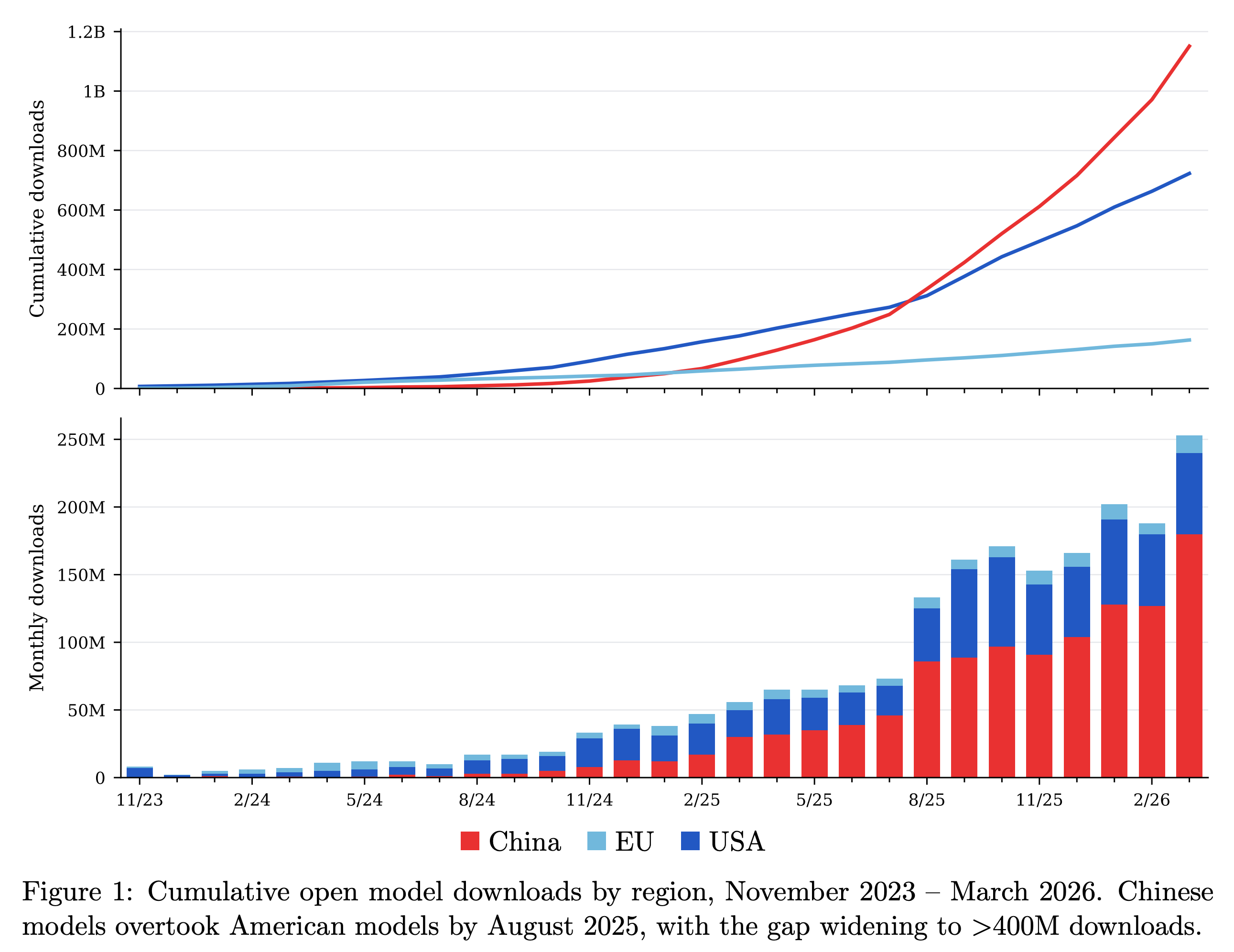
To accompany The ATOM Project memo, arguably a manifesto, making the case for investment in open models in the U.S. – originally launched in August 2025 – we’ve released an updated technical report with our latest data, analysis, and storytelling within the open language model ecosystem. The ATOM Report is dense with the methods Florian and I use to keep track of the open ecosystem. It covers GPT-OSS’s rise, inference market share, the influence of China’s mid-tier players like Moonshot, Z.ai, & MiniMax, signs of the U.S.’s progress on open models, and much more.

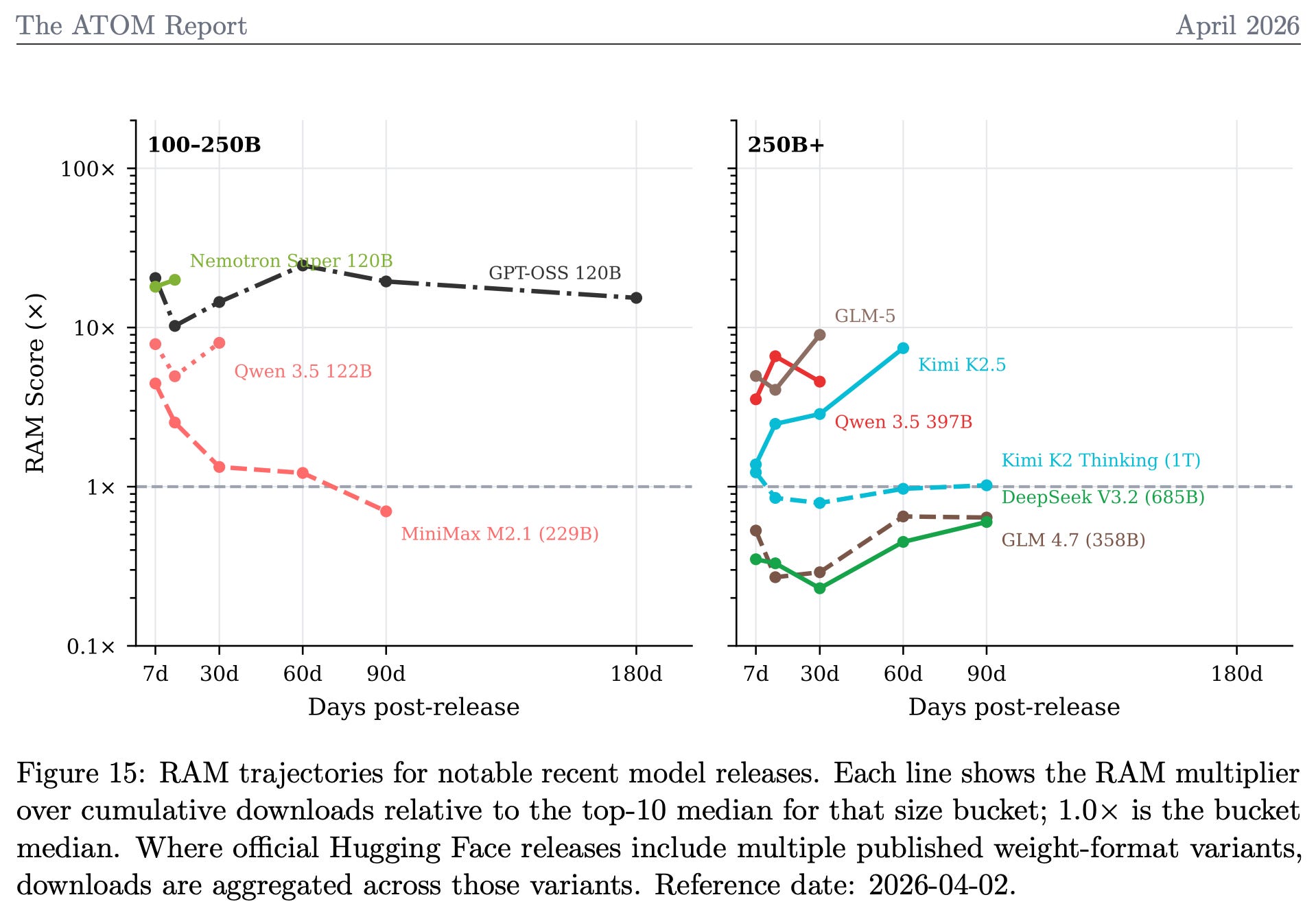
In particular, the paper details our updates to the Relative Adoption Metric (RAM), which we use to evaluate the adoption of recent models in a time-varying and size-normalized manner. Here’s a sampling of recent, primarily Chinese, models on the RAM score. The RAM score is designed so that a score >1 indicates a model is, at that point in time, on track to be a top 10 most downloaded model of its size category, ever. It reduces a messy landscape to one, easily interpretable number!

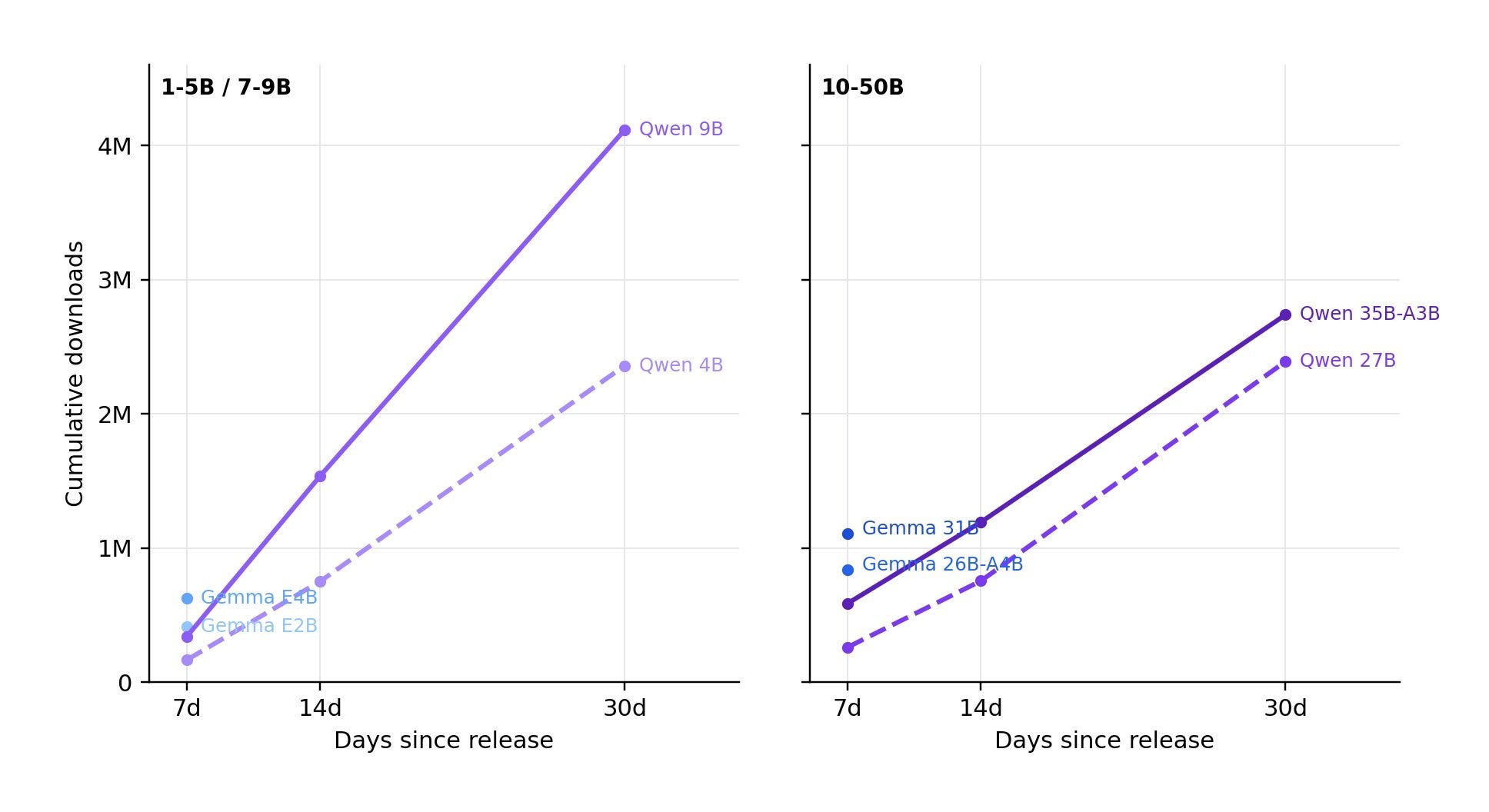
We used the data to also analyze the recent Gemma 4 release, which is showing incredible early adoption numbers. We’ll stay tuned on it!

Image

Subscribe to the (infrequent) ATOM Project Substack for more updates like this!

2. RLHF Book is done & ready for pre-order!

http://rlhfbook.com/

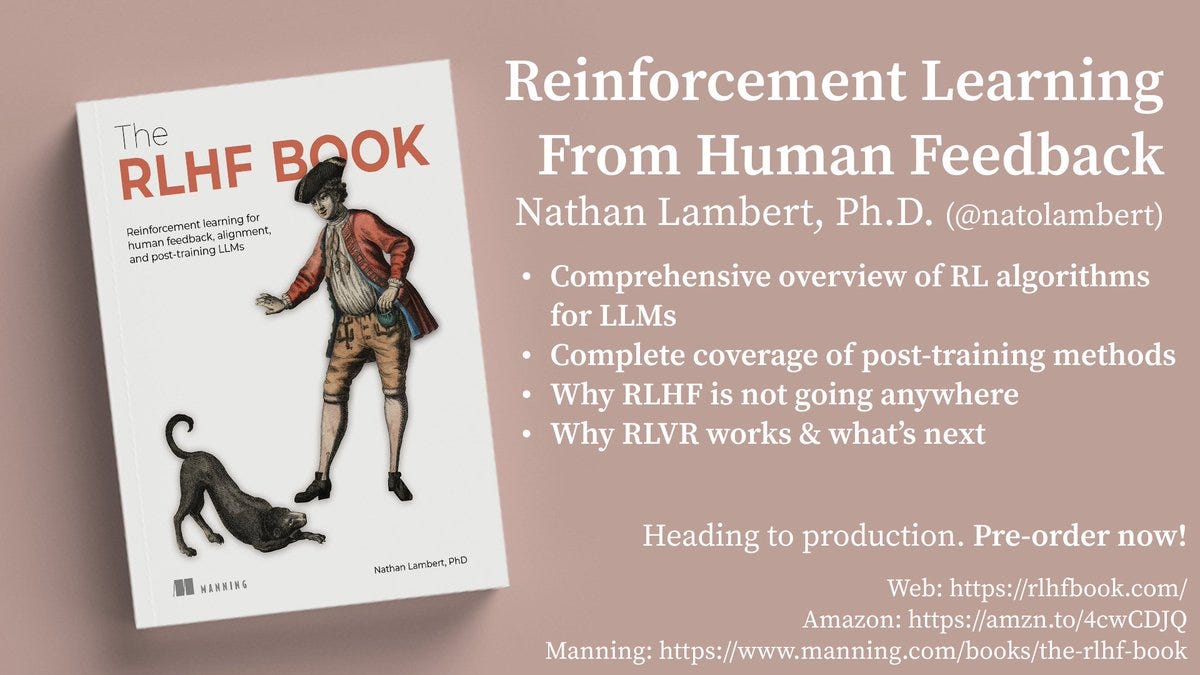
The goal of this book was to write the book I wished I had when I was getting started in post-training language models. This project has been on my mind for a long time. I bought the domain rlhfbook.com and started to take it more seriously on May 20th, 2024. Here we are!

Last week, it was sent to production with the Manning team. This means content edits are done, and it’ll be sent to print in ~2 months. In the meantime, I’m spending my time developing the accompanying code and course (more on that below).

You can preorder on Amazon or Manning (currently cheaper).

Image

3. A post-training course I’m making

https://rlhfbook.com/course

The goal of my book is for it to be the central resource for people looking to transition from beginner to expert in post-training. It’s not necessarily an entry-level book, but as AI models become stronger, it needs to be a community-building effort as well. The first step I’ve made to expand the scope from just a book to a complete learning experience is building a lecture series. The lectures will be freely available on YouTube and incorporate community questions & answers (as standalone videos in between lectures).

You can watch the first batch of videos below, and subscribe on YouTube for future ones. I’m going to build on the book platform more this summer, as I develop the book codebases and host in-person events.

4. Recent technical research

Long-time followers of Interconnects know that this blog has its roots in explaining fundamental research in the field. This has immense value in two ways. First, as AI moves incredibly fast, far more people need to be able to parse research to make the right bets on the technology. Research is the only early warning of some big changes coming. Second, it helps uplift the careers of my collaborators – the people I spend my life with! On that note, check out two papers I had the privilege of being part of below.

https://arxiv.org/abs/2603.16759 - TurnWise: The Gap between Single- and Multi-turn Language Model Capabilities, Graf et al. 2026

This work explores the strengths of various models in multi-turn dialogue settings, how to create training data to improve it, and other quirks in post-training. My interests here have fully shifted to agents, where I see multi-turn interactions as a very important user interface problem — what information do I show to the user to solve the task as soon as possible without cutting corners?

https://arxiv.org/abs/2603.11327 - Meta-Reinforcement Learning with Self-Reflection for Agentic Search, Xiao et al. 2026

This paper frames solving hard problems with RLVR as a meta-learning problem, where context from previous attempts should be used to inform future rollouts. It’s a very obvious idea in some ways, where most of RL for LLMs is still very on-policy, but naive. The models learn from recent trials in parameters, but not in context. This research feeds into a ton of other recent work on ways that RL can be formulated to solve different forms of continual learning. Another great related paper is Learning to Discover at Test Time.


Leave a comment

I’m off to China (and then hopefully DC) in the next couple of months to learn even more about how the world sees progress in AI. I’m excited to talk to a broader range of people than I tend to in my focused technical job. Thanks for reading, as always!

The inevitable need for an open model consortium

11 April 2026 at 13:02

Recently, I was talking with Percy Liang, Stanford professor and lead of the Marin project (another fully-open model lab), and it set in on me that there will eventually be a consortium of companies funding a foundational set of open models used across industry. It’s not clear when this’ll emerge, and Nemotron (Coalition) is Nvidia’s attempt to bankroll and bootstrap this approach within a single wealthy company, but a consortium is the only long-term stable path to well-funded, near-frontier open models.

In recent months, we’ve seen a lot of turnover in open model labs, with high-profile departures at Qwen and Ai2 (my comment). This shouldn’t be super surprising to followers of the ecosystem — it’s happened before with Meta shifting its focus away from Llama, and it’ll only happen more as the cost of trying to keep pace at the frontier of AI only increases. The other leading labs with models available today include Chinese startups such as Moonshot AI, MiniMax, and Z.ai — all of which look precarious on their ability to fund continued growth in the cost of training or R&D. Releasing one’s strongest models openly today is in active tension with the option of spending focus and resources on AI products that can currently generate meaningful revenue (and profits).

Share

We’re going to see business models emerge around releasing some, or even many, models openly, but these will largely be smaller models that enable a long-tail of functionality, rather than models at the absolute frontier. This class of companies that’ll release many, strong fine-tunable models will include the likes of Arcee AI, Thinking Machines, OpenAI, Google with Gemma, and more in that class. The cost and relative advantage of keeping the best models closed in a business environment with many opportunities for revenue are too high. To summarize — there will be an ever increasing number of companies releasing models that are good for creating a lively niche of smaller, custom models, but an ever decreasing number of companies willing to release fully open, near-frontier models.

This is the core thesis of why I’m pushing hard for more people to do more research on how these smaller models can complement the best closed agents, the science of finetunability, etc. See my post below — it’s about creating a sustainable open model ecosystem, whether or not the frontier of open keeps paced with closed:

It’ll take years for this equilibrium to become more obvious, seen through the lens of more open model families coming and going. This year, it seems likely we’ll see Nvidia’s Nemotron reach new heights, Reflection AI challenge some of the Chinese models with a strong, large MoE, maybe Meta releases a new open-weight model, and so on. True pressure to change strategy will only come when the capital environment punishes the less efficient spend on resources (e.g. giving away your competitive advantage, in having an in-house model). This pressure will likely hit Chinese startups training these models first.

All of Moonshot AI, MiniMax, and Zhipu AI will show signs of financial challenge in the coming years if they retain their strategy, on top of their models falling further behind the best open models in terms of generality. This is inevitable pressure to evolve open models to areas that are profitable and complementary of the frontier of AI.

Nvidia, which is best positioned to support the open ecosystem in the near term to support its core GPU business, could face many pressures to pull back its open model efforts. It could:

  • Realize it’s too competitive to their biggest customers as they succeed too much with Nemotron,

  • Fall to competition on their core business and lose the free cash flow buffer needed to fund this (e.g. it’s 2031 and OpenAI, Anthropic, Google, and the other frontier labs are worth so much they build their own chips).1

  • Start succeeding beyond their initial goals and keep the chips for them to build ASI themselves, as a closed-weight model.

The pressures for new funding mechanisms for open models are based on the assumptions of continued, substantive progress on the capabilities of frontier models. Mechanisms such as self-improvement and scaling all stages of the training pipeline are underway. This progress of capabilities will only increase the potential profit in selling models as and in products, not giving them away. The scale of investment required has already begun to push away non-profits from the game of making truly frontier-scale models.2 Capitalism is designed to make companies ruthless and chase down leads on profitability, not donate technology as charity.

As the economic environment shifts companies away from releasing the strongest models openly, more companies that rely on these models will look for an outlet of securing model access into the future. This is going to be compounded by a growing group of companies who come to rely on open-weight models for their workflows.

These points loop back into how model training is getting more expensive, so where desire to have the models will go up, ability to procure them will go down for many players. There are x-factors that could multiply the demand for institutions to ensure the existence of open models, such as the best frontier models not even being available via API (such as if Claude Mythos never goes general access).

Subscribe now

As training relevant models is shifting to cost billions of dollars, rather than millions, few companies well be able to afford it. many companies will bite at the cost of paying 1/10th of the cost to train a frontier model, or if the consortium works, 1/50th. The upside for companies will be some mechanism to steer development (e.g. model sizes) or getting early access to develop internal and open-source tooling for the model.

It is in my nature to, by default, say this idea will fail, as training models is inherently a complex and high-focus endeavor, one that requires integration of every part of the stack and focusing specifically on your own vision and needs, rather than trying to serve every possible user. Eventually the need for open intelligence — and economic pressure to build it — will make a model consortium inevitable.

1

There’s a meaningful chance in my estimates that Anthropic, OpenAI, and Google are the most valuable companies in the world in the 2030s by owning frontier intelligence.

2

Truly open is a prospect for safety research and long-term innovation, which suits both the narratives of AI risk and AI optimism. We need it for both. Mech interp is one of the heaviest users of Olmo models. If we don’t find what’s after the transformer, there may not be enough benefit to AI models. (edit, I had published that as a half baked thought, it’s about how fully-open models operate in the ecosystem differently) All of these are largely orthogonal to the point of the post.

Claude Mythos and misguided open-weight fearmongering

9 April 2026 at 21:28

With the announcement of the Claude Mythos model this week and the admittedly very strong stated abilities, especially in cybersecurity, a new wave of anti open-weight AI model narratives surged. The TL;DR of the argument is that our digital infrastructure will not be ready in time for an open-weight version of this model, which will allow attacks to be conducted by numerous parties.

The backlash against open models in the wake of the Mythos news conflates too many general unknowns into a simple, broad policy recommendation that could actually further weaken cybersecurity readiness.

We’ve been here before – open-weight models were discussed as being extremely dangerous when OpenAI withheld GPT-2 weights in 2019, and when OpenAI released GPT-4 in 2023. Both of these waves came and went. The core mistake that is being made is the composition of two issues: 1) the acceptance of the open-closed model gap being static in time and 2) linking open-weight viability generally to specific issues.

I’ve written at length recently on how I think that the best, frontier-level open weight models are going to fall behind the best closed models in overall capabilities in the near future. I’ve also written about how the open-weight ecosystem needs to adapt to accept this reality. This is one of the times for the AI industry where I will repeat that it’s a total blessing to have the 6-18 month delay from when a certain capability is available within a closed lab to it being reproduced in the open. It’s a good balance of safety and monitoring the frontier of AI systems while allowing a useful open-source ecosystem to exist and thrive.

The core argument I’ve focused on in the open-closed model time gap has been in general capabilities – i.e. for general purpose, frontier models such as Claude Opus 4.X or GPT Thinking 5.X. The abilities of these closed models to robustly solve and work in diverse situations as agents remains out of scope of the best open-weight models. What the open-weight models have tended to be better at is quickly keeping pace on key benchmarks (which admittedly is helped to some extent, but not necessarily substantially by distillation). This discussion is entirely different, it has to do with if open weight models can keep pace on the specific skills related to cybersecurity, and when we could expect an open version of this model to be available to the world.

The case of a Claude Mythos level open weight model is admittedly more nuanced to me than the previous few anti-open weight narratives the community has experienced. Where GPT-4 was about a more hypothetical risk, especially in areas like bio-risk, the clear and present reality of cyber infrastructure being prone to attack is far more tangible. Still, much of this nuance in the moment comes down to not knowing the full details of what the system can actually do (i.e. Mythos), and the state of the environment it would act in (i.e. our digital infrastructure).

To properly assess this risk, we need to know what it takes to build and deploy a Claude Mythos scale model. This entails three pieces: 1) training and releasing the weights, 2) the harness that gives the model effective tools it knows how to use, and 3) the inference compute and software.

Share

(Below I make some model size & price estimates to show my thinking, these should not be taken as ground truth.)

Current estimates put the size ranges of leading models like Claude Opus 4.6 or GPT 5.4 as being around 3-5T parameters. Currently, the largest open-source models, which have been coming from Chinese labs, are around 1T parameters. Claude Mythos’s preview pricing is 5X Opus, which could come from a simple multiplicative increase in active parameters (with the same serving system design), far higher inference-time scaling, more complex harnesses that make inference less efficient, lower utilization expectations, and so on. The simplest guess is that it’s a mix of all of the above, something like 2X bigger in parameters and much less efficient to serve. That’s a huge model, likely something similar to GPT 4.5, but actually post-trained well (GPT 4.5 was ahead of its time, infra-wise).

With size comes the challenge actually training the model, as bigger models always come with new technical problems that must be solved to unlock the capabilities. For the case of cybersecurity, my guess is that most of the capabilities can be learned by training a model to be superhuman on coding. Unlike some capabilities such as knowledge work, medicine, law, etc., coding can be studied and improved substantially with public data like GitHub. I’m far more optimistic in open-weight models staying fairly close to the frontier in narrow domains of code execution and processing, but I don’t understand the full scope of skills needed to be superhuman in cybersecurity understanding. How much expert knowledge and special sauce went into training Claude Mythos? That’s a substantial source of my error bars on the impact.

Second, we know nothing about how the model works under the hood. Today, models are complex systems that entail far more than just weights. They require complex tools and infrastructure to run them, of which Claude Code is the one we are most used to. Mythos very likely has its own innovations here.

My estimate for how many GPUs you’d need to serve an 8T parameter, modern MoE is something like O(100) H100 GPUs, which costs something like $10K a day (and this may be very slow in terms of tok/s). Heck, the official marketing copy of the Nvidia GB200 VL72 system is “Unlocking Real-Time Trillion-Parameter Models” on the rack. Does Mythos fit on one rack? The point isn’t to rely on my specific estimate as a policy reference, but to repeat that running leading AI systems is very expensive and not something you can just do on a laptop or self-service cloud portals.

There are far fewer actors who can get their hands on these resources, relative to those who can download the model. Of course, there are still many, but it’s important to flesh out all the details of what it would take to proliferate the capabilities of a Mythos-like model. In summary, tools like Mythos will make the best attackers have more powerful tools of the trade, but it won’t be handing a nuke to every teenager connected to the internet.

Interconnects AI is a reader-supported publication. Consider becoming a subscriber.

Personally, I do acknowledge there’s a chance that cybersecurity abuse is a red line that makes releasing open-weight text models above a certain capability threshold morally grey. Many people thought this red line would come far earlier, somewhere in between GPT-2 and GPT-4, through the harm axis of mis/disinformation, but that had different bottlenecks. For image generation models, we’re well past the first red line which is enabling non-consensual AI deepfakes with readily available open-weight models. We’re balancing the reality of these fears having come and gone before with a technology that’s becoming increasingly capable.

So, my second large source of error bars is “how bad is it actually” with respect to the state of cybersecurity. How much can humans clean up in the most important software with months of private access to a model like Claude Mythos? What will never get fixed?

For example, if we get open-weight models that are close to the capabilities of Claude Mythos, could those be fine-tuned by organizations to harden the security of their tools?

Currently, it’s too soon to call it as a general reason to stop progress in open models. When Claude Mythos is closed to so few partners, in some ways having strong open models close to the threshold makes assessing the danger easier. Having to rely fully on a single private company to determine the security of essential, international infrastructure is not a tenable equilibrium.

So, in conclusion, I urge people to further study three things:

  1. How do we measure cybersecurity related capabilities across open and closed models. With this, are open models truly keeping up at a 6-9month lag, or are they only maintaining performance relevance in other areas of coding?

  2. How do we independently measure the true impact of Claude Mythos and Project Glasswing on existing cybersecurity concerns?

  3. If it is the case that the models are keeping up and the defensive capabilities of Claude Mythos are weak, how do we better monitor (and if needed, try to regulate) the targeted capabilities of open-weight models in narrow domains?

The goal is to encourage fears about open models remaining very specific. Any general ban on open models in a nation will immediately and likely irrevocably remove that entity’s ability to influence a crucial, and amorphous technology. If we stop building the best open models in the U.S., then another country will do this and become the center of the technology. There’s no way to fully kill open models, only influencing, understanding, and steering.

❌