❌

Reading view

Modernize your workflows: Amazon WorkSpaces now gives AI agents their own desktop

Enterprises face a significant challenge when deploying AI agents: the desktop and legacy applications that power most business workflows are simply inaccessible to modern AI systems. According to a 2024 Gartner report, 75% of organizations run legacy applications that lack modern APIs, and 71% of Fortune 500 companies operate critical processes on mainframe systems without adequate programmatic access. For many organizations, this has meant choosing between delaying AI adoption or undertaking expensive and risky modernization projects.

Today, we are announcing that Amazon WorkSpaces now enables AI agents to securely operate desktop applications without requiring application modernization. The same managed virtual desktops that millions of employees use and trust can now also serve AI agents, turning WorkSpaces into infrastructure for scaling enterprise productivity, not just delivering it. Because agents operate within your existing WorkSpaces environment, there are no APIs to build, no application migrations to plan, and no new infrastructure to manage.

Some of our customers had an early opportunity to give their agents a WorkSpace. Chris Noon, Director, Nuvens Consulting shared with us, “WorkSpaces lets our clients give AI agents the same secure, governed desktop environment their employees already use — no custom API integrations, full audit trails, and enterprise-grade isolation out of the box. For regulated industries, that’s not a nice-to-have — it’s the baseline.”

Secure cloud desktop access for AI agents
With WorkSpaces, AI agents can securely access and operate desktop applications running inside managed WorkSpaces environments to complete complex business workflows. Agents authenticate through AWS Identity and Access Management (IAM) and connect via Workspaces with complete audit trails available through AWS CloudTrail and Amazon CloudWatch. Because agents operate within secure WorkSpaces environments rather than on local machines, your existing security controls and compliance policies remain fully intact.

Amazon Workspaces supports the industry-standard Model Context Protocol (MCP), which means WorkSpaces works with any agent framework, such as LangChain, CrewAI and Strands Agents.

Let’s try it out
To set up a WorkSpaces environment for AI agents, I started in the AWS Management Console by creating a new WorkSpaces Applications stack—the environment definition that controls how agents connect and what they’re allowed to do.

From the Amazon WorkSpaces console, I chose Create stack and configured the basics: name, fleet association, and VPC endpoints. In Step 3 of the stack creation workflow, I noticed the new AI agents section with two options. The first, No AI agent access, is the default configuration for standard WorkSpaces designed for people. The second, Add AI Agents, allows AI agents to securely access and operate applications using their own identity and permissions. I selected Add AI Agents to enable agent connections on this stack.
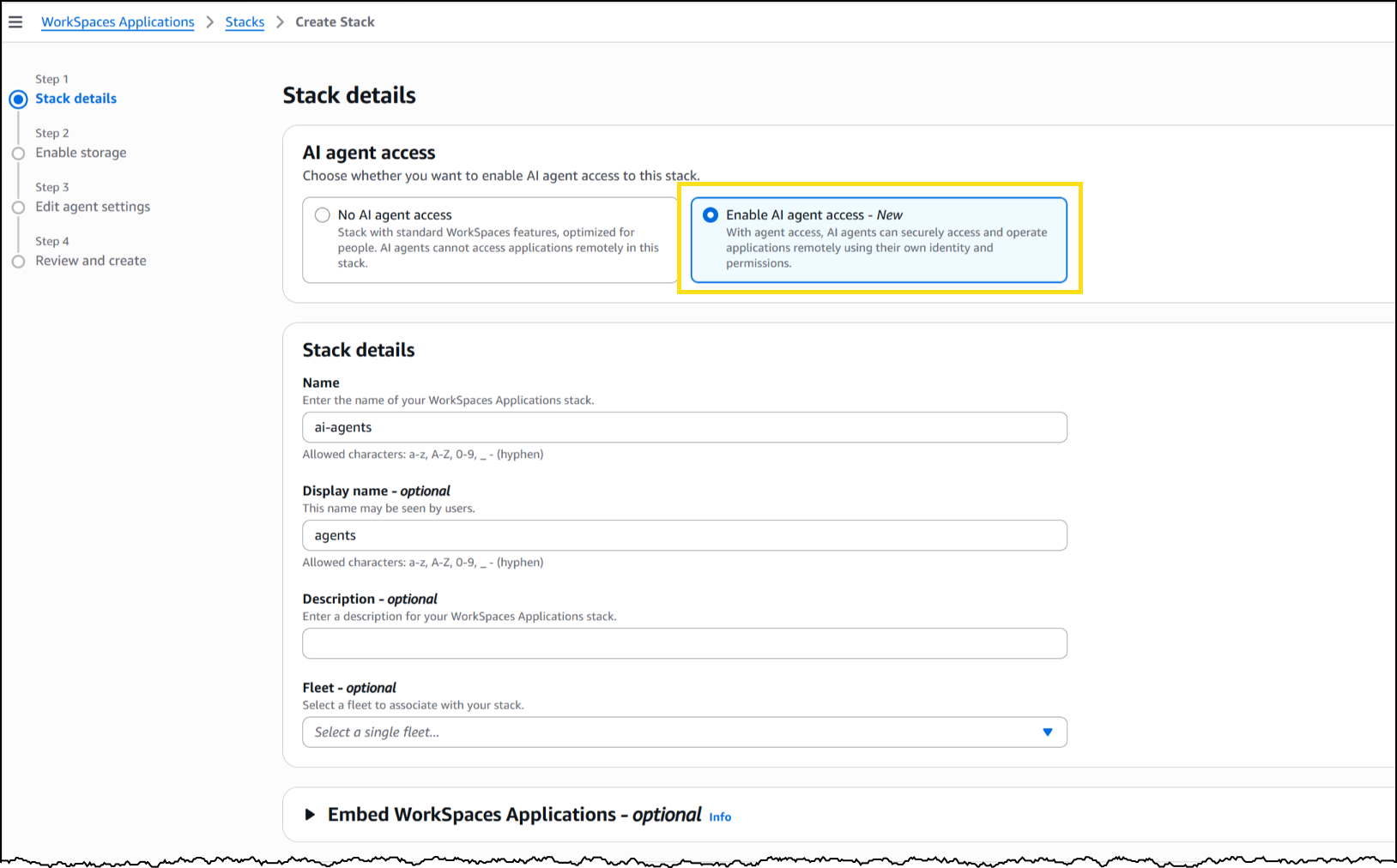
Workspaces Screenshot

Next, I will enable storage before configuring the agent access settings to define how agents interact with the desktop.
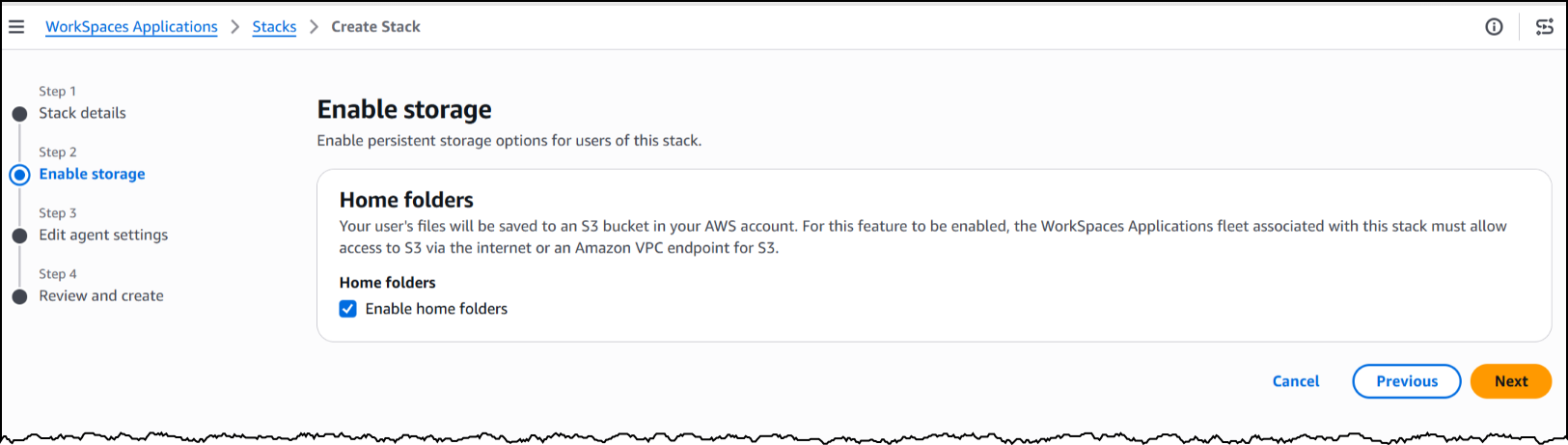
Workspaces screenshot

Under Agent features, I enabled three capabilities. Computer input allows the agent to click, type, and scroll within the desktop. Computer vision allows the agent to capture screenshots of the desktop, which is how it “sees” the application. Finally, screenshot storage configures where session screenshots are stored for audit and debugging.
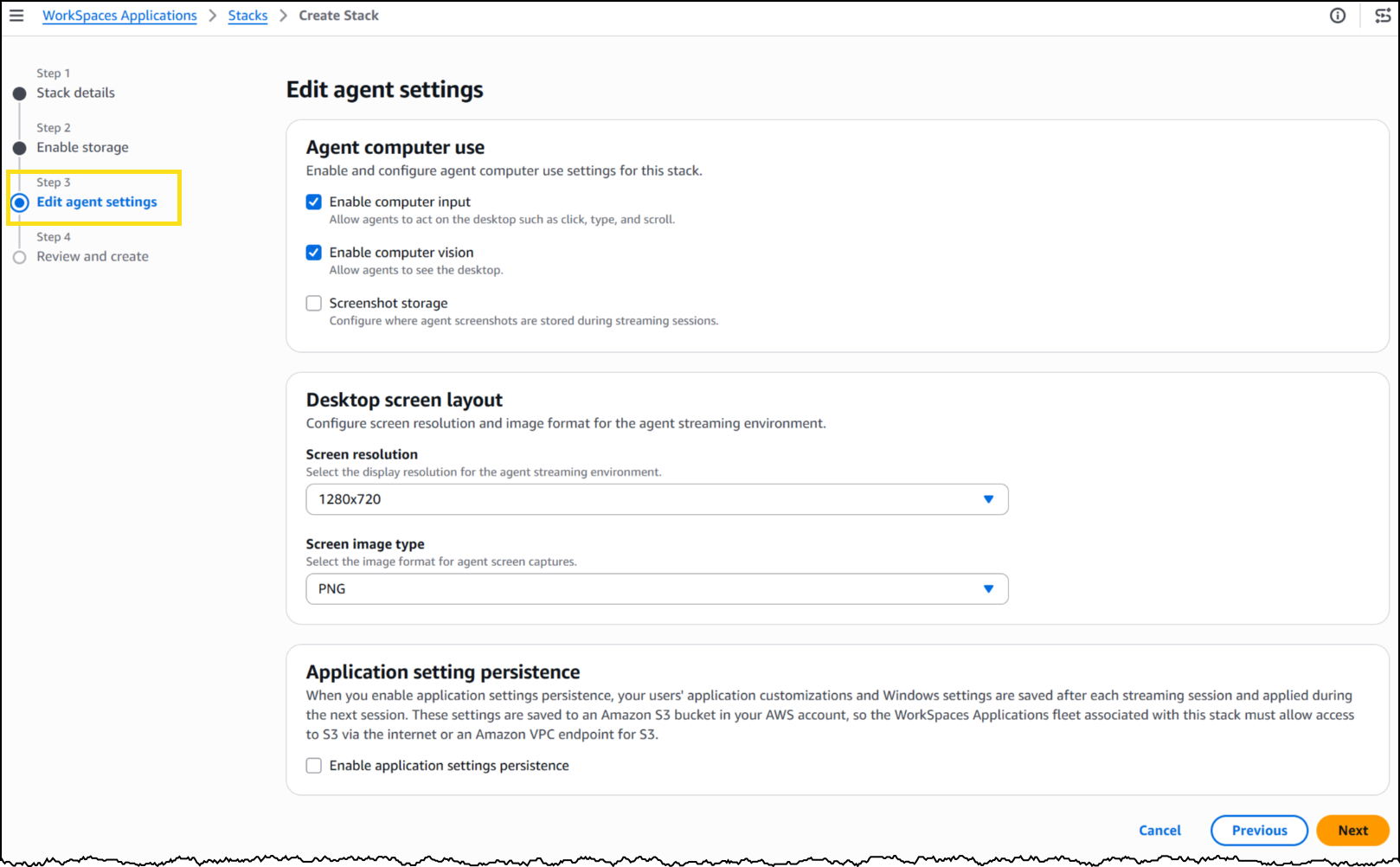
Workspaces Screenshot

Under Desktop screen layout, I set the screen resolution to 1280×720 and image format to PNG. The resolution determines the fidelity of what the agent sees during a session—a complex application with dense UI elements might benefit from higher resolution, while a terminal-style interface works well at 720p.
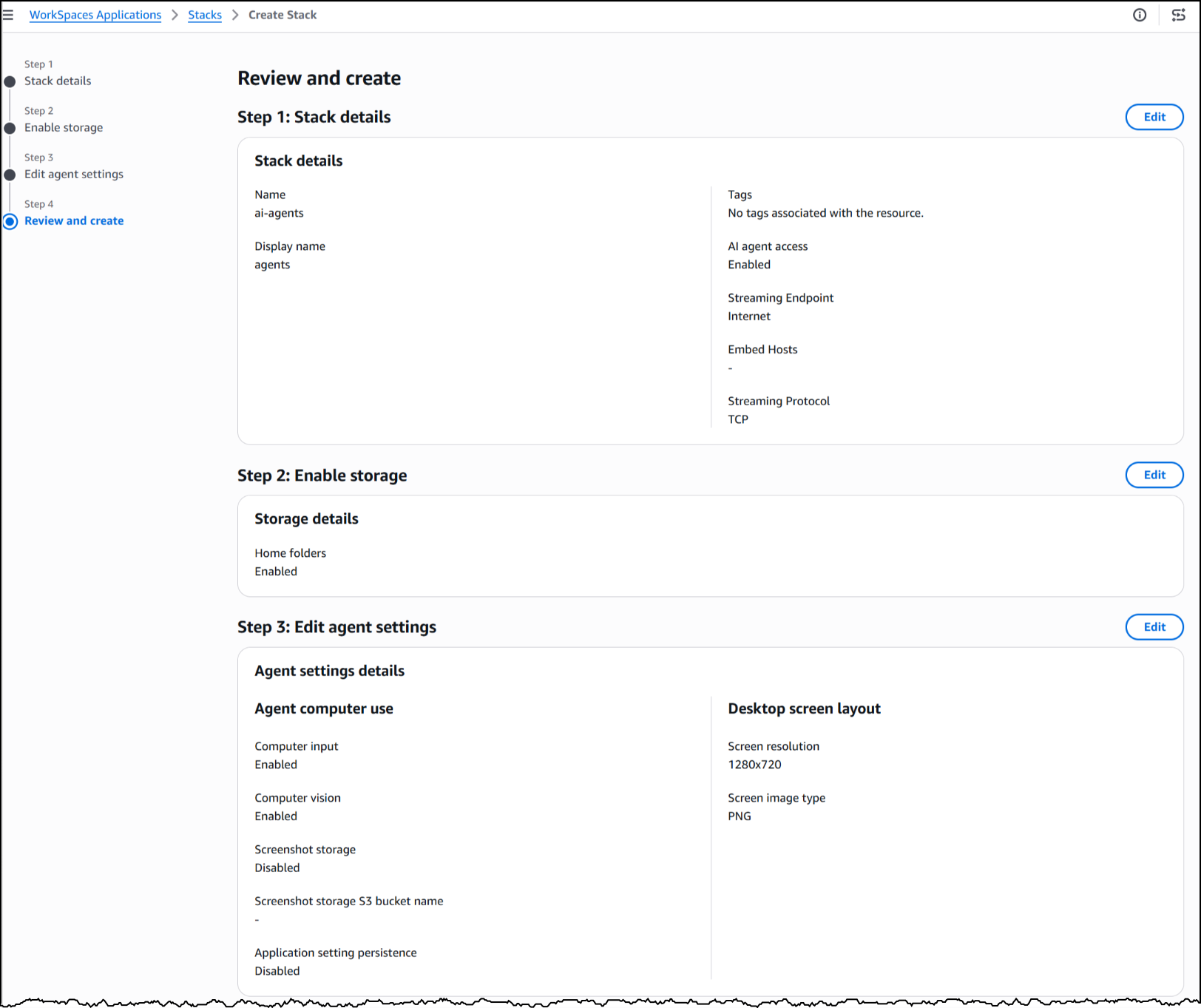
Workspaces Screenshot

With my stack configured, WorkSpaces exposes a managed MCP endpoint. I pointed my agent framework to this endpoint, provided IAM credentials for authentication, and my agent began interacting with the desktop applications installed on the fleet’s image.

To see this in action, here’s an agent built with the Strands Agent SDK and Amazon Bedrock handling a prescription refill, looking up the patient record, searching for the medication, placing the order, and confirming a successful refill, all inside a sample pharmacy system with no API.

The application doesn’t know an agent is driving it. Nothing about the software was modified, rebuilt, or integrated. The agent worked with it exactly as it exists today.

Now available
This feature is available today at no additional cost in US East (N. Virginia, Ohio), US West (Oregon), Canada (Central), Europe (Frankfurt, Ireland, Paris, London), and Asia (Tokyo, Mumbai, Sydney, Seoul, Singapore) Regions.

Get started building today using our GitHub repo, or visit the WorkSpaces page for more details.

Updated July 1, 2026– Feature has moved from public preview to GA.

  •  

AWS Weekly Roundup: Claude Mythos Preview in Amazon Bedrock, AWS Agent Registry, and more (April 13, 2026)

In my last Week in Review post, I mentioned how much time I’ve been spending on AI-Driven Development Lifecycle (AI-DLC) workshops with customers this year. A common theme in those sessions is the need for better cost visibility. Teams are moving fast with AI, but as they go from experimenting to full production, finance and leadership really need to know who is using which resources and at what cost. That’s why I was so excited to see the launch of Amazon Bedrock new support for cost allocation by IAM user and role this week. This lets you tag IAM principals with attributes like team or cost center and then activate those tags in your Billing and Cost Management console. The resulting cost data flows into AWS Cost Explorer and the detailed Cost and Usage Report, giving you a clear line of sight into model inference spending. Whether you’re scaling agents across teams, tracking foundation model use by department, or running tools like Claude Code on Amazon Bedrock, this new feature is a game changer for tracking and managing your AI investments. You can get all the details on setting this up in the IAM principal cost allocation documentation.

Now, let’s get into this week’s AWS news…

Headlines
Amazon Bedrock now offers Claude Mythos Preview – Anthropic’s most sophisticated AI model to date is now available on Amazon Bedrock as a gated research preview through Project Glasswing. Claude Mythos introduces a new model class focused on cybersecurity, capable of identifying sophisticated security vulnerabilities in software, analyzing large codebases, and delivering state of the art performance across cybersecurity, coding, and complex reasoning tasks. Security teams can use it to discover and address vulnerabilities in critical software before threats emerge. Access is currently limited to allowlisted organizations, with Anthropic and AWS prioritizing internet critical companies and open source maintainers.

AWS Agent Registry for centralized agent discovery and governance now in preview – AWS launched Agent Registry through Amazon Bedrock AgentCore, providing organizations with a private catalog for discovering and managing AI agents, tools, skills, MCP servers, and custom resources. The registry helps teams locate existing capabilities rather than duplicating them, with semantic and keyword search, approval workflows, and CloudTrail audit trails. It is accessible via the AgentCore Console, AWS CLI, SDK, and as an MCP server queryable from IDEs.

Last week’s launches
Here are some launches and updates from this past week that caught my attention:

  • Announcing Amazon S3 Files, making S3 buckets accessible as file systems – Amazon S3 Files transforms S3 buckets into shared file systems that connect any AWS compute resource directly with your S3 data. Built on Amazon EFS technology, it delivers full file system semantics with low latency performance, caching actively used data and providing multiple terabytes per second of aggregate read throughput. Applications can access S3 data through both file system and S3 APIs simultaneously without code modifications or data migration.
  • Amazon OpenSearch Service supports Managed Prometheus and agent tracing – Amazon OpenSearch Service now provides a unified observability platform that consolidates metrics, logs, traces, and AI agent tracing into a single interface. The update includes native Prometheus integration with direct PromQL query support, RED metrics monitoring, and OpenTelemetry GenAI semantic convention support for LLM execution visibility. Operations teams can correlate slow traces to logs and overlay Prometheus metrics on dashboards without switching between tools.
  • Amazon WorkSpaces Advisor now available for AI powered troubleshooting – AWS launched Amazon WorkSpaces Advisor, an AI powered administrative tool that uses generative AI to help IT administrators troubleshoot Amazon WorkSpaces Personal deployments. It analyzes WorkSpace configurations, detects problems automatically, and provides actionable recommendations to restore service and optimize performance.
  • Amazon Braket adds support for Rigetti’s 108 qubit Cepheus QPU – Amazon Braket now offers access to Rigetti’s Cepheus-1-108Q device, the first 100+ qubit superconducting quantum processor on the platform. The modular design features twelve 9 qubit chiplets with CZ gates that offer enhanced resilience to phase errors. It supports multiple frameworks including Braket SDK, Qiskit, CUDA-Q, and Pennylane, with pulse level control for researchers.

For a full list of AWS announcements, be sure to keep an eye on the What’s New with AWS page.

Other AWS news
Here are some additional posts and resources that you might find interesting:

Upcoming AWS events
Check your calendar and sign up for upcoming AWS events:

  • What’s Next with AWS (April 28, Virtual) Join this livestream at 9am PT for a candid discussion about how agentic AI is transforming how businesses operate. Featuring AWS CEO Matt Garman, SVP Colleen Aubrey, and OpenAI leaders discussing emerging agent capabilities, Amazon’s internal experiences, and new agentic solutions and platform capabilities.

Browse here for upcoming AWS led in person and virtual events, startup events, and developer focused events.


That’s all for this week. Check back next Monday for another Weekly Roundup!

~ micah

  •  
❌