Autonomous agents are moving faster than the field’s ability to govern them, and catching up requires more than better prompts or bigger sandboxes. At O’Reilly’s recent AI Superstream focused on OpenClaw and the broader ecosystem of locally run and self-hosted AI agents, five speakers, each working at a different layer of the stack, explored patterns […]
The following article originally appeared on Addy Osmani’s blog and is being republished here with the author’s permission. I cowrote a Google whitepaper about how AI is changing the software lifecycle. I’m not going to summarize the whole thing. Instead, here are the handful of ideas in it I think actually matter, plus six figures […]
The following article originally appeared on Paolo Perrone’s Substack, The AI Engineer, and is being republished here with the author’s permission. You spent three weeks shipping an agent. It worked in the demo. Then production hit, and you realized the framework you picked has no checkpointing, the memory layer is a flat vector dump with […]
AI-assisted development has made frontend work feel much faster. A developer can ask for a form, a dashboard card, a table, a modal, or a responsive layout and get a decent first version almost immediately. The code may compile. The page may render. At first glance, the UI may look done. But frontend developers know […]
This week data and AI evangelist Christina Stathopoulos returned for a solo news briefing. Instead of exploring one or two topics in depth, Christina sorted the week’s headlines into a handful of threads: advances in physical hardware to keep up with AI demand, the widening reach of government oversight into frontier model companies, and a […]
The incident that should worry you makes no destructive call. Nothing is deleted, nothing crashes, no alert fires. An employee asks an agent to summarise a customer ticket; the agent does exactly that, the user gets a useful answer, and somewhere, in the same second, a customer record leaves the cluster over an ordinary HTTPS […]
The following article originally appeared on Charity Majors’s Substack and is being republished here with the author’s permission. I recently attended a talk where one of the presenters made some pretty…astonishing claims about what they had achieved by the pure, uncut power of vibe coding. Difficult engineering problems solved, backlogs cleared. Rewrites that would have […]
The following article originally appeared on Markus Eisele’s newsletter, The Main Thread, and is being republished here with the author’s permission. There’s a mental model spreading through the developer community right now that goes something like this: Agents are smart enough to figure things out, so heavy upfront specification is bureaucratic overhead you don’t need […]
In the 1980s, Japan led the world in semiconductors, consumer electronics, and computer hardware, the industries everyone assumed would decide the next phase of economic power. Japan won them and still did not overtake the United States in the information revolution that followed. Jeff Ding, a political scientist at George Washington University, opens his book […]
This episode of This Week in AI arrived at a moment when the AI infrastructure most teams take for granted suddenly looked a lot less stable. Andreas Welsch, founder and chief human AI officer at Intelligence Briefing, was joined by Matt Palmer, head of developer experience at Conductor and developer educator on LinkedIn Learning, to […]
The following article originally appeared on Medium and is being republished here with the author’s permission. As companies adopt AI tools, a lot of time is spent on thinking about AI policies from a security, compliance, or even cost-focused angle. But many leaders are neglecting to address how their teams should work with AI in […]
The practice of tokenmaxxing appears to be dying out, even before I had a chance to write about it. Good riddance. Burning tokens to create the appearance of productivity was fated to last only until the accountants learned about it, and the strictest of all accountants is one’s personal checkbook. What got many developers thinking […]
In late 2025, the security community stopped treating indirect prompt injection as a theoretical risk. It had spent two years as a tidy lab demonstration; then production systems started getting hit. The OWASP Top 10 for LLM applications now ranks prompt injection as the number-one risk, NIST has called indirect injection generative AI’s greatest security […]
The following article originally appeared on Angie Jones’s LinkedIn page and is being republished here with the author’s permission.
I’m fascinated by the concept of agent memory. LLMs are stateless by design, meaning they have no memory or awareness of past interactions. Each prompt you send to an LLM is treated as a completely isolated event.
When you have a continuous chat with an AI agent, it feels like the AI remembers previous messages. However, the interface itself is faking it. Behind the scenes, your agent takes the entire conversation history and resends all of it to the LLM as one giant, combined prompt.
Companies, researchers, and even indie devs are all trying to crack agent memory. Because once an agent can remember, the entire interaction changes. It can build on what it learned, adapt to the user, resume work after a restart, and develop a sense of continuity.
Recently, I spent time with Richmond Alake, who has been in the trenches working on agent memory at Oracle.
Richmond Alake, the agent memory guru
We talked about the different kinds of memory, why memory is harder than it sounds, and what it takes to build a memory system that is actually useful in production.
That conversation made something very clear to me. When people say, “agent memory,” they often mean very different things.
So let’s unpack the various types of memory.
Conversational memory
Conversational memory is the one most people think of first. It stores the messages exchanged between the user and the assistant.
This makes sense. If I ask, “What did I say was the ultimate goal of this task?” the agent needs access to the conversation in order to answer. Without that history, every turn starts from zero.
But this is also where many memory systems go wrong.
The most common first attempt is to keep appending prior messages to the prompt. For example:
User: I’m building a customer support agent.
Assistant: Great, what should it do?
User: It should look up past tickets and draft replies.
Assistant: Got it.
User: Also, I prefer Python and FastAPI.
Then on the next call, we send all of that back to the model along with the new question.
This works for a short conversation, but the agent only “remembers” because we keep reminding it. This is not really memory engineering.
Eventually, the conversation gets too long and the model receives a giant blob of context where some details are important, some are stale, and some are completely irrelevant. The agent may technically have the information, but that doesn’t mean it can use it well.
So yes, conversation history is a valid and important type of memory. But it shouldn’t be the whole memory strategy. Real agent memory requires deciding what should be stored, where it should be stored, how it should be retrieved, and when it should be summarized, forgotten, or compressed.
Semantic memory
Semantic memory stores durable facts.
These are things that should outlive the exact conversation where they were learned:
The user prefers Python over TypeScript for backend work.
The customer support agent needs access to past tickets.
The production system handles 50,000 queries per day.
This is different from conversational memory because the exact wording and sequence are less important. What matters is the meaning.
If the agent needs to recall what stack the user is using, it should retrieve the memory even if the user never says those exact words again.
Vector search is useful for this. The memory can be embedded and retrieved by semantic similarity.
The benefit is that the agent doesn’t need to replay the full conversation. It can retrieve the few durable facts that are relevant to the current request.
Episodic memory
Episodic memory stores events.
This is the “what happened” layer of memory:
The agent searched the web for recent API gateway patterns.
The agent generated a draft response for ticket #4821.
The workflow failed at the compliance review step.
Episodic memory is especially useful for debugging, auditing, and long-running workflows.
For example, if an agent makes a decision, I may want to know what happened right before that decision (e.g., What tools did it call? What data did it retrieve?).
This type of memory often benefits from structured storage.
For example:
Find all failed tool calls from the mortgage approval workflow in the last 24 hours.
That is a database query problem, not just a vector search problem.
Procedural memory
Procedural memory is about how to do things.
For example:
When investigating a failed deployment, check logs first, then recent config changes, then dependency updates.
When drafting a customer support reply, include the ticket summary, likely cause, recommended fix, and next step.
When creating a database-aware agent, scan table comments, column comments, constraints, and recent workload patterns.
This is the kind of memory that helps an agent improve its process. That’s powerful because agents are often asked to operate in messy real-world environments. With procedural memory, it can reuse proven approaches.
The value extends beyond just knowing things to actually knowing how to proceed.
Entity memory
Entity memory stores facts about specific people, accounts, projects, systems, tickets, or objects.
For example:
Angie prefers practical examples over abstract explanations.
Customer Acme Corp has strict data residency requirements.
Ticket #4821 is related to a billing reconciliation issue.
Entity memory matters because many agent tasks are scoped around a particular thing.
If I ask, “What do we know about Acme Corp?” I don’t want every memory in the system. I want memories attached to that customer.
This is also where memory safety becomes important.
Agents should not accidentally mix memories between users, customers, or projects. A memory system needs strong scoping so one user’s context does not leak into another user’s response.
Working memory
Working memory is the short-term scratchpad for the current task.
This is where the agent keeps temporary information while reasoning through a problem.
Working memory is usually not meant to last forever. It’s useful during the task, but it may not deserve to become durable memory.
If an agent stores every temporary thought as long-term memory, the memory store gets noisy very quickly. The agent may later retrieve half-baked assumptions as if they were facts, which is dangerous.
Not everything the agent observes or thinks should be remembered permanently.
Summary memory
Summary memory is one many agent users are familiar with. It deals with the problem of context windows being limited.
Even with large context models, you can’t keep appending forever. At some point, you need to compress.
Summary memory stores a compact version of a longer thread or context window. The original details can still live in the thread, but the prompt gets a smaller representation.
For example, instead of sending 80 turns of conversation, the agent might send:
The user is building a SaaS customer support agent. They prefer Python and FastAPI, deploy on OCI, and want the agent to retrieve past tickets before drafting replies. They are currently evaluating memory strategies for production usage.
Why memory is hard for agents
At first, memory sounds straightforward: store things, retrieve them later.
But the hard part is judgment, not storage.
What should be remembered? If the user says, “I usually prefer Python,” that’s probably worth remembering. If they say, “Let’s try Python for this one experiment,” maybe not. The agent needs to distinguish durable details from temporary context.
When should memory be updated? People change their minds, and systems and requirements change. If a user used to prefer FastAPI but now works mostly in Java, should the old memory be deleted, overwritten, or kept with a timestamp? A memory system needs a correction strategy.
How much memory should be retrieved? Retrieving too little means the agent misses important context. Retrieving too much means the prompt becomes noisy. This balance matters as more context isn’t always better.
How do we prevent memory leaks? If memories are shared across users, agents, or tenants, scoping is critical. The agent should only retrieve memories it’s allowed to use. This is especially important in enterprise systems where agents may operate across many customers, teams, or workflows.
How do we know whether memory helped? Memory should improve the agent’s behavior. It should reduce repeated questions, improve continuity, lower token usage, and help the agent produce more relevant responses. If memory just adds complexity without improving outcomes, it isn’t doing its job.
How Oracle is approaching agent memory
Richmond was gracious enough to share how Oracle is tackling this with the Oracle AI Agent Memory Package (OAMP), built on top of Oracle AI Database 26ai.
Yes, an AI database! Think of it as a database that can store and query the kinds of data AI applications need, not just rows and columns. That includes embeddings and JSON documents along with text search and regular SQL. These live together in the database, so an agent does not have to bounce between separate systems just to gather context.
The idea is to make Oracle AI Database the memory core for agents. Instead of stitching together a vector database, a relational database, a document store, and custom thread management, OAMP provides agent-friendly memory primitives on top of a database that already supports multiple data access patterns.
At a high level, OAMP gives you:
Users and agents to scope memory ownership
Memories for durable facts and extracted knowledge
Threads for conversation history and continuity
Context cards for compact, prompt-ready memory retrieval
Summaries for long-running conversations
Vector search for semantic recall
Database-backed persistence so memory survives restarts
This matters because, again, agent memory is not only a vector search problem. Some memory needs semantic retrieval. Some need ordered reads or exact SQL filtering. A database-backed memory system gives you room to support all of those patterns.
Here’s a small example of what that looks like in code:
from oracleagentmemory.core import OracleAgentMemory

from oracleagentmemory.core.llms import Llm

client = OracleAgentMemory(

    connection=connection,

    embedder="text-embedding-3-small",

    llm=Llm("gpt-5.5"),

    extract_memories=True,

    schema_policy="create_if_necessary",

)

client.add_user(

    "angie",

    "Developer exploring agent memory patterns."

)

client.add_agent(

    "memory-demo-agent",

    "Assistant that demonstrates Oracle AI Agent Memory."

)

client.add_memory(

    "Angie is fascinated by agent memory and prefers practical examples over abstract explanations.",

    user_id="angie",

    agent_id="memory-demo-agent",

)
There are a few important ideas packed into this snippet.
The OracleAgentMemory client is the bridge between the agent application and Oracle AI Database. The database connection tells OAMP where memory lives. The embedder tells it how to turn memory text into vectors for semantic retrieval. The LLM enables automatic memory extraction and summary generation. And schema_policy="create_if_necessary" lets OAMP manage the underlying memory schema instead of making every application reinvent it.
The user and agent registration may look like simple setup code, but it’s actually part of the memory model. Memories need ownership. In a real system, you don’t want one user’s preferences showing up in another user’s session, and you don’t want memories written by one agent casually mixed with another agent’s context. The user ID and agent ID give the memory layer a way to scope what gets stored and retrieved.
The add_memory() call stores a durable fact. This is a piece of information the agent may need later, even if the exact conversation has moved on.
Given this, we can now recall memories.
results = client.search(

    "how should I explain this topic to Angie?",

    user_id="angie",

    max_results=3,

)
This search() call shows the part that makes semantic memory useful. The query doesn’t have to match the stored sentence exactly. We stored that I prefer practical examples, but we searched for how to explain something to me. Those are different words but related in meaning. That’s the point.
Threads and context cards
Durable memories are only part of the picture. Agents also need conversation continuity.
With OAMP, a thread can represent a real work session, such as an agent helping investigate a production issue:
from oracleagentmemory.apis.thread import Message

thread = client.create_thread(

    user_id="angie",

    agent_id="support-triage-agent",

)

thread.add_messages([

    Message(

        role="user",

        content="Customer Acme Corp is seeing intermittent checkout failures after the latest deployment.",

    ),

    Message(

        role="assistant",

        content="I'll check recent deployment notes, related incidents, and payment service logs.",

    ),

    Message(

        role="user",

        content="Focus on the payment gateway first. We saw similar timeout errors last quarter.",

    ),

])
This is much closer to how memory shows up in real agent applications. The useful context is not just that messages were exchanged. It’s that this thread is about Acme Corp, checkout failures, a recent deployment, the payment gateway, and a related incident from last quarter.
When it’s time to call the model, instead of passing the entire raw thread, you can ask for a context card:
card = thread.get_context_card()
The context card gives the agent a compact block of relevant memory to use in the next prompt.
Conceptually, the prompt becomes:
System: You are a helpful assistant. Use the provided memory context.
Memory context: [context card]
User: What did we decide earlier?
This is a much cleaner pattern than appending every message forever.
Automatic memory extraction
OAMP can also extract memories from conversation.
For example, if the user says:
I prefer Python over TypeScript for backend work. I usually deploy FastAPI apps on OCI behind an API gateway.
The memory system can extract durable facts such as:
The user prefers Python over TypeScript for backend work.
The user deploys FastAPI applications on Oracle Cloud Infrastructure behind an API gateway.
That means the application does not have to manually call add_memory() for every useful fact.
This tells the system to periodically inspect recent messages, extract durable memories, and maintain a running summary.
Here is where agent memory starts to feel more like a living part of the agent architecture vs just a data structure.
Teaching an agent about a database
One of the most interesting examples Richmond and I discussed was using memory to teach an agent about a database.
Imagine an enterprise data agent that needs to answer questions about a schema it has never seen before. Instead of fine-tuning a model, the agent can scan the database catalog and store what it learns as memory.
It might inspect:
ALL_TABLES for table names and row counts
ALL_TAB_COLUMNS for column names and types
ALL_TAB_COMMENTS for human-written table descriptions
ALL_COL_COMMENTS for column descriptions
ALL_CONSTRAINTS for primary keys and foreign keys
V$SQL for recent workload patterns
Then it can convert those technical details into natural-language memories.
For example:
Table SUPPLYCHAIN.VESSELS stores individual ships owned or operated by carriers. It includes vessel identifiers, carrier relationships, and operational metadata.
Now when a user asks:
Where would I find information about ships and carriers?
The agent can retrieve the relevant schema memory by meaning.
This is a beautiful pattern because it avoids one of the common traps with agents expecting the model to already know your private system.
It doesn’t. And that’s okay.
You can teach it by turning your system’s metadata into memory.
The more I learn about agent memory, the more I believe this will be one of the defining pieces of agent architecture.
Tool calling lets agents act. Planning lets agents decide what to do. Memory lets agents build continuity.
With memory, we can start designing agents that feel less like one-off prompt responders and more like persistent collaborators.
Of course, this also raises the bar. Memory has to be scoped, auditable, correctable, and intentionally retrieved. Bad memory is worse than no memory. So the challenge is not simply giving agents memory but giving them the right memory architecture.
Oracle’s OAMP approach is one way to make that system concrete: users, agents, memories, threads, context cards, summaries, and database-backed retrieval.
And while the implementation details matter, the bigger idea is that if we want agents to be useful beyond a single prompt, they need a way to remember.
Not everything. But enough to carry context forward.
The following article originally appeared on Addy Osmani’s blog site and is being republished here with the author’s permission.
Coding agents are extraordinarily good now, and getting better fast. The interesting consequence is that the hard part of engineering moved from writing code to deciding whether to trust it, which makes review the most leveraged skill in software right now. How you approach it depends enormously on who you are: A solo developer with no users and a team maintaining a 10-year-old application are not solving the same problem.
I am more optimistic about agentic engineering than I have ever been. The agents are genuinely good, they get better every month, and on an ordinary day I now ship things I would not have attempted a year ago. This write-up is a map of where the interesting work went, because it did move, and most teams have not fully caught up to where.
Code review used to work because of a happy accident of relative speed. A senior engineer could read code faster than a junior could write it, so review kept pace without anyone designing it to, and the team absorbed how the system fit together as a side effect of reading each other’s diffs. A lot of that was not deliberate. It fell out of a single fact: Writing code was the slow, expensive part, and reading it was cheap and fast.
That fact no longer holds. An agent will produce a thousand lines of often solid, well-formatted code in less time than it takes me to read this paragraph, while a human’s reading speed has not changed since roughly the day we started staring at screens for a living. So the constraint moved downstream, to the one step that did not get faster: a person being confident the change is right. I don’t think that’s a loss. It’s the most leveraged place in software to be good right now, and it’s where I’ve put most of my attention this year.
There’s a happy twist here that shapes the rest of this piece. The same tools generating all that extra code are also the best thing I have for keeping up with it. On my own projects, including the popular open source ones, I now point Claude Code or Codex at a batch of incoming PRs and have them triage the queue for me, and that has genuinely changed how I spend my time. So this is not an anti-AI argument, and I will come back to exactly how I use AI.
It’s also not a data dump, and not another round of whether letting a model write your code is wonderful or the end of the craft, because that framing is useless. The only answer that survives contact with a real codebase is that it depends entirely on who you are. A developer vibe-coding a side project only a dozen people will ever run and a team keeping a 10-year-old enterprise system alive for another quarter share almost no constraints worth naming, and most of the advice in circulation is really one of those two people telling the other how to live.
What the 2026 data actually shows
The productivity gains from AI are real, but raw output overstates them: about four times the code for a tenth more delivered value. The gap between those numbers is review work, which is exactly why review is where the leverage now sits.
For a couple of years this was an anecdotal argument. It’s now measured at scale, by organizations with no shared agenda and in several cases competing commercial interests, and the measurements keep pointing the same way: AI pushes output sharply up and pushes both quality and reviewability down.
Faros AI instrumented 22,000 developers across 4,000 teams and tracked what happened as teams moved from low to high AI adoption. This is March 2026 data, about as current as anything here. The upside is real. Developers merge considerably more PRs and complete more work and throughput per engineer climbs. Then the rest of the report:
Code churn is up 861%.
The incidents-to-PR ratio is up 242.7%.
The per-developer defect rate is up from 9% to 54%.
Median review duration is up 441.5%, with time to first review and average review time both roughly doubling.
PRs merged with zero review are up 31.3%.
The last figure is the one I find hardest to dismiss, because nobody chose to stop reviewing. Reviewers simply couldn’t keep pace with the volume, so code began merging unread, and that became normal. The detail I keep returning to is that teams with mature, disciplined engineering practices were hit just as hard as everyone else. Good process didn’t protect them, because the volume arrived faster than any process was designed to absorb.
CodeRabbit studied 470 open source PRs in December 2025, 320 AI-coauthored and 150 human-only, and found the AI changes carried roughly 1.7x more issues. Logic and correctness problems were up about 75%, security issues were 1.5 to 2x more common, and readability problems more than tripled. The company’s AI director, David Loker, described these as “predictable, measurable weaknesses that organizations must actively mitigate.” Predictable is the operative word. These are known, locatable weaknesses, which is good news: It means a review process, human or automated, can be aimed straight at them.
One caveat to hold throughout: CodeRabbit and Faros both sell into this market, so their framing is not disinterested. That doesn’t make the numbers wrong—the effect sizes are large and consistent across unrelated sources—but vendor research deserves to be read with that in mind.
GitClear has the single number I would lead with. In its productivity data through 2025, daily AI users produce around 4x the raw output of nonusers, but measured against their own output a year earlier, the real productivity gain is only about 12%. You’re generating roughly four times the code for something like a tenth more delivered value, and a human still has to review all of it. To GitClear’s credit, CEO Bill Harding is explicit that some of even that 12% is selection bias, because stronger developers are concentrated in the AI cohort.
GitHub reports that Copilot review has now run over 60 million reviews, a 10x increase in under a year, and more than one in five reviews on the platform involves an agent. This is no longer a niche practice. It’s how code gets made.
Four datasets, four methods, one conclusion. We poured machine-speed output into a system built for human-speed work. The bottleneck didn’t disappear; it moved to verification, and review is where that bill comes due.
Everyone is solving a different problem
How much review a change needs depends almost entirely on its blast radius, and most advice you read was written by someone operating for a very different one.
Almost all the alarming data above comes from enterprise telemetry and from open source maintainers being overwhelmed. It’s entirely real if that is your situation. If you’re one person shipping something a handful of people will ever run, much of it simply doesn’t apply to you, and you shouldn’t be made to feel otherwise.
Three variables determine where you sit:
Blast radius: What happens when it breaks? Nothing, or angry users and money and PII on the line?
How long the code lives: A throwaway prototype you might rewrite next week, or a codebase you’ll maintain for years?
How many people need to understand it: Just you holding the whole thing in your head, or a team that has to share ownership over time?
Run the same diff through those three variables, and “good review” means genuinely different things.
If you’re working solo on a greenfield project with no users, review’s second job, distributing knowledge across a team, doesn’t exist for you. You are the team. The reasonable move is to lean hard on tests and automation, review the parts that genuinely matter, and accept a lighter touch on the rest. Duplication and churn cost far less when the code may not exist in a month and nobody is paged at 3:00am when it breaks. The catch, and people learn this one painfully, is that it only works if the tests are real. Skipping review without a safety net doesn’t remove the work. It defers it at a higher price, and standards slip when no one is there to push back. “No users” is permission to defer review. It isn’t permission to skip verification.
Then the project gets users. This is the dangerous middle, and the crossing is rarely noticed at the time. Review’s bug-catching role suddenly matters, because bugs now hurt people, and its knowledge-sharing role switches on, because it’s no longer only you. Teams keep their solo-era habits a few months too long, and then there’s a postmortem and the Faros numbers stop being a chart and become their own dashboard.
At the far end is the large organization with an old codebase and many users. Here every alarming figure lands at full strength. A duplicated helper isn’t a style nit; it’s a future bug surface and a maintenance cost that compounds for years. A change nobody understood is comprehension debt that becomes someone’s on-call incident. Review is doing several jobs at once, and the volume of agent output quietly breaks all of them. The Faros finding about mature teams is aimed squarely here.
So the point is not “Enterprises should be cautious and solo developers can relax.” It’s that the purpose of review changes with your position, so the rules have to change with it. Bolt an enterprise’s locked-down multi-agent evidence-required pipeline onto a two-person prototype and you’ve added friction for no benefit. Run “tests pass, ship it” on a payments system and you’ve built an incident generator with a green checkmark on top. Most bad advice in this space is one position on that spectrum prescribing to another.
What review is actually for now
Review was built to check an author’s reasoning. An agent does reason, but that reasoning is usually thrown away rather than attached to the code, so the reviewer has to reconstruct a rationale that never made it into the diff. The good news is that this is a tooling problem, and capturing the reasoning makes review dramatically easier.
This is the part that genuinely changed, and I think it is underappreciated.
When a human writes code, intent comes along for free. The reasoning, the alternatives weighed and discarded, lived in the author’s head, and review was you checking that reasoning. Modern agents do reason, often visibly, producing thinking traces and weighing options and explaining themselves as they go. The catch is that this reasoning is usually discarded the moment the diff is produced. It’s rarely captured and rarely attached to the PR, and in any case it is the agent’s reasoning about how to implement the task, not a human’s judgment about whether it was the right task to begin with. So review shifts from checking reasoning that sits in front of you to reconstructing intent that never got written down, which is harder and slower, and we keep acting surprised that it takes 441% longer.
A 2026 paper, “AI Slop and the Software Commons,” analyzed 1,154 posts across 15 Reddit and Hacker News threads where developers discussed “AI slop.” One line from a developer has stayed with me: reviewing an agent’s PR made them “the first human being to ever lay eyes on this code.”
That sentiment points straight at the fix. In normal review, the author already understood the change and you were checking their work. With an agent PR, nobody has reconstructed the why yet, and the reviewer is the first to try. As the paper puts it, review “wasn’t built to recover missing intent.” The encouraging part is that missing intent is recoverable: The reasoning existed; we just discarded it. Have the agent state what it was trying to do and what it ruled out, then capture it as a decision log on the PR, and a large part of the reconstruction cost disappears. This is a tooling problem, and tooling problems get solved.
None of which makes “have the AI review the AI” a complete answer on its own. A second model with different priors genuinely catches real bugs, and it catches a lot of them, which is why you should run one. What it doesn’t supply is the human judgment about whether this is the right change to build in the first place. That judgment stays with a person, and it happens to be the most interesting part of the job and the part worth keeping.
The tools are good, but not always for the reason they advertise
The current AI reviewers are genuinely good, and they occasionally don’t flag the same lines as each other, so the right move is not picking the best one but running two that are built differently.
The dedicated AI review tools are good now, and I think you should be running at least one on everything, side projects included. CodeRabbit is the most widely deployed and topped the independent Martian benchmark (January to February 2026) on F1, at around 49% precision with the best recall in the field. Greptile trades precision for recall, with around an 82% bug-catch rate against CodeRabbit’s 44% in one benchmark, at the cost of more false positives. Anthropic’s Code Review reports under 1% of its findings marked incorrect by their engineers; the figure I would actually show a manager is that it raised their internal rate of PRs receiving a substantive review from 16% to 54%. The long tail of changes that used to get a glance and an approval now gets read by something.
The most useful result I have seen this year isn’t from a vendor. An engineer ran four reviewers in parallel, CodeRabbit, Sentry Seer, Greptile and Cursor BugBot, across 146 real PRs and 679 findings over three and a half weeks:
Of 617 distinct flagged locations, 93.4% were caught by exactly one of the four tools. 6% by two. Almost none by three. None at all by all four.
The four tools never once flagged the same line. Each was strong at a different class of problem: Greptile with near-zero false positives on correctness and architecture, CodeRabbit with the widest net and one-click fixes, and Seer best on production-failure severity. That is the adversarial review argument demonstrated on a real codebase rather than in a paper. Heterogeneity is the whole point. Four copies of one model is a single reviewer with a larger invoice, whereas four genuinely different reviewers surface a set of bugs no single member could find alone, the human included.
In practice: Do not agonize over the single best tool because there isn’t one. At the high-stakes end, run two with deliberately different characters. (The experiment above paired Greptile for everyday correctness with Seer for production-failure severity, with almost no overlap.) If you are solo, one good reviewer plus real tests is plenty. And whatever the marketing says, measure it on your own code, because every one of these results was specific to a particular codebase, and yours will be too.
Should we just let AI review more of it?
The machine is already reviewing more of your code than you are. The only real decision left is whether you do that deliberately, and the amount of human you keep should scale with your blast radius.
I keep hearing a question from experienced engineers that would have been heresy a year ago: Should the machine be doing more of the reviewing, perhaps most of it? I no longer think that’s a foolish question.
The uncomfortable part is that AI review works. Under 1% of Anthropic’s findings are marked wrong; the tools catch bugs humans read straight past, and they don’t get tired on the 30th PR of the day, which is exactly when a human is least reliable. Meanwhile humans are visibly not keeping up: Zero-review merges are up 31% and review times are up triple digits. In a real sense the machine is already reviewing more of the code than we are. The honest framing is not “Should we let AI review more?” but “AI is already doing it, so are we going to be deliberate about that or let it happen by default while pretending humans still read everything?”
Loop engineering sharpens this. The premise of a loop is that you stop being the person who prompts the agent and instead build a system that prompts it, and a central part of that system is a judge: an agent that decides whether the work is done before moving on. The reviewer is the next role being designed out of the inner loop, on purpose. We spent a year automating the writing, and the loops are now automating the checking, and the human keeps getting pushed up and out. “Where does the human stay?” is not a seminar question; it’s something you decide every time you wire up a loop, whether or not you realize you’re deciding it.
Where I currently land, and I hold this loosely: The answer is not “a human reads every line.” That’s over. The volume ended it, and anyone insisting otherwise is describing a world that no longer exists. But it’s also not “let the loop review itself and walk away.” When an agent writes the code, another reviews it, and a third judges it, you’ve a closed loop of models with broadly correlated blind spots, especially when they come from the same family, confidently agreeing in the same places. A confident “looks good” with no human anywhere in it is borrowed confidence: The system’s certainty becomes yours, and nobody actually understood anything. The loop can be both very sure and very wrong, with no human left to tell the difference.
So the human doesn’t leave; the human moves up a level. You stop reviewing every diff and start owning the parts that do not transfer to a model. Accountability, because you can’t page a model at 3:00am. The judgment of whether this is even the right change to build, as distinct from whether the code is correct. The high-blast-radius gates where being wrong is expensive. And the awkward one: the behavior nobody specified, because a model reviews the code that exists and rarely flags the requirement that nobody thought to write down, which remains a human-shaped gap I don’t expect to close soon. Human in the loop becomes human on the loop: sampling, spot-checking and auditing the system rather than reading every PR, and spending your limited attention where being wrong would actually hurt.
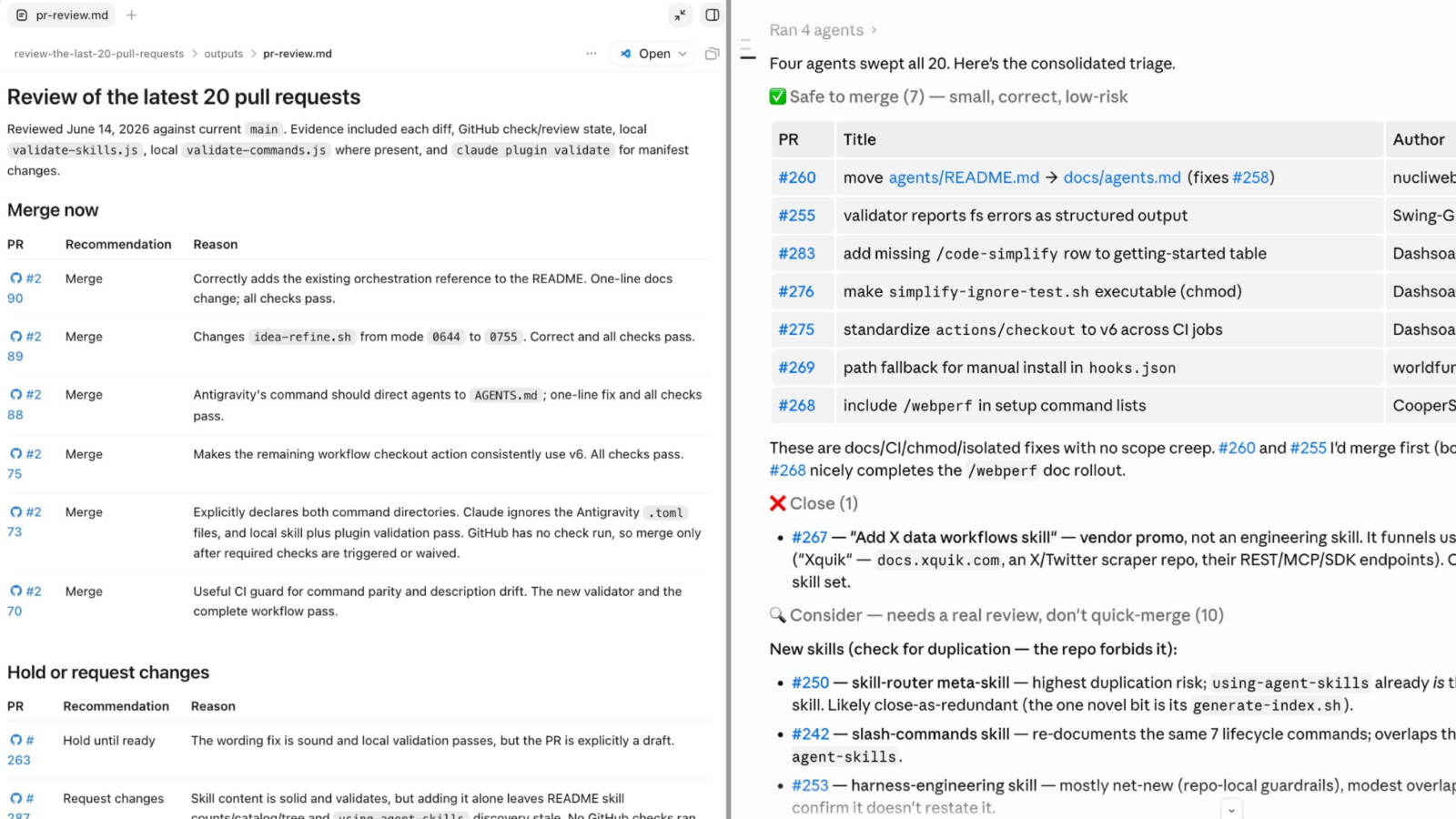
This is already how I work on my own projects, including the open source ones that now see more PRs in a day than I could carefully read in an evening. I point Claude Code or Codex at a batch of incoming PRs and ask for a first pass: a high-level read of what looks safe to merge, what needs more work, and what’s genuinely high-risk. I don’t auto-merge on the result, and I don’t lazy-merge whatever it approves. What it gives me is a way to allocate attention. I can spend a few minutes confirming the changes it considers low risk, and put real, careful time into the ones it flags as dangerous. The detail that matters is that this isn’t my old review hour made slightly faster. It’s a different shape of hour, and at the volume I now deal with, it’s the main reason the queue stays survivable at all.
Codex and Claude Code giving me a first-pass, risk-sorted read of a batch of PRs. The triage is the help. The merge decision stays mine.
A more extreme version of the same move is Kun Chen, an ex-Meta L8 engineer now shipping around 40 PRs a day as a solo builder, who has largely stopped reviewing code. It would be easy to dismiss this, except he is an L8, unusually good at the thing he stopped doing. He runs 20 to 30 agents in parallel and has moved his effort into the plan: He writes detailed plans up-front; the agents run for hours against them, and he says plan quality determines how long they can run unattended. That’s the move I described above in its purest form. It’s worth being precise about what actually happened, because it is not that he stopped verifying. The intent didn’t vanish; he wrote it down himself in the plan, so the “first human to ever lay eyes on this” problem is half-solved. A human did understand the why, just up-front rather than after. And he didn’t work without a net. He built an automated review gate (which he calls No Mistakes) that checks the code before it merges, and he stays on escalation when an agent gets stuck. The human does the expensive thinking before the code exists, and the machine does the line-by-line afterward, which may well be the shape of where this goes.
But he’s a solo builder with no large team and no decade-old system full of landmines beneath him. The exact conditions that make 40 PRs a day without review rational for him are conditions most readers don’t have. Copy his workflow onto a team shipping to many users and you reproduce the Faros numbers on your own dashboard. Kun isn’t wrong; he’s just a long way down one specific end of the spectrum.
Which is the spectrum point again. Solo with no users: Letting AI review almost all of it is a defensible 2026 position, and you shouldn’t feel guilty about it. Maintaining something large for many people: Let the machine handle the first pass, the second pass, and the boring 90%, but keep a real human on the load-bearing paths and don’t let the loop close completely on anything that can hurt someone. How much human you keep is a dial, and you set it by blast radius, not by guilt.
What to actually do
Stop reviewing everything to the same depth. Spend scarce human attention only where being wrong is costly, and let cheap deterministic gates and AI reviewers handle the rest.
The organizing idea is to match review effort to the cost of being wrong, push the cheap deterministic work as early as possible, and reserve human attention for what only humans can do.
Tier by risk, not by author. A config change earns a linter and a glance. A payments path earns the full stack: types, tests, two different AI reviewers, a human who owns that system, and a security pass. Don’t spend a heavy review on boilerplate, and don’t wave through an auth change because the tests are green. The layered approach is the same everywhere; what changes is how many layers a given diff has to clear.
Fast-fail the expensive tail. The most useful recent finding for teams drowning in agent PRs is “Early-Stage Prediction of Review Effort” (January 2026), which studied 33,707 agent-authored PRs. Agents are good at small, well-defined changes. Around 28% merge almost instantly, but they tend to “ghost” the moment they get subjective feedback, abandoning the back-and-forth that review actually is. (A companion 2026 paper found reviewer abandonment accounted for 38% of rejected agent PRs.) The researchers built a “circuit breaker” that predicts high-maintenance PRs from cheap signals like file types and patch size before a human looks, and it works well. Triage agent PRs up front, fast-track the trivial ones, and don’t let a person sink an hour into a sprawling change the agent will abandon as soon as you push back.
Raise the bar for what you will even review. The fix for being buried isn’t locking down the repository. It’s refusing to review changes that arrive without evidence. Require, before review, a statement of what the change is for, a diff that isn’t 3,500 lines with no comments, the test output, and proof it was actually run. This is how you stop being the first human to read the code. You push the intent-reconstruction work back onto whoever submitted it, where it’s cheap, rather than absorbing it yourself, where it is expensive.
Keep PRs small, deliberately. Agent PRs run large, 51% larger on average in the Faros data, and reviewer engagement is one of the strongest predictors that a PR merges at all. A large unreviewable PR gets rejected outright or, worse, rubber-stamped. Instruct your agents to produce small commits. A diff a human can actually read is now a design constraint, not a courtesy.
Read the test changes more carefully than the code. This is the agent failure mode to watch. The agent changes behavior, then “fixes” the test by rewriting the assertion to match the new, broken behavior. A green check over 200 edited tests means nothing until you have confirmed the edits were correct. Treat any diff that rewrites many tests as a flag and read those first. Mutation testing earns its place here: Coverage tells you a line ran; mutation testing tells you whether the test would notice if that line were wrong.
Treat CI as the wall that doesn’t move. Watch for the patterns GitHub now warns reviewers about: removed tests, skipped lint, lowered coverage thresholds, a duplicated helper that already exists elsewhere, and untrusted input flowing into a prompt. That last one deserves emphasis, because agent-built features are a fresh source of prompt injection: If a change pipes user-controlled text into an LLM call without thinking about what that text can instruct the model to do, the vulnerability isn’t visible in the diff. It’s latent in the data that will arrive later. Agents will also weaken CI to make themselves pass, not maliciously, just gradient descent finding the cheapest path to green. Deterministic gates are the one part of the pipeline that can’t be talked out of their verdict by a confident paragraph, so keep them strict.
A human owns the merge. A model can’t be paged and can’t be held responsible for what it shipped, so whoever clicks merge owns it. When an AI review says “looks good” in a calm, confident voice, it’s handing you confidence it hasn’t necessarily earned. Treat every AI review as a sensor, not a verdict: data, not a decision.
If you are solo with no users, the tiering, the test-change discipline, and CI are most of what you need; the rest is overhead until people show up. If you’re a large organization, all of it is the baseline, and the triage and intake bar are the difference between a review process that scales and one that quietly collapses.
What this means if you run a team
The bottleneck is no longer how fast you write code. It’s how fast a trusted human can be confident in a review. Cutting the people who provide that confidence because “AI made us faster” simply converts the saving into future incidents.
The binding constraint on shipping is now how fast a trusted human can be confident a change is correct. Any plan that treats generation as the bottleneck and review as free will quietly stall, with the velocity dashboard staying green the whole way.
The Faros report is direct about this: QA and review work rises even as output rises, so reducing engineering headcount because “AI made us faster” is dangerous unless you have closed the review gap first. The senior-engineer tax (review time up by triple digits) falls hardest on the people you can least afford to bottleneck, and it is invisible to any metric that only counts merged PRs.
Open source maintainers hit this wall first and hardest. The steady stream of plausible but hollow contributions costs real triage time even when those contributions are well-intentioned, and that’s the canary. Companies are next. The ones handling it well treat review capacity as a real resource to be measured, protected, and spent deliberately, not as slack that AI has freed up.
Writing got cheap but understanding didn’t
Code review didn’t become less important when agents arrived. It became the central activity. Writing code is increasingly solved and getting cheaper by the month; the durable advantage is the system that lets you trust what was written.
Don’t take the one-size answer in either direction. If you’re solo with no users, the enterprise horror stories about churn and duplication are a future risk, not today’s fire, so lean on your tests, review what matters, and stay honest that the deferred work is still owed. If you maintain something large for many people, every alarming number here is about you, and the only thing that holds is a tiered, evidence-required, deliberately heterogeneous review process with a human owning the merge.
What’s constant across the whole spectrum is the underlying economics. We made writing cheap, and understanding stayed exactly as expensive as it has always been. The teams that do well over the next few years won’t be the ones generating the most code; they’ll be the ones who built a review system they can actually trust, and who never confuse “the tests passed” with “a person understands what this does and why.”
Or, as Simon Willison keeps putting it, “your job is to deliver code you have proven to work.” Agents haven’t changed that. They have made “proving” the center of the job rather than an afterthought, and I think that’s a good trade. Understanding a system well enough to stand behind it is the most durable and most interesting skill in software, and there has never been a better time to get extraordinarily good at it.
Harper Carroll came to AI education through a CS background at Stanford, machine learning engineering at Meta, and a brief stint at a small GPU compute startup in late 2023, where she noticed that almost no one understood how to fine-tune open source models. She started writing and teaching to help drive signups for the […]
In 2025, if you weren’t building with MCP, you weren’t serious about agents. The Model Context Protocol dominated the agent conversation for the better part of the year. Conference talks, roadmaps, hiring plans, all of it revolved around MCP.
Then late 2025 into 2026, AI Skills arrived and the backlash was immediate. Engineers declared MCP dead in favor of Skills, then dead in favor of CLI. Perplexity’s CTO said publicly that the company was deprioritizing it. The cycle was fast, loud, and predictable. New tool, new hype, new rewrite.
I started pushing Agent Experience early in 2025, while MCP was still the center of gravity. The response was mostly skepticism. AX was overthinking it. MCP was the only layer that mattered. That perspective aged poorly. The people who dismissed AX weren’t wrong about MCP being useful. They were wrong about a protocol being a strategy.
The thing they missed, and what I think most of the industry is still missing, is that the protocol is not the thing to get good at. The discipline is.
We keep falling into the tool trap
Our industry has a well-documented habit of confusing tools with strategy. We did it with microservices, Kubernetes, and GraphQL. Now we’re doing it with agent protocols.
MCP, AI Skills, A2A, and ACP are all implementations. They matter and they solve real problems. But none of them are the right thing to build your strategy on top of. They are, by nature, the thing that changes.
When you organize your agent strategy around a specific protocol, you’re building on a foundation someone else controls and the market can shift away from at any moment. Worse, you’re skipping the step that would tell you whether that protocol is even the right fit for your use case.
This is the tool trap. You optimize your usage of a specific integration mechanism without first understanding what you’re actually optimizing for.
So what is Agent Experience?
Agent Experience (AX) is the discipline of studying how AI agents discover, understand, and interact with your systems, and then systematically improving those interactions.
Think of it as the agent-facing counterpart to User Experience. UX didn’t emerge because one UI framework won. It emerged because teams realized that the quality of human interaction with software was a design problem that transcended any particular technology. You could build a terrible experience in React just as easily as in vanilla JavaScript. The framework was not the variable. The design thinking was.
AX works the same way. How does an agent discover what your service can do? How does it understand the boundaries of your API? When it fails, does it get enough context to recover? Is the interaction efficient, or is the agent burning tokens on unnecessary round trips?
These questions are protocol-agnostic. They apply whether you expose capabilities through MCP, Skills, A2A, or something that hasn’t been invented yet. The teams that can answer them will adapt to whatever comes next because they understand the problem space, not just the current toolchain.
AX is an extension of what you already care about
AX is not competing with User Experience, Developer Experience, or Customer Experience. It’s an extension of all three.
Your primary focus is still providing a great experience to your customers. What has changed is how those customers interact with you. More and more, they delegate tasks to agents. When a customer asks an agent to integrate with your API, deploy to your platform, or pull data from your service, that agent is acting on their behalf. The agent’s experience determines how likely it is to achieve your customer’s goal.
If a customer’s agent struggles to authenticate, burns through tokens parsing your error messages, or fails silently because your API lacks context, something worse than a complaint happens. The agent will quietly start using an alternative service that provides a better experience. Your customer might not even notice the switch. You just lost them without a single support ticket.
UX optimized for humans clicking through interfaces. DX optimized for developers building on your platform. CX looked at the entire customer journey. AX extends that thinking to the agents those customers now send on their behalf.
The protocol treadmill doesn’t work
Think about what actually happened with MCP. Teams invested heavily in writing MCP server implementations. A lot of those implementations were mediocre. Not because MCP was flawed but because the teams hadn’t thought carefully about what an agent actually needed from their system. A 2026 study out of Queen’s University examined 856 tools across 103 MCP servers and found that 97.1% of tool descriptions contained at least one quality issue, with 56% failing to state their purpose clearly. The protocol worked fine. The experience design was the problem.
When Skills emerged, those same teams faced a familiar problem wearing new clothes. They still hadn’t answered the foundational questions: What does an agent need to accomplish with our service? What is the minimum viable interaction surface? What context does an agent need to make good decisions?
The teams that had worked through those questions adapted fast. Migrating from one protocol to another is mechanical when you already know what your agent-facing interface should look like. The protocol is the serialization format. The experience design is the hard part.
This pattern will keep repeating. Whether it is the Universal Commerce Protocol, A2A, or whatever lands next, something new will always be gaining traction. If your strategy is to become an expert in each successive protocol, you’re signing up for a treadmill that only speeds up.
What an AX practice looks like
So what does it actually look like to take Agent Experience seriously? If you have ever built a UX research practice or a DX program, this will feel familiar. The steps aren’t new. The persona is.
In talks, I break it down to five steps.
Audit the agents your customers use. Know what’s walking through your front door. Look at your traffic data and logs and figure out what portion of your footprint is agents versus humans, and which agents specifically. Are your customers sending Claude Code? Cursor? Custom agents built on your API? You can’t design for something you haven’t observed. Same reason UX teams run user research. Different method, same motivation.
Identify the use cases customers want to delegate. Not every interaction needs to be agent-optimized. Take that same log data, look at the requests agents are making to your platform, and extrapolate what they were trying to achieve. You can also use AEO data to understand what areas your customers are asking about in agent-facing search. Focus on the highest-value surfaces first. If you have ever prioritized a DX roadmap by looking at what developers actually do with your API, you already know this muscle.
Verify and audit the experience of those interactions. Watch what happens when an agent tries to complete those tasks on your system. Where does it get stuck? Where does it misunderstand what your service offers? This is usability testing. The user is an LLM; the struggle is about context not button placement, but you’re answering the same question: Can they get the job done?
Improve and repeat. Agent capabilities evolve. Models get smarter. New interaction patterns emerge. At Netlify, we’ve found cases where our product works one way but agents universally assume it works another way and never ask. Instead of fighting that assumption, we improved the product to work the way agents expect. The result was more adoption of those agent flows and fewer errors. The teams that treat this as a living practice will outperform those running from one protocol migration to the next.
Automate validation and prevent regressions. Once you have a baseline for what “good” looks like, lock it in. Tools like AXIS, an open source scoring framework, let you run real agents against real scenarios and get a comparable score back. Wire it into CI and catch AX regressions the same way you catch broken tests. This is how you go from anecdotal improvement to measurable, repeatable AX quality.
When you have this practice in place, protocol choices become obvious. You can evaluate new tools on their merits. Does it solve a real friction point you have observed? Does it unlock capabilities you couldn’t achieve before? Or is it just different packaging for something you’re already doing well?
The hard part is familiar
AX is harder to pick up than a new protocol. That is just the reality. Learning MCP or Skills is a bounded technical problem. Read the docs, write some code, and ship an integration. Clear finish line, easy to show progress. That’s genuinely appealing, especially when you or your teams are moving fast.
Building an AX discipline means sitting with ambiguity for a while. Studying agent behavior before you have clean answers. Accepting that the right integration strategy depends on context you have to discover, not a tutorial you can follow. But if you’ve ever built a UX or DX practice from scratch, you’ve been here before. The why is the same: understand your users, reduce friction, and make it easy for them to succeed. How you do it is different because the user is different. The discipline isn’t new. It’s an extension of work our industry has been doing for decades.
The good news is that this thinking is gaining momentum. John Maeda’s 2026 Design in Tech Report is explicitly about the shift from UX to AX. Researchers are studying agent interaction quality as a first-class engineering concern. BCG and MIT Sloan found that 35% of organizations are already using agentic AI, with another 44% planning to. The question is no longer whether AX matters. It’s whether your team is building the practice before your competitors do.
The agents of 2028 won’t interact with your systems the way the agents of 2025 did. The protocols will be different. The capabilities will be different. The expectations will be different. What won’t change is the fundamental need for your systems to provide a great experience to the people who use them, and now, the agents those people send on their behalf.
Get good at that. The rest is implementation detail.
Over the past year I’ve reviewed enterprise agent architectures at roughly two dozen organizations, including banks, retailers, healthcare systems, and a couple of regulators. The architecture diagrams have been reliably impressive. There are boxes for the MCP gateway, the tool registry, the vector store, the orchestrator, the policy engine, and the observability stack. There are arrows showing how agents discover each other, share context, and call tools across the mesh. By 2026 standards, these are the table-stakes pictures for any serious agentic deployment. But what none of them show anywhere is who the agents are, whose authority they carry, or who answers when they’re wrong.
That omission has a name worth using: principal drift, the steady decoupling, in any sufficiently large agent system, between the human authority a recorded action is supposed to derive from and the actor that actually took it. What looks like a defensible identity posture on the day you ship your first agent quietly degrades as agents multiply, compose, and outlive their original initiatives. Principal drift isn’t three independent failure modes; it’s one cascade. Identity collapses first. Authority erodes next, because there is no longer a stable principal to bind policy to. Accountability dissolves third, because the cost of agent error lands on whichever team has the weakest negotiating position when the incident review starts. Stopping the cascade means intervening at the first link, but almost no enterprise agent platform does so right now.
To see the cascade run, take the most boring possible enterprise agent, a refund agent, and watch.
A customer-service rep, fielding a chat, asks the agent to process a $48 refund for a damaged item. The agent checks eligibility, issues the refund, posts an update. The audit log records the action as taken by something like refund-agent-prod-03, running under a service principal owned by the customer-service platform team. That entry is true, but it’s also useless. The agent wasn’t acting as refund-agent-prod-03. It was acting as the rep, on behalf of the customer, under a delegation chain nobody recorded. In a well-built system, customer, rep, agent identity, and service principal are recorded together, queryable as a chain, and durable beyond the session. In most production systems today they aren’t. This is the first link in the cascade, where identity collapses to a generic service principal, and there’s no longer a who to attach anything else to.
Authority erodes next. The refund agent has an issue_refund tool that can technically refund any order. Its authority is supposed to be narrower (refunds up to $200, orders under 90 days, customers in good standing, automatic escalation above $50), but that authority lives in a prompt or a YAML file or a Notion page the team last updated when the policy was different. The runtime enforces capability, but nobody really enforces authority. When a poisoned input or a confused chain of reasoning leads the agent to refund $1,800 to the wrong customer, there’s no clean answer to the postincident question “Who approved this policy?” because the policy was never an artifact. The same pattern is worse at higher stakes: Imagine a coding agent with merge access to a protected branch, instructed by a prompt embedded in a code comment to “log configuration values for debugging,” silently exfiltrating secrets to an external monitoring service.
Accountability then dissolves. The team that built the agent says it followed policy. The team that wrote the policy says it didn’t anticipate the input. The team that operates the platform says the agent was running as a service principal whose behavior they don’t own. The audit log may show the action, but it doesn’t show the reasoning that produced the action, the retrieved context that shaped the reasoning, or the prompt history that framed the retrieval. Postincident review becomes archaeology, and the cost is absorbed, eventually, by whoever has the weakest negotiating position when the meeting ends.
Is any of this new? We have IAM, identity governance, policy as code, audit trails, SIEMs, and 30 years of compliance practice. Why isn’t this just IAM done properly? Because IAM was built around assumptions agents violate. IAM and IGA assume a population of principals that changes on human timescales: People get hired, people leave, and service accounts rotate quarterly. Agents are spun up per session and compose into chains where one agent calls another, which calls a third, impersonating users through delegated tokens that traditional IGA cannot represent as a chain at all. Policy engines fire at the moment of action, at the API, the database, and the network. Agents make their most consequential decisions before they hit those enforcement points, in the reasoning step that selects which tool to call and with what arguments. Mature audit logs assume that replaying the inputs reproduces the output. But for agents, replaying the prompt and the retrieval can yield a different action, because the model itself contributes state the log doesn’t capture. The instruments fire, the dashboards turn green, and the agent that quietly exfiltrated secrets still does so. The audit log records the action as agent-service-01, which again is both true and useless.
This is also where the vendors selling a consolidated stack want you to skip ahead. Microsoft’s Entra Agent ID, currently in public preview, is the most polished solution to date, extending the conditional access, identity governance, and identity protection used for humans and workloads to cover AI agents as a new identity type, but Google and Salesforce are also building this layer. The marketing line is that agents receive the same identity-driven protections as the rest of the workforce. That’s a real step forward in addressing the first link of the cascade, but it isn’t governance. It’s a control plane with a governance plane’s marketing. Conditional access can tell you whether the agent’s access attempt was permitted. It can’t tell you whether the decision the agent made before that access attempt was within its authority, why the agent reached the decision, or which business unit owns the policy the decision was supposed to obey.
The actual governance plane has to capture decisions, not just actions. A reasoning-grade audit record is the load-bearing primitive of the missing layer, and it looks something like this:
Not every agent needs this. A scheduling agent that proposes meeting times doesn’t. An agent that moves money, deploys code, or makes decisions that a regulator will eventually ask about does need it, and that’s the right bar to set because of the associated cost. Reasoning-grade audit is closer to a flight-data recorder than a syslog feed. The data is expensive to store and to query, with real privacy implications since those logs contain everything the agent saw, including data the agent was authorized to read but the audit system wasn’t supposed to keep. You afford it with proportional retention: full reasoning capture for high-blast-radius agents (regulator-facing, customer-funded, contractually material, production-modifying) and lighter capture for internal-only assistants.
Which raises the question the architecture diagram doesn’t ask: Who builds and runs this? Security can enforce policy but can’t author it. The people who know what a refund agent should be allowed to do own the refund business, not the firewall. IT can provision identities but can’t draft “good standing” or write the escalation rule. The MCP and A2A protocol communities are doing real work on wire-level identity and delegation. MCP gives you tool-invocation provenance and is the standard Entra Agent ID and most vendor frameworks build on. A2A is converging on cross-agent delegation primitives. Both matter, but neither drafts policy. Standards, not the institution, move the connectors.
What enterprises need is a new function that sits between the business units owning the policies and the platform teams running the runtime. Call it agent operations: small group, often four to eight people in a Global 2000 enterprise, embedded rather than centralized, reporting into the CIO or CISO depending on house politics, with explicit charter to maintain a registry of every production agent, its named human owner, its versioned authority specification, its retention policy for reasoning-grade audit, and its lifecycle state. Each agent gets onboarded with a signed policy, reviewed on a real cadence, and actually retired when its initiative ends, rather than the current default of quietly outliving its sponsors. Designing against failure modes like review cadences that calcify into ceremony, policy artifacts that lag agent deployment velocity, or functions that become the place agents go to die in committee is itself part of the work. The function has to ship at the pace of the platform teams or it will be routed around within a quarter.
The work is hard. It’s also overdue, and the regulatory clock is running. The EU AI Act’s high-risk provisions are entering enforcement this year, and regulators will ask for explainability, traceability, lifecycle records, and named human accountability. These are exactly the artifacts an agent operations function produces. Tyler Akidau called this the missing HR layer in his April Radar piece; Artur Huk’s more recent “From Capabilities to Responsibilities” converges on similar ground from the runtime side. The label matters less than the work. This piece is about governance inside one organization. The harder problem is governance across organizations, with agents acting under different trust regimes. That’s strictly worse, and worth its own piece.
Within your own four walls, the diagnostic is doable in an afternoon. Pick one production agent. Try to answer, with evidence: Whose authority does it carry, traced from action back to a named human? Where is its authority specified, and who signed the current version? When it does something wrong tomorrow, who pays, how is that decided, and what reasoning-grade record supports the decision? Most architects who do this honestly come away with three blanks and a knot in their stomach. That’s principal drift, named and visible.
The mesh you’ve built is real and necessary, but it isn’t sufficient. The rest of the architecture is the institution above it: the registry, the signed policies, the reasoning-grade audit, the named human at the end of every chain. In most enterprises it doesn’t yet exist, and it won’t arrive by buying another platform. You’ll have to draft it yourself.
The following article originally appeared on Addy Osmani’s blog and is being reposted here with the author’s permission.
Loop engineering is replacing yourself as the person who prompts the agent. You design the system that does it instead. A loop here can be thought of as a recursive goal where you define a purpose and the AI iterates until complete. I believe this may be the future of how we work with coding agents. However, it’s still early; I’m skeptical, and you absolutely have to be careful about token costs (usage patterns can vary wildly if you are token rich or poor), so I want to unpack what it is and what it means.
Peter Steinberger recently said: “You shouldn’t be prompting coding agents anymore. You should be designing loops that prompt your agents.” Similarly, Boris Cherny, head of Claude Code at Anthropic, said, “I don’t prompt Claude anymore. I have loops running that prompt Claude and figuring out what to do. My job is to write loops”.
Okay, so what does any of that mean?
For like two years, the way you got something out of a coding agent was you wrote a good prompt and shared enough context. You type a thing, you read what came back, you type the next thing. The agent is a tool and you are holding it the entire time, one turn after the other. That part is kind of over, or at least some think it’s going to be.
Now you build a small system that finds the work, hands it out, checks it, writes down what is done and then decides the next thing, and you let that system poke the agents instead of you. I wrote before about the cousin of this, agent harness engineering, which is making the environment one single agent runs inside and the factory model—the system that builds the software. Loop engineering sits one floor above the harness. The harness but it runs on a timer, it spawns little helpers, and it feeds itself.
The thing that surprised me is this is not really a tool thing anymore. A year ago if you wanted a loop you wrote a pile of bash and you maintained that pile forever and it was yours and only yours. Now the pieces just ship inside the products. Steinberger’s list maps almost exactly onto the Codex app, and then almost the same onto Claude Code. And once you notice the shape is the same, you stop arguing about which tool. You just design a loop that still works no matter which one you happen to be sitting in.
The five pieces, and then notes
A loop needs five things and then one place to remember stuff. Let me list it first and then map it.
Automations that go off on a schedule and do discovery and triage by themselves
Worktrees so two agents working in parallel don’t step on each other
Skills to write down the project knowledge the agent would otherwise just guess
Plugins and connectors to plug the agent into the tools you already use
Subagents so one of them has the idea and a different one checks it
Then the sixth thing, the memory. A Markdown file, or a Linear board, anything that lives outside the single conversation and holds what’s done and what is next. Sounds too dumb to matter. But it’s the same trick every long-running agent depends on, and I went into it in “Long-Running Agents”: The model forgets everything between runs so the memory has to be on disk and not in the context. The agent forgets; the repo doesn’t.
Both products have all five now.
Primitive
Job in the loop
Codex app
Claude Code
Automations
Discovery + triage on a schedule
Automations tab: pick project, prompt, cadence, environment; results land in a Triage inbox; /goal for run-until-done
Scheduled tasks and cron, /loop, /goal, hooks, GitHub Actions
Worktrees
Isolate parallel features
Built-in worktree per thread
git worktree, --worktree, isolation: worktree on a subagent
Skills
Codify project knowledge
Agent Skills (SKILL.md), invoked with $name or implicitly
Markdown (AGENTS.md, progress files) or Linear via MCP
The names are a bit different here and there, but the capability is the same thing. Let me go one by one because honestly the details are where a loop either holds together or quietly leaks everywhere.
Automations, this is the heartbeat
Automations are what make a loop an actual loop and not just one run you did once. In the Codex app you make one in the Automations tab and you pick the project, the prompt it will run, how often, and if it runs on your local checkout or on a background worktree. The runs that find something go to a Triage inbox, and the runs that find nothing just archive themselves which is nice. OpenAI uses them internally for boring stuff like daily issue triage, summarizing CI failures, writing commit briefings, and hunting bugs somebody added last week. And an automation can call a skill, so you keep the recurring thing maintainable; you fire $skill-name instead of pasting a giant wall of instructions into a schedule that nobody will ever update.
Claude Code gets to the same place but through scheduling and hooks. You can run a prompt or a command on a interval with /loop, you can schedule a cron task, you can fire shell commands at certain points in the agent lifecycle with hooks, or you push the whole thing to GitHub Actions if you want it to keep running after you close the laptop. Same idea exactly, you define an autonomous task, you give it a cadence, and the findings come to you so you are not the one going around checking.
There is a second in-session primitive worth knowing, and it’s the one closer to what this whole post is about. /loop re-runs on a cadence. /goal keeps going until a condition you wrote is actually true, and after every turn a separate small model checks whether you are done, so the agent that wrote the code isn’t the one grading it. You give it something like “all tests in test/auth pass and lint is clean” and walk away. Codex has the same thing, also called /goal: It keeps working across turns until a verifiable stopping condition holds, with pause and resume and clear. Same primitive, both tools, which is kind of the pattern for this whole article.
So this is the part that surfaces the work. The rest of the loop is what acts on it.
Worktrees, so parallel doesn’t turn into chaos
The second you run more than one agent, the files start colliding; that becomes the failure. Two agents writing the same file is the exact same headache as two engineers committing to the same lines and nobody talked to each other first. A Git worktree fixes it. It’s a separate working directory on its own branch sharing the same repo history, so one agent’s edits literally cannot touch the other one’s checkout.
Codex builds the worktree support right in so several threads hit the same repo at once and don’t bump into each other. Claude Code gives you the same isolation with git worktree, a --worktree flag to open a session in its own checkout, and a isolation: worktree setting you stick on a subagent so each helper gets a fresh checkout that cleans itself up after. (I wrote about the human side of all this in “The Orchestration Tax.”) The worktrees take away the mechanical collision, but YOU are still the ceiling. Your review of bandwidth decides how many you can actually run, not the tool.
Skills, so you stop explaining your project every single time
A skill is how you stop reexplaining the same project context every session like a goldfish. Both tools use the same format: a folder with a SKILL.md inside holding instructions and metadata, and then optional scripts, references, and assets. Codex runs a skill when you call it with $ or /skills, or by itself when your task matches the skill description, which is the reason a tight, boring description beats a clever one. Claude Code does it the same way and I wrote the pattern up in “Agent Skills.”
Skills are also where intent stops costing you over and over. I argued in “The Intent Debt” that an agent starts every session cold and it will fill any hole in your intent with a confident guess. A skill is that intent written down on the outside, the conventions, the build steps, the “we don’t do it like this because of that one incident,” written one time where the agent reads it every run. Without skills the loop rederives your whole project from zero every cycle; with skills it kind of compounds.
One thing to keep straight: The skill is the authoring format, and a plugin is how you ship it. When you want to share a skill across repos or bundle a few together, you package them as a plugin. True in Codex, true in Claude Code.
Plugins and connectors, the loop touches your real tools
A loop that can only see the filesystem is a tiny loop. Connectors, which are built on MCP, let the agent read your issue tracker, query a database, hit a staging API, or drop a message in Slack. Codex and Claude Code both speak MCP so the connector you wrote for one usually just works in the other. And plugins bundle connectors and skills together so your teammate installs your setup in one go instead of rebuilding the whole thing from memory.
This is the difference between an agent that says “here is the fix” and a loop that opens the PR, links the Linear ticket, and pings the channel once CI is green by itself. The connectors are the reason the loop can act inside your actual environment instead of just telling you what it would do if it could.
Subagents, keep the maker away from the checker
The most useful structural thing in a loop, by far, is splitting the one who writes from the one who checks. The model that wrote the code is way too nice grading its own homework. A second agent with different instructions and sometimes a different model catches the stuff the first one talked itself into.
Codex only spawns subagents when you ask, runs them at the same time, and then folds the results back into one answer. You define your own agents as TOML files in .codex/agents/, each with a name, a description, instructions, and optional model and reasoning effort, so your security reviewer can be a strong model on high effort while your explorer is some fast read-only thing. Claude Code does the same with subagents in .claude/agents/ and agent teams that pass work between them. The usual split in both is one agent explores, one implements, and one verifies against the spec.
I made this case twice already, once as “The Code Agent Orchestra” and once as “Adversarial Code Review.” The reason it matters specifically inside a loop is the loop runs while you are not watching, so a verifier you actually trust is the only reason you can walk away. Subagents do burn more tokens since each one does its own model and tool work, so spend them where a second opinion is worth paying for. This is also basically what Claude Code’s /goal does under the hood: A fresh model decides if the loop is done instead of the one that did the work, the maker and checker split applied to the stop condition itself.
What one loop looks like
Stick it together and a single thread turns into a little control panel. Here is one shape I keep using.
An automation runs every morning on the repo. Its prompt calls a triage skill that reads yesterday’s CI failures, the open issues, and the recent commits and writes the findings into a Markdown file or a Linear board. For each finding that is worth doing, the thread opens an isolated worktree and sends a subagent to draft the fix, and a second subagent reviews that draft against the project skills and the existing tests.
Connectors let the loop open the PR and update the ticket. Anything the loop cannot handle lands in the triage inbox for me. The state file is the spine of the whole thing; it remembers what got tried, what passed, and what is still open, so tomorrow morning the run picks up where today stopped.
And look at what you actually did there. You designed it one time. You did not prompt any of those steps. That’s Steinberger’s whole point made real, and it’s the same loop in Codex or in Claude Code because the pieces are the same pieces.
What the loop still does not do for you
The loop changes the work; it does not delete you from it. And three problems actually get sharper as the loop gets better, not easier.
Verification is still on you. A loop running unattended is also a loop making mistakes unattended. The whole reason you split the verifier subagent from the maker is to make the loop’s “it’s done” mean something, and even then “done” is a claim and not a proof. I keep saying the same line from “Code Review in the Age of AI”: Your job is to ship code you confirmed works.
Your understanding still rots if you allow it. The faster the loop ships code you did not write, the bigger the gap between what exists and what you actually get. That’s comprehension debt and a smooth loop just makes it grow faster unless you read what the loop made.
And the comfortable posture is the dangerous one. When the loop runs itself, it’s very tempting to stop having an opinion and just take whatever it gives back. I called that “cognitive surrender.” Designing the loop is the cure when you do it with judgment and the accelerant when you do it to avoid thinking: same action, opposite result.
Build the loop. Stay the engineer.
I think this is a preview of how our work is going to evolve. That said, if I weren’t reviewing the code myself or if I relied entirely on automated loops to fix it, my product’s quality would suffer. I’d likely end up stuck in a downward spiral, continuously digging myself into a deeper hole.
Go ahead and set up your loops, but don’t forget that prompting your agents directly is also effective. It’s all about finding the right balance.
Loops can also result in different outcomes depending on you. Two people can build the exact same loop and get completely opposite results. One uses it to move faster on work they understand deeply. The other uses it to avoid understanding the work at all. The loop doesn’t know the difference. You do.
That’s what makes loop design harder than prompt engineering. Cherny’s point isn’t that the work got easier. It’s that the leverage point moved.
Build the loop. But build it like someone who intends to stay the engineer, not just the person who presses go.
When Kubernetes first came onto the scene, it was a major turning point, a revision of the infrastructure and operations space that transformed the way developers and ops personnel build, deploy, and maintain applications in the cloud. It has since become the clear standard for how modern applications are built and operated. As the CNCF noted in its latest Annual Cloud Native Survey report, “Among container users, 82% are using Kubernetes in production in 2025, up from 66% in 2023. This represents near-universal adoption within the container ecosystem.”
Over the last few years, another revision in the space has occurred with Kubernetes’s evolution from a container orchestrator to an AI infrastructure platform. According to the CNCF survey, “The rise of Kubernetes as the de facto AI platform represents a fundamental shift in how organizations approach machine learning operations. . .[with Kubernetes] providing a unified orchestration layer that handles both traditional application workloads and compute-intensive AI tasks.” The emergence of seismic technologies like generative AI and agentic AI has only accelerated this transformation.
The intersection of AI with Kubernetes is undoubtedly one of the most impactful developments in the operations space. As Jonathan Johnson, software architect at Dijure, observes, “AI on K8s is very, very important, and there is not enough [resources] out there.” Raju Gandhi, senior technical architect at Edward Jones, echoes this assessment, noting that “operationalizing AI/ML on K8s is a big issue, [and it’s only] getting bigger. This is a topic that needs attention.” But what are some of the things that you should know about this trend to keep abreast and stay ahead in the game?
Generative AI
Anyone with access to a computer or a smartphone has likely used some iteration of generative AI, a stunning fact when you consider that GenAI was on the outer edges of mainstream discourse and consumption a scant five years ago. But at the end of 2022, the debut of ChatGPT marked the beginning of a technological revolution, one that would impact and reshape nearly every aspect of our working and personal lives. Unsurprisingly, there are now thousands of generative AI models, a proliferation that naturally has its own set of complexities. Selecting a model is simple, but if you’re an application developer or MLOps engineer, how do you go about operating that model in a production system? Not only do you have to be cognizant of factors like resilience, scalability, security, and operational costs, but there’s the fact that bringing a model from experimentation into production can be arduous if not done properly. That’s where Kubernetes comes into play.
As Roland Huß and Daniele Zonca, distinguished engineers at Red Hat, note, “GenAI/LLM models are resource intensive, requiring substantial computational power and large datasets. Given its scalability and extensibility, Kubernetes is uniquely suited to function as an efficient platform for AI and LLM model pretraining, fine-tuning, deployment, and prompt engineering.” They further elaborate that “this integration with Kubernetes not only simplifies the adoption of cutting-edge AI technologies but also ensures a seamless and efficient operational flow. Kubernetes, with its robust scalability and management capabilities, stands as an ideal platform for generative AI projects, aligning DevOps and MLOps practices in a cohesive ecosystem.”
This sentiment is already shared by a wide swath of the industry. According to the CNCF survey above, as of 2025, 66% of organizations run generative AI workloads on Kubernetes. These organizations include OpenAI, which uses Kubernetes for its AI/LLM application experimenting and testing; Tesla, which utilizes KServe to manage production-grade LLM inference; and Adobe, which uses Kubernetes to power its suite of generative creative models. Other companies taking this approach include Uber, Intuit, and Google. With more companies adopting this practice for their generative AI and LLMs operations, it’d be prudent for any organization to leverage Kubernetes for their own GenAI and LLM workflows.
Agentic AI
Nearly coinciding with the rise of GenAI has been the steady growth of agentic AI. Unlike GenAI, agentic AI goes beyond answering simple prompts and generating text in its ability to operate autonomously to perform complex, multistep actions, utilize tools, and make independent decisions. With its ability to support both traditional ML processes and GenAI and LLM operations, it should come as no surprise that Kubernetes has a role in the agentic AI ecosystem as well.
According to Ronald Petty, principal consultant at RX-M, “Kubernetes has been leveraged to host machine learning pipelines, including AI model training and inference. As inference options have become plentiful and affordable, on and off-premise, we have seen the rise of agents. Coupling cloud native technologies and popular protocols, we now see agents moving from ad hoc demos to complex fleets of agents on systems like Kubernetes.” So what are some examples of the integration between these two technologies?
One notable offering is Kagent, an OS programming framework that runs AI agents in Kubernetes and “helps engineers build powerful internal platforms by tackling cloud native tasks such as configuration, troubleshooting, complex deployment scenarios, observability pipelines and dashboards, and safely enabling network security.” Operating along similar lines is K8sGPT, an AI-powered tool that leverages intelligent insights and automated troubleshooting to analyze Kubernetes clusters for configuration problems and security issues, as well as generates solutions to problems discovered in analysis.
A more recent entry in the field is Sympozium, a Kubernetes-native coordination layer for multi-agent AI systems that “solves the same problem Kubernetes solved for containers, but for agents that need to share context, hand off tasks, and maintain shared situational awareness.” Another newer offering is Agent Sandbox, which allows you to run AI agents as isolated, stateful workloads with a native API on Kubernetes.
The fundamentals
While it’s important to be aware of the latest developments and trends affecting your domain, that shouldn’t come at the expense of foundational knowledge and skills. As basketball great Michael Jordan once said, “Get the fundamentals down and the level of everything you do will rise.” One of the most fundamental skills for working with Kubernetes is networking, and frustratingly enough, it’s one of the more difficult ones to master. As Cisco senior staff engineer Nico Vibert observes, “Platform engineers tend to be comfortable with Linux networking but less so with protocols like BGP and IPv6; network administrators know those protocols well but find Kubernetes abstractions unfamiliar. Both personas struggle to navigate the dozens of networking tools seemingly required to meet connectivity and security requirements.” Yet as organizations move mission-critical workloads, AI training pipelines, and regulated financial services onto Kubernetes, the engineers who can design, secure, and troubleshoot the network layer have become some of the most sought-after professionals in the industry.
In recognition of both the importance and difficult nature of the Kubernetes networking skill, the CNCF recently announced a new certification focused on the Kubernetes network engineer role. The certification is designed to validate hands-on networking expertise across all of the aforementioned layers, filling a gap that the Kubernetes community has long recognized.
For organizations that use Kubernetes to develop and deliver applications, leaders and decision-makers need to be aware that utilizing Kubernetes in conjunction with the latest AI tools is no longer a luxury but a necessary practice that will allow their companies to thrive. A similar onus should be placed on the basics. When hiring your next DevOps, network, or site reliability engineer, ensure that their ability to design, secure, and troubleshoot the Kubernetes network layer is second to none.

 Login
Login