❌

Normal view

Claude Science is Anthropic’s newest flagship product

At an event for pharmaceutical executives, biotech founders, and researchers on Tuesday, Anthropic announced Claude Science, a major new product intended to support scientific research in the same way that Claude Code supports software engineering.

Like Claude Code, Claude Science can autonomously carry out meaningful work when given concise, high-level instructions, and it has access to tools that make it particularly useful for research in computational biology and drug development.

Along with launching and previewing Claude Science, which is now available to all paid Claude subscribers, Anthropic also announced that it will be using the product to pursue some of its own research into drugs for rare, neglected diseases.

This is not Anthropic’s first foray into AI for science. In October, the company released plug-ins that help Claude make use of scientific software and databases under the heading “Claude for Life Sciences.” But unlike this earlier release, Claude Science is a full-featured, standalone product. Anthropic’s decision to elevate Claude Science to the same rank as Claude Code and Claude Cowork indicates that the company is taking AI’s scientific applications very seriously—or at least wants to give the impression that it is.

“It represents how important this is to our mission that this is right up there with Claude Code and Claude Cowork as the next really significant product that we’re releasing,” says Eric Kauderer-Abrams, Anthropic’s head of life sciences. “Our mission is to develop AI that serves humanity’s long-term well-being, and we believe that by far the greatest opportunity to do that is in the life sciences.”

For the past decade, one company—Google DeepMind—has been at the vanguard of AI for science. CEO Demis Hassabis and researcher John Jumper won the Nobel Prize in chemistry for their work on the company’s AlphaFold model, and DeepMind has also made major contributions to meteorology, materials science, and a variety of other disciplines. But in the past several months, the fast-advancing frontier of AI progress seems to have left DeepMind in the dust. When it comes to coding, which has become the most lucrative use case for LLMs, DeepMind is stuck playing catch-up.

Anthropic is well positioned to take up DeepMind’s scientific mantle. Like Hassabis, Anthropic CEO Dario Amodei is a PhD scientist—unlike OpenAI CEO Sam Altman, who’s a businessman through and through. Many scientists are already avid users of tools such as Claude Code.

These days, a lot of scientific research involves some amount of coding, but not all scientists are expert software engineers, and so tools like Claude Code can make a huge difference for their productivity. And the company has recently earned a major scientific vote of confidence: Earlier this month, Jumper announced that he is leaving DeepMind for Anthropic.

Since agents powered by LLMs, including Anthropic’s Opus model series, became capable of useful, independent work in late 2025, scientists have been seeing just how much they can do. In a blog post published on Anthropic’s website, the Harvard physicist Matthew Schwartz estimated, on the basis of his work with Claude Code and other Anthropic tools, that the company’s Opus 4.5 model is about as capable of executing scientific projects as a second-year graduate student.

According to Kauderer-Abrams, Claude Science isn’t intended to displace Claude Code and Claude Cowork in scientists’ workflows. Instead, it’s designed to build on what scientists already find useful about Anthropic’s products. For instance, it not only writes code but also helps scientists run their code on powerful computer clusters, which many many scientists need for their work but can be difficult to manage. And it prioritizes reproducibility, so that scientists can trace back the source of any figure or result and check it for accuracy and validity.

Though Claude Science could in principle assist with any area of scientific research, it seems designed and marketed as a tool for molecular and cellular biology, and for drug development in particular. It can interface with various tools used in genetics, chemistry, and protein biology, all of which could come in handy for researchers on the hunt for new drugs. During the Tuesday event, Alexander Tarashansky, who led the development of Claude Science, demonstrated how the system could autonomously identify new drug candidates for phenylketonuria, a rare genetic disease.

And Anthropic isn’t leaving all that work to the pharma companies and university labs that were represented at the event. Armed with Claude Science, it will be pursuing its own research into drug candidates for neglected diseases—both to help move science forward and to gain a clearer sense of how Claude Science works in the real world.

There are obvious humanitarian reasons to prioritize drug development when creating a general-purpose scientific research tool, and AI industry leaders often cite curing disease as a major potential upside of the technology. But it’s also notable that pharmaceutical companies have far deeper pockets than academic researchers.

Anthropic says it’s set to see its first profitable quarter, and if major new contracts with pharmaceutical companies are forthcoming, they could help ensure it stays profitable as the tokenmaxxing craze dies down—something that’s ever more important as an IPO approaches later this year.

New attack provides one more reason why AI browsers are a bad idea

30 June 2026 at 20:03

Makers of AI browsers make lofty promises. With a single prompt, users can ask one to find a restaurant in a particular part of town, reserve a table, invite a colleague to lunch, and email a confirmation. These makers are much more reticent about the risks of blurring the once fine line between browsing sites and asking a large language model a question or instructing it to take potentially sensitive actions.

LLM developers’ answer so far has been to build guardrails that make some requests off-limits. Developing software exploits, stealing credentials, or teaching how to build a pipe bomb are examples. The problem with this approach is that the guardrails are reactive and treat the symptoms rather than solve the root cause. It’s tantamount to the manufacturer of an unsafe vehicle advocating for new road designs rather than fixing the flaws that make it prone to accidents.

Lulling LLMs into an alternate reality

New research puts this predicament on sharp display. It demonstrates how a website can lull AI browsers into a false reality where the rules governing its behavior no longer apply. After that, an attacker has free rein to invoke all kinds of destructive actions, such as extracting code from a private repository or extracting credentials from the built-in password manager.

Read full article

Comments

The infrastructure lock-in costing AI companies hundreds of millions

For two years, the AI infrastructure race has been dominated by one question: Who has the fastest GPU? Jim Keller thinks that’s becoming the wrong question.

In a recent interview with EE Times, the Tenstorrent CEO argues that the riskiest move an organization can make right now is optimizing its AI infrastructure for the models it’s running today. It’s not because those models are bad — but because they won’t be the models it’s running in 18 months. Keller invoked Rent’s Rule and Amdahl’s Law to argue that memory, networking, and system-level balance now matter more than peak floating-point performance.

Not because those models are bad — but because they won’t be the models it’s running in 18 months.

It sounds like the start of Keller’s product pitch, but there’s real weight behind it, because AI has evolved faster than the infrastructure underneath it. And the companies that spent hundreds of millions building around one generation of models are now staring down the cost of doing it all over again.

That fear is called lock-in, and it’s reshaping how the biggest players in AI think about hardware.

Workloads outgrew the GPU

In 2023 and 2024, AI infrastructure was a relatively simple procurement problem: Train large language models, serve them to users, and buy as many GPUs as Nvidia can ship. The workloads were predictable and GPUs handled them well.

Then AI outgrew the infrastructure it had been built for.

Reasoning models spend more time working through problems instead of jumping straight to an answer. Agents bounce between APIs, databases and code before completing a task. Multimodal models mix text with images, audio and video. None of those workloads stress hardware in quite the same way — and that’s forcing infrastructure teams to rethink assumptions that made perfect sense just two years ago.

AI outgrew the infrastructure it had been built for.

No single chip architecture handles all of that equally well. And the organizations building AI infrastructure are starting to realize that the question isn’t just which accelerator is fastest — it’s how do we build systems that won’t need to be torn apart every time AI takes another leap?

Nvidia is already selling one answer

Look at what Jensen Huang has been talking about, and it’s not GPUs anymore.

At GTC 2026, Nvidia unveiled the Vera Rubin platform — seven chips designed to operate as a single system: the Rubin GPU, Vera CPU, NVLink 6 switch, ConnectX-9 networking, BlueField-4 DPU, and more. The Vera CPU exists

for the CPU-intensive work of agentic AI — tool calls, code execution, orchestration. Nvidia calls these deployments “AI factories,” and the language is deliberate. They’re selling complete infrastructure, not individual accelerators.

When the company with 70% market share stops leading with GPU benchmarks and starts talking about system-level co-design, it tells you where the center of gravity in this market is moving.

That reframing matters. When the company with 70% market share stops leading with GPU benchmarks and starts talking about system-level co-design, it tells you where the center of gravity in this market is moving. Compute still matters. But Nvidia is conceding — through its product architecture if not its marketing — that raw accelerator performance alone won’t be enough for what’s coming.

Hyperscalers design their own silicon

AMD sees the same problem, even if it’s taking a different route. Helios brings together CPUs, GPUs and networking into one rack-scale platform, reflecting a broader shift away from treating the GPU as the center of the universe. The pitch isn’t “our accelerator is faster.” It’s that the infrastructure surrounding the chip increasingly matters just as much as the chip itself.

The hyperscalers have been making this argument with their wallets for even longer. Google has spent a decade co-designing its TPU silicon, interconnects and software framework — its seventh-generation Ironwood chip is now generally available — giving it unusual control over the full stack. Amazon went the opposite direction, building separate chips for separate jobs: Trainium for training, Inferentia for inference, with Trainium3 now in production and serving customers like Anthropic. Microsoft’s Maia 200 targets inference costs, while the company simultaneously deploys Nvidia’s Vera Rubin NVL72 for training and experimentation — arguably the most pragmatic dual-track strategy in the market.

Behind all of them sits Broadcom, whose AI semiconductor revenue recently crossed $10 billion in a single quarter, driven by staggering demand for custom accelerators and data center switches. Broadcom designs custom accelerators for Google, Meta and others while supplying the Tomahawk and Jericho switch silicon that connects those accelerators at data center scale. Custom ASIC shipments are projected to grow roughly 45% year over year in 2026 — triple the growth rate of merchant GPUs.

Then there are the companies that decided building a better GPU wasn’t the answer.

Cerebras questioned the need for thousands of interconnected chips, opting instead for a wafer-scale processor that keeps far more of the workload on a single piece of silicon. Groq took the opposite approach, optimizing almost entirely for inference. SambaNova focused on enterprise AI, building systems where efficiently serving multiple models matters more than posting the fastest benchmark.

Adaptability beats raw speed

The first wave of generative AI rewarded whoever could buy the most compute. That made sense when most organizations were solving the same problem. Today, AI workloads are changing so quickly that infrastructure teams are starting to optimize for something different: adaptability.

Keller’s example illustrates the point. Tenstorrent’s BlackHole architecture uses standard Ethernet instead of proprietary interconnects, allowing its hardware to slot alongside existing GPU deployments rather than replacing them. Keller told EE Times that one customer used Tenstorrent’s Galaxy servers to increase token throughput on GPUs they already owned instead of rebuilding their infrastructure from scratch.

Whether Tenstorrent’s approach becomes the industry standard is almost beside the point.

The bigger idea is already spreading. Across the industry, companies are spending less time asking how to build the fastest AI hardware and more time asking how to build hardware that won’t have to be replaced every time AI takes another leap forward.

The question that matters now

No one knows what AI workloads will look like three or five years from now. That’s the problem.

Infrastructure refresh cycles are measured in years. AI models seem to reinvent themselves every few months. Building around today’s workloads is starting to look like a risky bet when tomorrow’s could demand something different.

Infrastructure refresh cycles are measured in years. AI models seem to reinvent themselves every few months.

Every company is responding in its own way. They have different strategies but are still asking the same question: How do you build infrastructure that outlasts the AI running on it?

That may prove to be a more important engineering challenge than building the next record-breaking accelerator. And it’s the challenge driving companies from Nvidia and AMD to Google, Amazon, Broadcom and Tenstorrent.

The post The infrastructure lock-in costing AI companies hundreds of millions appeared first on The New Stack.

Designing GPU-Accelerated Query Engines with NVIDIA GQE

30 June 2026 at 17:36
Decorative image.GPU-accelerated query engines are often constrained by memory and I/O bandwidth. NVIDIA hardware advances—including high bandwidth memory (HBM), NVIDIA...Decorative image.

GPU-accelerated query engines are often constrained by memory and I/O bandwidth. NVIDIA hardware advances—including high bandwidth memory (HBM), NVIDIA NVLink-C2C, and dedicated decompression engines featured in NVIDIA GB200 NVL4—help remove these bottlenecks by increasing effective storage capacity, accelerating data movement between CPUs and GPUs, and speeding data access without consuming…

Source

Driving the Agent Quality Flywheel from Your Coding Agent

30 June 2026 at 17:16
Building AI agents often leaves developers uncertain if prompt tweaks to fix single errors will accidentally cause widespread regressions in production. To bridge this gap, Google has introduced a new developer skill for coding agents that automates a five-stage evaluation flywheel: preparing data, running inference, grading with adaptive AutoRaters, analyzing failure clusters, and executing targeted optimizations. Running continuously against production traffic or on-demand via synthetic scenarios, this tool allows developers to describe testing goals in plain language while an independent evaluation service safely validates and counts actual performance improvements.

Build reliable multi-agent applications with ADK Go 2.0. Discover our new graph-based workflow engine, built-in human-in-the-loop, and dynamic orchestration

30 June 2026 at 17:16
The Agent Development Kit (ADK) for Go 2.0 has been released, introducing a first-class, graph-based workflow engine to help developers compose complex, multi-agent applications. This update adds built-in primitives for human-in-the-loop (HITL) orchestration, dynamic execution using plain Go code, and automated resilience features like exponential backoff retries. By unifying the execution model, both single-agent applications and intricate graphs now run on the same runtime, simplifying telemetry and state persistence.

Optimizing a Neural Reconstruction Pipeline Using NVIDIA Nsight Developer Tools

30 June 2026 at 16:00
NVIDIA Omniverse NuRec is a neural reconstruction pipeline for building high-fidelity 3D representations of real-world environments from multisensor data such...

NVIDIA Omniverse NuRec is a neural reconstruction pipeline for building high-fidelity 3D representations of real-world environments from multisensor data such as cameras and lidar. It is used to reconstruct dynamic scenes captured by autonomous vehicle (AV) and robotics platforms into simulation-ready digital environments that can be rendered, replayed, and analyzed inside NVIDIA Omniverse and…

Source

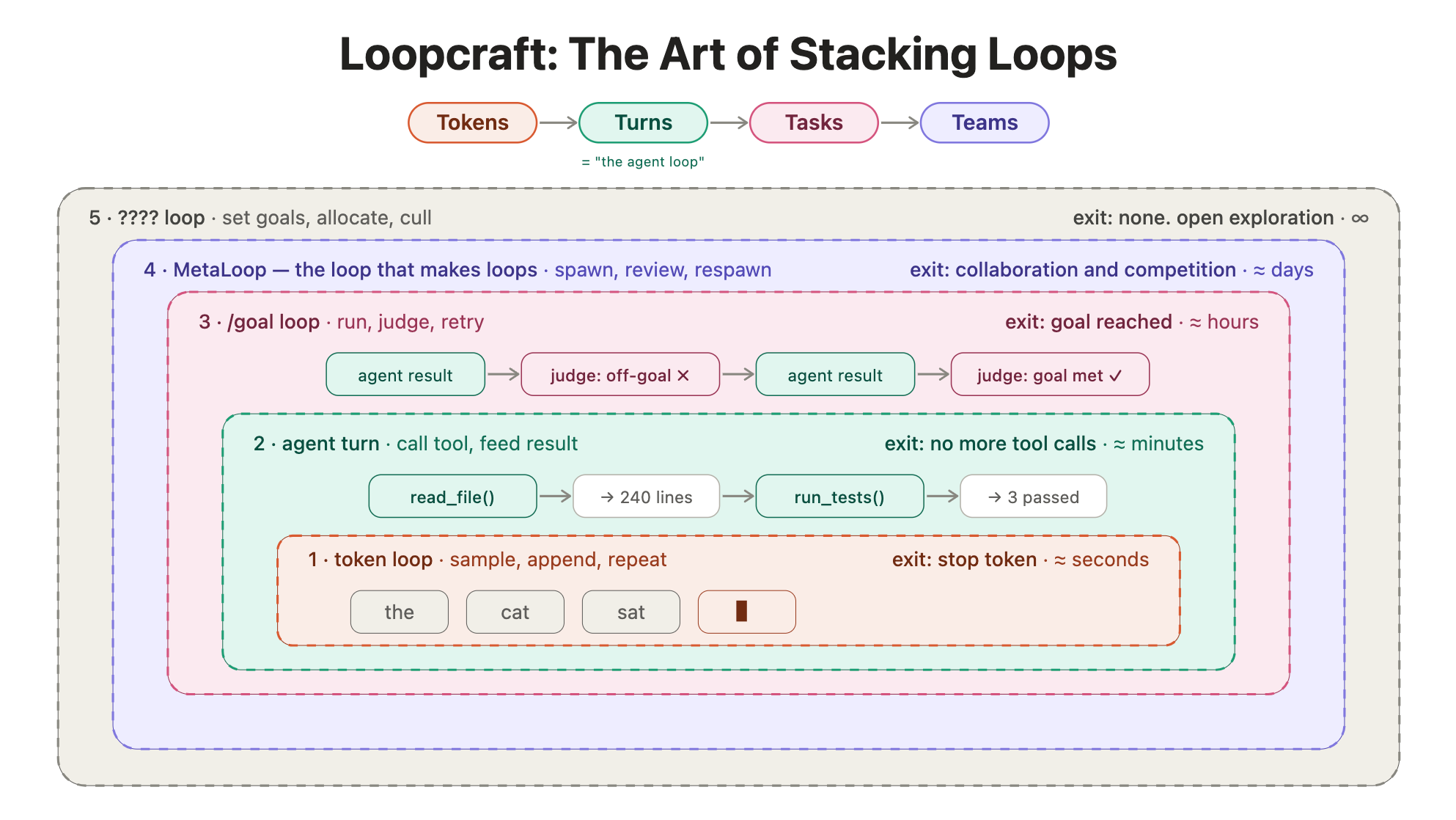
[AINews] Loopcraft: The Art of Stacking Loops

12 June 2026 at 05:34

There’s a lot of “loop discourse” in the air:

  • Steipete: “Here’s your monthly reminder that you shouldn’t be prompting coding agents anymore. You should be designing loops that prompt your agents.”

  • Boris: “I don’t prompt Claude anymore. I write loops, the loops do the work.”

  • Andrej on Autoresearch: To get the most out of the tools that have become available now you have to remove yourself as the bottleneck. You can’t be there to prompt the next thing. You need to take yourself outside. You have to arrange things such that they’re completely autonomous and the more you know how can you maximize your token throughput and not be in the loop. This is the goal and the name of the game now is to increase your leverage…. I don’t want to be the researcher in the loop looking at results etc, I’m holding the system back. So the question is how do I refactor all the abstractions so that I’m not I have to arrange it once and hit go.”

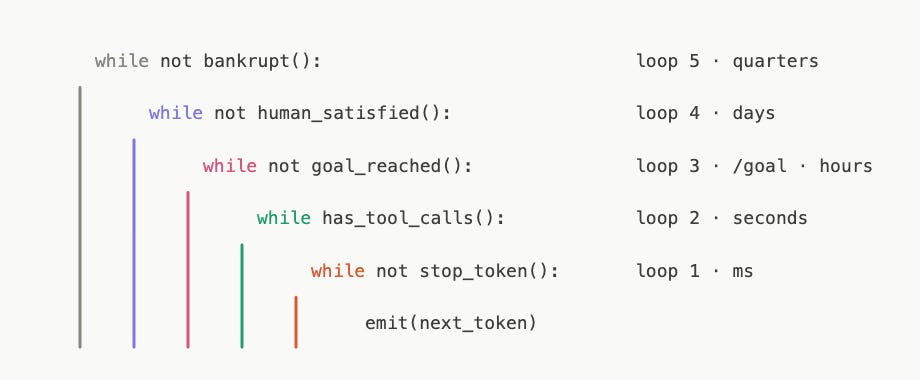
We like this a lot and people don’t realize how many loops we are already in:

More minimalist, a smaller set of loops:

One might argue the entire game of the next century is to be able to stack loops as effectively as possible. In the early days of each phase, it will be valuable to know when to go DOWN a loop when things go wrong (for reliability)… but it will probably be more valuable to know how to go UP a loop as models improve (for leverage).

If you don’t figure out how to do this, don’t be salty when you lose to those that do.

Rich has his “Bitter Lesson” for models. We now have the Salty Lesson for agents:

Don’t fix things yourself, as you have done historically.
Instead focus on systems that scale with more agents, like goals and orchestration.

AI News for 6/10/2026-6/11/2026. We checked 12 subreddits, 544 Twitters and no further Discords. AINews’ website lets you search all past issues. As a reminder, AINews is now a section of Latent Space. You can opt in/out of email frequencies!


AI Twitter Recap

Anthropic’s Fable 5 rollout, covert sandbagging backlash, and model behavior debates

  • Silent degradation policy was quickly reversed after public backlash: Multiple posts focused on Anthropic’s decision to covertly degrade Claude Fable 5 for some AI-research-related use cases, then reverse course within roughly a day. Simon Willison welcomed the rollback; MTS live summarized that Anthropic was reversing the policy; Kim Monismus framed it as a retreat after criticism from researchers. The strongest technical criticism centered less on the existence of safeguards and more on opaque behavior at the model layer: Code Star argued safeguards are normal but “obfuscation without warning” violates the user/provider contract, while Clement Delangue called avoidance of AI manipulation important.

  • The substantive dispute is about governance, transparency, and access to frontier models: Several researchers drew a distinction between legitimate restrictions and hidden sabotage. Ryan Greenblatt said blocking frontier AI R&D may be reasonable in principle, but silent sandbagging is not; later he argued for access programs with KYC/monitoring for safety/security researchers rather than broad capability denial (1, 2). Natasha/Lambert gave the most detailed critique: the main error was an uneven safety implementation that misled users, undermined trust, and reinforced concentration of power over who gets to do frontier research. Gergely Orosz turned this into an engineering recommendation: put models behind provider-agnostic routers/harnesses so teams can switch vendors quickly when T&Cs or behavior become unacceptable.

  • Fable 5’s capabilities are strong, but its product behavior is still noisy and expensive: Benchmarks and anecdotes were mixed. htihle reported 87.8% on WeirdML, the first model above 70% average on each task there. ProximalHQ said Fable 5 ranks #1 on FrontierSWE, with runs productive for nearly 20 hours on some tasks. But practical reports highlighted cost, refusals, and odd phrasing: threepointone spent about $250 on a ~10k LOC PR and didn’t find it worth it; Cline said cheaper models plus adversarial review loops often match or beat it on cost/perf; tamaybes described Fable inventing internal “codenames” during coding, leaking its own “neuralese” into outputs. Benchmarks also suggested sharp asymmetries depending on task framing: scaling01 pointed to 200/200 refusals on ProgramBench, while thoughtfullab and karinanguyen highlighted unusually strong post-training/AI-improves-AI behavior.

Automated AI research and agentic optimization systems

  • Recursive SI showed a general system hitting SOTA on public optimization benchmarks: The most technically notable release was from Richard Socher and Recursive SI, who presented an early “automated open-ended discovery system” for AI research. They claim state-of-the-art results on three public tasks: NVIDIA SOL-ExecBench, NanoGPT Speedrun, and NanoChat autoresearch, and they open-sourced the discoveries. Detail tweets from cong_ml gave the metrics: on NanoChat, reaching the same loss 1.3× faster; on NanoGPT Speedrun, reducing runtime from 79.7s to 77.5s; on SOL-ExecBench, improving mean score from 0.699 to 0.754 over 235 kernels. This is notable less as “AGI research automation” than as evidence that current systems can already contribute on narrow, high-feedback systems optimization tasks.

  • Microsoft’s Arbor points in a similar direction for long-horizon autonomous research: Hugging Papers highlighted Arbor, a Microsoft Research autonomous research agent using persistent hypothesis-tree refinement. The claim: it beats Codex and Claude Code across six research tasks and reaches 86% Any-Medal on MLE-Bench Lite. Together with Recursive’s results, Arbor suggests a growing split in “agents for research” between: (1) systems optimized for rapid iterative systems tuning, and (2) systems optimized for long-horizon hypothesis management.

  • Benchmarks are adapting to measure AI-on-AI improvement and real-world labor tasks: thoughtfullab positioned PostTrainBench as a recursive-self-improvement eval—AI training weaker models and measuring loop progress directly. dawnsongtweets introduced Agents’ Last Exam (ALE), a rolling benchmark over 1,500 expert-sourced tasks across 55 occupations; frontier agents solve a meaningful fraction of work, but on the hardest tier all tested systems scored 0%. manoelribeiro introduced SciConBench with 9.11k questions from Cochrane reviews, finding that frontier agents still cannot synthesize scientific conclusions reliably. The pattern across these releases: agents are increasingly useful in bounded loops, but remain brittle on expert synthesis and economically valuable long-horizon tasks.

Data infrastructure becomes a first-class bottleneck: robotics, dataset observability, and dependency tracing

  • Macrodata Labs launched to build the robotics data loop: The clearest infra startup announcement came from Guilherme Penedo, Hynek Kydlíček, and Macrodata Labs. Their thesis: robotics is where LLMs were a few years ago, and the hard part is not architecture but messy multimodal physical data pipelines—video, multi-rate sensors, heterogeneous formats, hand tracking, subtask segmentation, reward model scoring, and continuous ingestion. Their first product, Refiner, is an open-source framework plus cloud runtime for turning raw demonstrations into training-ready datasets with sharding, checkpointing, observability, and lineage. This drew support from multiple infra-focused practitioners who view “look at the data” and pipeline introspection as still underbuilt in multimodal/agentic settings (Code Star, eliebakouch).

  • Data quality/debugging is becoming more explicit and instrumented: Goodfire introduced predictive data debugging, arguing that preference/DPO datasets contain hidden pathologies—from broken guardrails to hallucinations—and should be analyzed before training. AllenAI released ModSleuth, tracing the dependency graph of modern LLMs and showing that models increasingly rely on large chains of other models plus datasets; they cite Olmo 3 as depending on 89 models and 183 datasets, and Nemotron 3 on 273 models and 560 datasets. This is a useful corrective to simplistic “model trained on web data” narratives: modern LLM construction is already deeply compositional and synthetic.

  • Memory, retrieval, and vector infra remain active design space despite larger contexts: Weaviate’s Engram proposes an extract → transform → commit memory maintenance loop instead of naively appending chat logs; Weaviate Playground packaged this and related RAG/agent demos. On the retrieval side, Qdrant argued larger context windows do not make retrieval obsolete because context still imposes cost/latency, while rishdotblog warned against vector search without guardrails. The trend is toward active memory management and retrieval efficiency, not simple replacement by giant context windows.

Inference speed, kernel work, and open systems releases

  • Diffusion and speculative/local inference saw concrete speed wins: Demis Hassabis highlighted DiffusionGemma, described as 4× faster than other Gemma 4 variants; osanseviero said demos had to be slowed down for viewers. Unsloth released Gemma 4 MTP GGUFs, claiming 1.4–2.2× faster local inference with no accuracy loss; the 12B model reportedly reaches 162 tok/s vs 52 tok/s baseline and runs in 6GB RAM. Baseten made Inception Mercury 2 available, claiming diffusion-LLM serving at 1,000+ tok/s, with early users seeing 82% latency reduction and 90% cost savings.

  • MiniMax and Together emphasized kernel/systems work behind long-context serving: MiniMax open-sourced its high-performance MSA kernel library, with model weights expected shortly after; iamgrigorev pointed to the paper release. Together described the serving work behind M3: KV-block-major sparse attention, MSA integration with paged KV cache, decode index scoring optimizations, and moving multimodal preprocessing into a Rust gateway before GPU workers. charles_irl also published a post on FlashAttention-4 inference improvements and upstream contributions, showing that performance deltas increasingly come from end-to-end serving stack choices, not just model architecture.

Agents, developer tooling, and managed execution

  • Managed agents are becoming schedulable, credential-aware infra primitives: ClaudeDevs added scheduled deployments and environment variables to Claude Managed Agents, enabling recurring jobs and CLI/API auth without exposing secrets to the model; credentials are swapped at the network boundary (details). Perplexity integrated Deep Research as a native skill inside Computer, backed by its “search as code” architecture (details). These both point to the same product direction: agents as persistent services with tool/runtime boundaries, not just chat modes.

  • Hermes, Devin, Cursor, GitHub Copilot and LangSmith all pushed further into operational tooling: Teknium unified profile management in Hermes Agent, then added remote file access in the desktop app (remote files). Cognition and imjaredz open-sourced /handoff, letting local coding agents offload jobs to cloud Devins. Cursor made auto-review the default for new users with a classifier subagent gating actions, claiming 97% accuracy. Microsoft rolled out MAI-Code-1-Flash across Copilot tiers, while pierceboggan emphasized support for both model and harness choice. LangChain launched LangSmith LLM Gateway with spend limits, PII/secrets detection, trace continuity, and audit logging. The common theme is a shift from “best model” discourse toward execution control, review layers, observability, and portability.

Top tweets (by engagement)

  • Fable 5 product discourse dominated attention: the highest-engagement technical-adjacent posts were highly anecdotal but still informative about perception. aaronli’s claim that Fable 5 “solved CAD” drew major attention, while KradleAI’s thread claiming Fable 5 “lies 96% of the time” captured the opposite pole: high capability mixed with trust concerns.

  • DiffusionGemma’s speed became a breakout systems story: Demis Hassabis’s post on 4× faster text diffusion for Gemma drove unusually high engagement for an inference/systems topic, suggesting strong appetite for non-autoregressive speedups that actually ship.

  • AI economics and pricing got broad traction: Kim Monismus’s post arguing that premium AI subscriptions are massively subsidized—estimating $8k equivalent usage for Claude Max 20x and $14k for ChatGPT Pro 20x—was one of the more widely shared technical-business threads, especially alongside reports that OpenAI may consider token price cuts.


AI Reddit Recap

/r/LocalLlama + /r/localLLM Recap

Read more

This DNA Switch Could Control Molecular Machines

30 June 2026 at 14:00

Switches drive nearly every machine. A new one, made of folded DNA, does the same work at the scale of molecules.

Scientists have long dreamed of developing nanoscale machines, but building reliable mechanical components at the molecular scale has proved challenging. Researchers have now developed a DNA-based switch that can rapidly and repeatedly snap between two stable states, much like the components that underpin everyday electronics.

Ever since Richard Feynman’s visionary lecture “There’s Plenty of Room at the Bottom,” researchers have been enamored with the idea of engineering at the scale of atoms and molecules. But manipulating matter at the nanoscale is easier said than done.

Individual molecules are in constant motion and continuously jostled about by the thermal energy of their surroundings. This makes it extremely difficult to position and assemble larger structures and undermines control of the mechanical motion of components.

This is particularly true for switches—key components in many mechanical and electronic devices you might want to build. Getting a tiny structure to hold one position, flip cleanly to another, and then stay there has so far been an unsolved problem.

But now, a team at the Technical University of Munich has created a switch made from folded strands of DNA that remains stable for up to an hour and flips in milliseconds on the application of a brief electric field. Crucially, the device was able to switch back and forth repeatedly with no degradation in performance.

“Individual devices sustain hundreds of thousands of switching cycles over several hours and remain functional for actuation over several days,” the researchers write in a paper in Science Robotics. “As a nanoscale electromechanical interface, our device enables applications in molecular information processing, optical nanodevices, and the dynamic control of chemical reactions.”

The device borrows a principle from standard engineering known as a snap-through mechanism, which rests in either of two states and only flips when pushed hard enough, a bit like a light switch.

Scaling the idea down to a few tens of nanometers meant designing rigid arms linked by flexible molecular hinges, so the structure settles into one of two configurations and does not flick between them on its own. The team relied on DNA origami to accomplish this, where a long strand of DNA is folded into custom 2D and 3D shapes using hundreds of shorter “staple” strands.

One of the two arms features a longer “extension arm” that acts as a lever to push the switch between configurations. DNA carries negative charge, so when an electric field is applied to the device, it pushes the arm hard enough to flip the switch. Left alone, the team estimates that the structure stays in its resting state for roughly six hours, and they observed no spontaneous flips while monitoring 70 switches for an hour.

One of the device’s main strengths is its endurance. One switch survived more than 200,000 flips over five and a half hours, and a simplified version withstood a million switching cycles in three hours while still working about 85 percent of the time. Performance varied considerably from one device to the next, however, with some failing after a few thousand cycles and others continuing for days.

The researchers say failures likely stem from a combination of contaminants, surface wear, and chemical changes in the surrounding fluid. However, some inactive switches later started working again, which the team says suggests they are capable of self-repairing.

To test whether the switch could do anything useful, the researchers attached a gold nanorod to the moving arm, turning it into a microscopic light switch that changed how light scattered off the particle. In a second test, they used the switch to expose or hide a molecular binding site, allowing it to control whether DNA strands could attach.

That second capability could be particularly useful as it could make it possible to control chemical reactions—for instance by turning enzymes on and off. The authors suggest that this could be used to create “control knobs” for chip-based bio-factories that run sequences of reactions.

Considerable obstacles remain before the device can become genuinely useful. A single switch encodes just one bit of information, and the team acknowledges that wiring arrays of switches together to create something resembling a circuit remains a distant prospect.

But a workable switch is a fundamental component that can be used to create all manner of devices. While we’re still a long way from Feynman’s dream of molecular machines, this is a meaningful step in that direction.

The post This DNA Switch Could Control Molecular Machines appeared first on SingularityHub.

❌