Protein design is a search problem. Choose amino acids for an eight-residue protein sequence and more than 25 billion combinations are possible. Choose amino...
Protein design is a search problem. Choose amino acids for an eight-residue protein sequence and more than 25 billion combinations are possible. Choose amino acids for a 100-residue protein sequence and the number of possibilities exceeds the number of atoms in the observable universe. Somewhere in that space is a protein that opens a path to a new therapy. There are too many combinations to…
Using a system called BootLoops, scientists produced 36 papers in three months. Paired with experts, the tool could pollinate ideas across fields.
Some major scientific advances involve taking a technique developed in one field and applying it to another, but interdisciplinary research is tricky and time-consuming. Now a new AI research system has automated the process, generating 36 papers in three months.
Most researchers work within a narrow specialty, and few have time to comb through unrelated fields for tools that might help them. As a result, researchers can end up banging their heads against a problem scientists in another discipline have already solved.
But Harvard physicist Matthew Schwartz stumbled across a potential solution while working as a visiting researcher at AI firm Anthropic. After getting the company’s AI, Claude, to develop a suite of tools for mathematical physics, Schwartz discovered they could help solve quantitative problems in a host of other areas.
Called BootLoops, the tools, which are model agnostic, help AI search scientific literature, write code, and solve mathematical problems. Working with 19 coauthors, Schwartz used BootLoops to produce 36 manuscripts on topics ranging from ecology and linguistics to health insurance and sunspots.
“Once Claude had BootLoops, it kept noticing the same pattern: many fields have problems that a technique from mathematics, physics, or computer science would solve outright if anyone knew it existed,” Schwartz wrote in an Anthropic blog post about the system.
Schwartz first started using Claude as a general-purpose research assistant last December, and while he was able to do some useful work with it, he says it required constant handholding. So he decided to instead point it at problems that were a good match for the model’s strengths—what he calls “Claude-shaped problems.”
He started with the equations physicists use to interpret particle collisions at the Large Hadron Collider. The best methods were scattered across software in several programming languages or existed only on paper, so he got Claude to combine them into a single framework. Using the tools it had built itself, the model reproduced the results of one of his papers in about 20 minutes.
Schwartz then moved onto a harder class of these equations, and within a few weeks, the model had solved 30 of them, including 15 that had never been calculated before. It didn’t take long for Schwartz to realize that many of the methods the AI had developed could be used in neighboring areas of physics such as cosmology and string theory.
But it was Claude itself that made the bigger leap, pointing out that the same kinds of equations turn up in population genetics and evolutionary biology. The problem for Schwartz, however, was that he found it harder to tell when Claude was overselling its findings in fields he was less familiar with. So he brought in experts from each field to judge which of Claude’s findings were worth pursuing, and from some 400 candidate problems, 36 ended up as papers.
One project examined the star ratings used to grade private health plans under Medicare, which determine the bonuses insurers receive. The rules say the boundaries between ratings levels should be drawn so each plan’s score sits as close as possible to the average of its group, but the algorithm Medicare actually uses is a shortcut that doesn’t guarantee this.
Using a statistical method dating back to 1958 to calculate the exact answer, BootLoops found drawing precise boundaries would push 34 plan ratings across the bonus line, 16 up and 18 down. This would shift an estimated $0.9 to $1.4 billion in bonus payments between 2025 and 2027.
Another project tackled a 150-year-old puzzle about what kills sunspots. Because the sun’s rotation hides sunspots from view for much of their lives, astronomers have never been able to agree on how long they last or why they disappear.
Borrowing a tool doctors use to measure how the risk of dying changes with age and applying it to every sunspot logged since 1874, the team found that sunspots age. At a given size, their risk of “dying” rises about 20 percent a day, something none of the published theories could account for.
For each new problem, Claude built new tools, so the BootLoops toolkit kept growing, and it now spans 22 fields, according to the project’s website. Other problems it’s tackled include how Earth’s atmosphere first filled with oxygen, how quickly tree species come and go in a Panamanian rainforest, and how natural selection weeds out harmful mutations in humans.
The kinds of cross-disciplinary leaps BootLoops can make are extremely rare, Georgia Channing, artificial intelligence for science lead at Hugging Face, told Science. “A physics researcher wouldn’t spend six months reading linguistics research in order to figure out how to repurpose linguistics methods,” Channing said.
That’s not to say the system isn’t without flaws. Schwartz says many of Claude’s early findings were technically correct but scientifically unremarkable until experts steered them, and he warns that the model “loves to declare victory” too early.
But the results suggest AI may be a powerful way to pollinate ideas across research fields, even if we still need humans to decide which ones are really worth pursuing.
NVIDIA CUDA Tile (cuTile) is a Python-based DSL and parallel programming model for NVIDIA GPUs that automatically leverages advanced hardware capabilities to...
NVIDIA CUDA Tile (cuTile) is a Python-based DSL and parallel programming model for NVIDIA GPUs that automatically leverages advanced hardware capabilities to deliver peak performance for tile-level GPU programming. By abstracting thread- and warp-level scheduling behind high-level, tile-centric primitives, cuTile enables you to write GPU kernels in Python while compiler optimizations automatically…
The DNA inside our cells isn’t just a series of instructions, but something far more dynamic. Like scientists, AI models don't yet have the data to properly decode it.
Jonathan the giant tortoise was born when Darwin was still a young man. Youthful gene activity may account for his exceptionally long life.
Getting a DNA sample is simple. Rub a Q-tip a few times inside your cheek, and voilà.
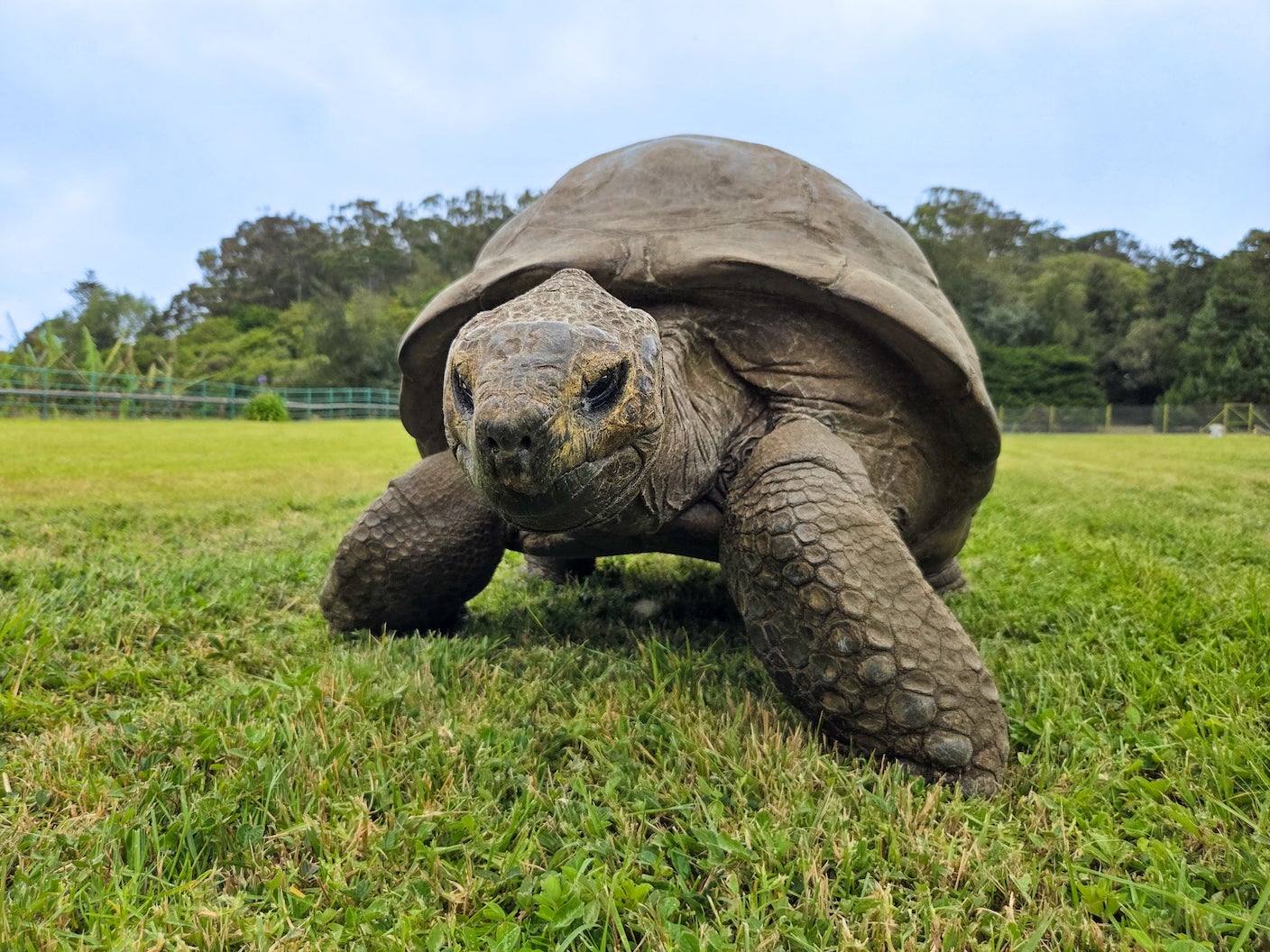
Not so with a 400-pound Aldabra giant tortoise. At the age of roughly 194, Jonathan is the oldest known living land animal on Earth. He’s spent most of his life lounging on the manicured lawns of the governor’s residence on the island of St. Helena, where he arrived as an adult. Though blinded by cataracts, Jonathan still chows down on grub and has excellent hearing.
Even among long-lived tortoises, Jonathan is exceptional. He’s lived around a century longer than others of his kind. Now, thanks to his DNA, an intrepid team of scientists may know why.
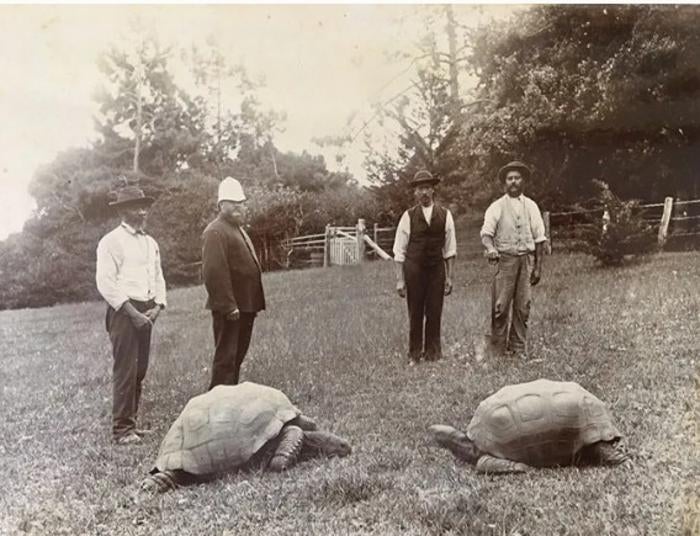
Jonathan (left) arrived in St. Helena in 1882, around the time of this photograph. Image Credit: A.L. Innes
Getting a sample was tricky and dangerous. Jonathan’s veterinarian, Joe Hollins, lured him in with fresh greens, then quickly wedged his mouth open to scrape cells from inside his cheek. The tortoise tolerated the unusual procedure for only a few seconds. Any longer, and Hollins might have faced the wrath of Jonathan’s razor-sharp beak.
But the maneuver paid off. After sequencing the sample, the team found that Jonathan’s genome was better maintained compared to tortoises roughly a century younger.
As animals age, their DNA accumulates mutations. Telomeres, the protective end caps of chromosomes, shrink. Chemical tags that control which genes are turned on or off also go awry, straying from their normal patterns and settling on unexpected spots across the genome.
For study author Stephen Clark, founder of the nonprofit Kallel Foundation, this growing disorganization, called entropy, is central to aging. Yet Jonathan has weathered plenty of biological wear and tear despite his advanced age.
“Nature has already solved the puzzle of aging in remarkable ways, and Jonathan’s genome provides a blueprint for cellular resilience,” said Clark in a press release.
At one end of the spectrum are short-lived creatures. Studies of lowly roundworms and fruit flies—often squished or swatted—have uncovered genes and molecular pathways that let cells sense nutrients, withstand stress, and clear cellular waste. These processes falter with age.
At the other extreme are animals that seemingly don’t age. Take the hydra, a tiny, carnivorous jellyfish-like animal. In long-term studies, some species showed no detectable rise in mortality or lower reproduction with age and retained the ability to regenerate after severe injuries. Their “immortality” may come from a steady supply of stem cells and resilience against senescent cells that no longer work properly.
Naked mole rats have also caught scientists’ attention. These nearly hairless rodents can live more than 30 years, roughly 10 times longer than a mouse of similar size. They resist many types of cancer, maintain strong hearts and muscle mass into old age, and rarely develop Alzheimer’s disease, even with toxic protein buildup. By studying these animals’ genetics, scientists have discovered ways they preserve gene expression machinery and maintain protein stability as the clock ticks on.
Tortoises offered more inspiration. In 2019, scientists sequenced the genome of Lonesome George, the last known Pinta Island giant tortoise, who died at an estimated 100 years old. His genome revealed beneficial adaptations in DNA repair, immune function, and inflammation. A subsequent study comparing multiple turtle lineages found shared genetic changes associated with cellular resiliency against stress and cancer protection.
“Each of these long-lived species has some kind of special trick,” biologist Steve Austad at the University of Alabama at Birmingham toldThe New York Times. “And some of those may turn out to be relevant to human aging.”
But as the oldest land creature, Jonathan is irreplaceable. Hidden in his DNA may be another set of tricks for keeping cells, and maybe the entire body, functioning for longer.
Spirited Supercentenarian
Collecting Jonathan’s DNA without getting bitten or kicked was only the first hurdle. Shipping the precious cargo across the ocean without damaging it was another. Then came the headache of piecing his genome together.
Cheek cells yield shorter DNA fragments that must be stitched together, and samples can be contaminated with bacteria. The first try at reconstructing Jonathan’s genomic blueprint had gaps, so the team, led by the Nashville-based nonprofit Kallel Foundation, used DNA from a younger tortoise to fill them in. Roughly 95 percent of the resulting Frankenstein genome was Jonathan’s.
A blood draw, the gold standard for DNA sequencing, might have yielded a clearer map. But St. Helena officials ruled it out because of the risk of infection.
Even so, Jonathan’s genes revealed intriguing differences compared to four other Aldabra tortoises roughly a century his junior. Of the 287 genes unique to Jonathan, many were involved in DNA repair or preventing telomeres from shortening—both of which help keep the genome stable. Roughly a dozen of Jonathans’ genes overlapped with genes implicated in naked mole rat longevity and that of other long-lived animals, hinting at shared evolutionary strategies.
But the surprise finding related to his epigenetics, the system of chemical tags, or DNA methylation, that regulates gene activity. Young animals tend to maintain relatively consistent methylation patterns between cells, coordinating which genes switch on or off. With age, some of these marks disappear while others attach chaotically, making gene activity less predictable.
Clark calls this growing disorganization entropy. As expected, Jonathan’s epigenome showed higher overall entropy than his younger peers. But some genes were spared.
Those involved in mitochondrial function kept a surprisingly youthful profile, comparable to that of a five-year-old Aldabra. Mitochondria, the cell’s energy producers, are closely linked to aging and age-related diseases. Maintaining mitochondrial health may have helped fuel DNA repair systems and warded off disarray in the epigenome—potentially creating a virtuous cycle to keep disorganization in check.
The findings echo genetic research on a woman who lived past 117. Although she harbored clusters of mutated blood cells and signs of DNA damage, her mitochondria appeared healthier than those of women decades younger.
How genes behave is just one piece of the aging picture. Diet, exercise, environment, and mental health all play roles. Jonathan mostly lived a life of luxury, with abundant fresh food, a safe home, and his veterinarian, Hollis, close at hand.
These comforts may have contributed to his longevity. But the results point to potential biological pathways that the body uses to stay spry for longer. The team plans to map the genomes of more Aldabra tortoises and other long-lived creatures. By studying these outliers, we may better grasp our own longevity and learn how to fight off age-related diseases.
“Our goal is to take these evolutionary insights and immediately translate them into practical, affordable treatments for everyday people,” said Clark.

 Login

 Protein design is a search problem. Choose amino acids for an eight-residue protein sequence and more than 25 billion combinations are possible. Choose amino...

 NVIDIA CUDA Tile (cuTile) is a Python-based DSL and parallel programming model for NVIDIA GPUs that automatically leverages advanced hardware capabilities to...